
Building a mobile app is one of the most powerful moves a startup can make — but only when done right. With over $935 billion in projected global app revenue in 2026, the opportunity is enormous.
So is the competition. That’s exactly why startups across industries are turning to App Development for Startups with ZenvySEO to launch faster, smarter, and with fewer costly mistakes.
Whether you’re validating a fresh idea or scaling an MVP into a full product, this guide walks you through every stage — from strategy to launch — and shows you what separates apps that succeed from those that quietly disappear.
If you are new then must be read e-commerce-website-development
Why Startups Choose App Development for Startups with ZenvySEO
Most early-stage teams underestimate how different startup app development is from enterprise software work. Startups need speed, budget discipline, and a partner who understands that requirements will change mid-project. ZenvySEO is built around that reality.
Here’s what makes the difference:
- Startup-first mindset — every decision is filtered through lean principles and real-world constraints
- Transparent process — no hidden steps, no surprise costs
- Cross-platform expertise — build once, deploy to iOS and Android simultaneously
- End-to-end support — from the first consultation through post-launch monitoring
- SEO and ASO integration — your app and its supporting web presence are optimized together
- Why Startups Choose App Development for Startups with ZenvySEO
- Step-by-Step Process
- Technologies Powering App Development
- Addressing Challenges
- Budget Guidance: What Every Startup Should Know
- Trends Shaping App Development
- How to Get Started with App Development for Startups with ZenvySEO
- Conclusion
- Frequently Asked Questions
- How long does it take to build a startup app?
- What is the cost of startup app development with ZenvySEO?
- Should I build for iOS, Android, or both?
- What is an MVP and why does it matter?
- How does ZenvySEO handle changes in requirements?
- What happens after the app launches?
- How does app development connect to SEO?
Step-by-Step Process
Ideation and Strategy Planning
Before a single line of code is written, ZenvySEO spends time understanding your market, users, and goals. This phase includes competitive analysis, target audience mapping, and feature prioritization. The output is a clear product brief that guides every decision that follows.
Key activities:
- Market research and gap analysis
- User persona development
- Feature list with MVP scope defined
- Budget and timeline framing
User-Centric Design and Prototyping
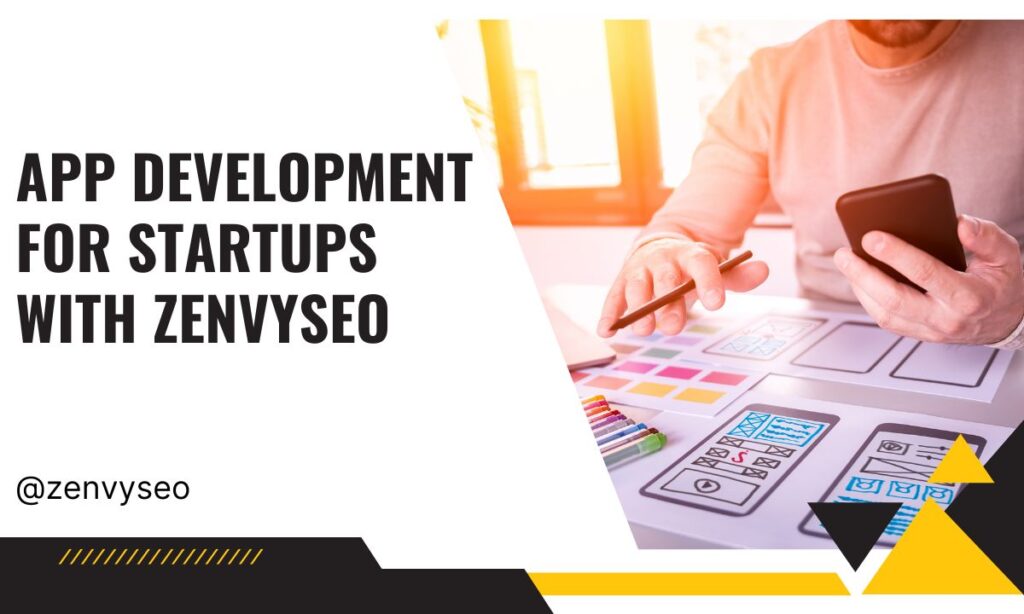
Great apps aren’t built around features — they’re built around people. The design phase produces wireframes and interactive prototypes that simulate the real user journey before App Development begins. This is where costly assumptions get caught early.
ZenvySEO follows a mobile-first design approach, ensuring intuitive navigation, fast load flows, and frictionless onboarding — because research consistently shows that 80% of users abandon an app after just three poor experiences.
Core Development and Integration
Once the prototype is approved, the development team builds the app using modern, scalable frameworks. Back-end infrastructure, APIs, third-party integrations (payments, maps, analytics), and front-end UI components are all assembled in structured sprints.
Agile methodology keeps the process flexible — you review progress regularly and can adjust direction without derailing the entire project.
Rigorous Testing and Quality Assurance
QA is not an afterthought at ZenvySEO. Testing covers:
- Functional testing — does every feature work as intended?
- Performance testing — how does the app behave under load?
- Device compatibility testing — across screen sizes, OS versions, and hardware
- Security testing — data handling, authentication, and vulnerability checks
- User acceptance testing — real feedback before public launch
Launch, Monitoring, and Ongoing Support
Submitting to the App Store and Google Play requires careful preparation — store listings, screenshots, descriptions, and compliance with platform guidelines. ZenvySEO handles the submission process and monitors early performance data closely.
Post-launch, the team provides bug fixes, performance patches, and iterative updates based on user feedback. Your app doesn’t go live and get forgotten.
Technologies Powering App Development
| Category | Technologies Used |
| Cross-Platform Frameworks | Flutter, React Native |
| Backend & APIs | Node.js, Firebase, AWS, REST/GraphQL |
| Databases | PostgreSQL, MongoDB, Firestore |
| Security | SSL/TLS, OAuth 2.0, biometric auth |
| Analytics | Firebase Analytics, Mixpanel |
| CI/CD & DevOps | GitHub Actions, Bitrise, Docker |
This stack balances performance, developer productivity, and long-term maintainability — all critical for a startup that plans to grow.
Addressing Challenges
Managing Limited Funds
Budget pressure is a reality for nearly every startup. The solution is disciplined scoping: launch with only the features that solve your core user problem.
Every added feature has a cost — in App Development time, testing effort, and ongoing maintenance. ZenvySEO helps you identify what’s essential versus what’s nice to have.
Handling Idea Changes Mid-Project
Requirements evolve. A good development partner expects this. Agile sprints allow the team to absorb changes without full restarts, and a clearly defined change management process keeps cost surprises to a minimum.
Ensuring Device Compatibility
With thousands of Android devices and multiple iOS generations in active use, compatibility testing is non-negotiable. Cross-platform frameworks help here — a single codebase reduces the surface area for inconsistencies, while automated device testing tools validate performance across environments.
Protecting User Data
Data breaches destroy trust and carry legal consequences. ZenvySEO builds security into the architecture from day one — not bolted on after launch. This means encrypted data transmission, GDPR-compliant data handling, and regular security audits.
Standing Out in Crowded Stores
With over 2.7 million apps on Google Play and 2.2 million on the App Store, visibility is a genuine challenge. App Store Optimization (ASO) — keyword-rich titles, compelling descriptions, strong visual assets — is built into every launch strategy.
Keeping Users Active Long-Term
Downloads are just the beginning. Retention depends on smooth onboarding, push notification strategy, personalization, and regular content or feature updates. ZenvySEO provides a post-launch roadmap, not just a launch date.
Scaling as Users Grow
Cloud-native architecture, horizontal scaling, and load balancing are planned upfront — not retrofitted when the app unexpectedly goes viral.
Budget Guidance: What Every Startup Should Know
Start with Core Features Only
An MVP (Minimum Viable Product) delivers your core value proposition with the minimum necessary feature set. It gets you to market faster, generates real user feedback, and reduces wasted investment.
Choose Cross-Platform Where Possible
Building separate native iOS and Android apps can double your development cost. Cross-platform frameworks like Flutter let you build both from a shared codebase — typically reducing cost and time-to-market by 30–40%.
Factor in Ongoing Costs
Development is a one-time cost. Hosting, maintenance, security patches, and feature updates are recurring. Build these into your financial model from the start.
Explore Phased Payments
ZenvySEO offers milestone-based payment structures that align costs with deliverables — reducing financial risk and giving you natural checkpoints to review progress.
Account for Hidden Expenses
Third-party API fees, app store developer accounts, push notification services, analytics platforms, and legal compliance costs all add up. A thorough upfront estimate should account for these.
Compare Fixed vs. Flexible Pricing
| Pricing Model | Best For | Trade-Off |
| Fixed Price | Clear scope, defined features | Less flexible to changes |
| Time & Materials | Evolving requirements | Costs can vary |
| Milestone-Based | Phased delivery | Requires clear milestones |
Trends Shaping App Development
AI Integration for Smarter Features
AI is no longer optional — it’s becoming the baseline. Personalized recommendations, predictive analytics, smart search, and in-app chatbots are all AI-driven capabilities that users increasingly expect.
Teams using AI-assisted development tools are delivering up to 55% faster with fewer errors, meaning AI accelerates the build process as much as the product itself.
Faster Networks and Real-Time Capabilities
5G enables lower latency and higher bandwidth, opening the door for richer, more responsive user experiences. For startups building apps with live data, video, or connected devices, this is a genuine architectural opportunity.
Immersive Experiences with AR
Augmented reality is expanding beyond gaming into retail, education, healthcare, and real estate. Developers can now build apps that handle real-time analytics, immersive AR/VR experiences, and connected IoT networks with greater ease.
For the right startup, AR features can become a meaningful differentiator.
Focus on Privacy and Security
Data protection has shifted from compliance task to brand identity — modern apps embed encryption, consent flows, and anonymization at the UX layer itself. Users notice, and they reward apps that handle their data with respect.
Cross-Platform Tools for Quicker Launches
Frameworks like Flutter and React Native are now default choices for enterprises seeking unified development, cutting delivery time and costs by up to 40%. For startups watching every dollar and every week, this matters enormously.
Wearable and Connected Device Support
Smartwatches, fitness trackers, and IoT-connected devices are now part of many users’ daily lives. Apps that extend their experience to these platforms capture more engagement touchpoints and deeper integration into users’ routines.
How to Get Started with App Development for Startups with ZenvySEO
Step 1: Schedule an Initial Consultation
The first conversation is about understanding your idea, your target users, your timeline, and your budget range. There’s no hard sell — just an honest assessment of what’s possible and what approach makes sense for your situation.
Step 2: Refine Your Idea and Set Priorities
After the initial conversation, ZenvySEO works with you to sharpen the concept. What problem does the app solve? Who specifically is it for? What are the three to five features that absolutely must be in version one?
Step 3: Receive a Customized Proposal
Based on the discovery session, you receive a detailed proposal covering scope, technology stack, timeline, and investment. Everything is itemized so you understand exactly what you’re getting.
Step 4: Kick Off Design and Prototyping
Work begins with wireframes and a clickable prototype. You see the app’s user experience before any development investment is made — and you have full opportunity to revise.
Step 5: Move into Development and Testing
Sprints begin. Progress is reviewed regularly, feedback is incorporated, and QA runs alongside development rather than at the end. You’re never waiting weeks to see what’s been built.
Step 6: Launch and Plan Next Steps
Your app goes live with a store-ready submission package and an initial marketing and ASO strategy. The ZenvySEO team stays engaged for post-launch monitoring and planning your next release cycle.
Conclusion
Building an App Development as a startup is equal parts exciting and demanding. The gap between a great idea and a successful product in users’ hands is filled with technical decisions, budget trade-offs, design iterations, and post-launch work that most founders don’t anticipate.
App Development for Startups with ZenvySEO bridges that gap — with a structured process, a proven technology stack, transparent pricing, and a team that understands what early-stage companies actually need.
If you’re ready to move from idea to product, the first step is a conversation. Book your initial consultation and find out what a well-built, properly launched app can do for your startup in 2026.
Frequently Asked Questions
How long does it take to build a startup app?
A focused MVP typically takes 3 to 6 months from kick-off to launch, depending on feature complexity and the team’s capacity for feedback turnaround.
What is the cost of startup app development with ZenvySEO?
Costs vary based on scope and platform choice. Cross-platform MVPs with a focused feature set are the most budget-efficient starting point.
Should I build for iOS, Android, or both?
For most startups, a cross-platform approach covers both with a single codebase, reducing cost while maximizing reach. The right answer depends on where your target users are.
What is an MVP and why does it matter?
An MVP (Minimum Viable Product) is a version of your app with just the core features needed to deliver value and gather real user feedback. It reduces risk, accelerates launch, and keeps early investment manageable.
How does ZenvySEO handle changes in requirements?
Agile sprint cycles are designed to accommodate evolving requirements. A structured change management process ensures adjustments are handled transparently, with cost and timeline impacts communicated clearly.
What happens after the app launches?
Post-launch services include bug fixes, performance monitoring, user feedback analysis, and planning for subsequent feature releases. The launch is a beginning, not an end.
How does app development connect to SEO?
ZenvySEO integrates App Store Optimization (ASO) with broader digital visibility strategies — ensuring your app and its supporting web content work together to drive organic discovery and downloads.
https://softwaremind.com/blog/startup-app-development-a-guide-to-building-mobile-applications