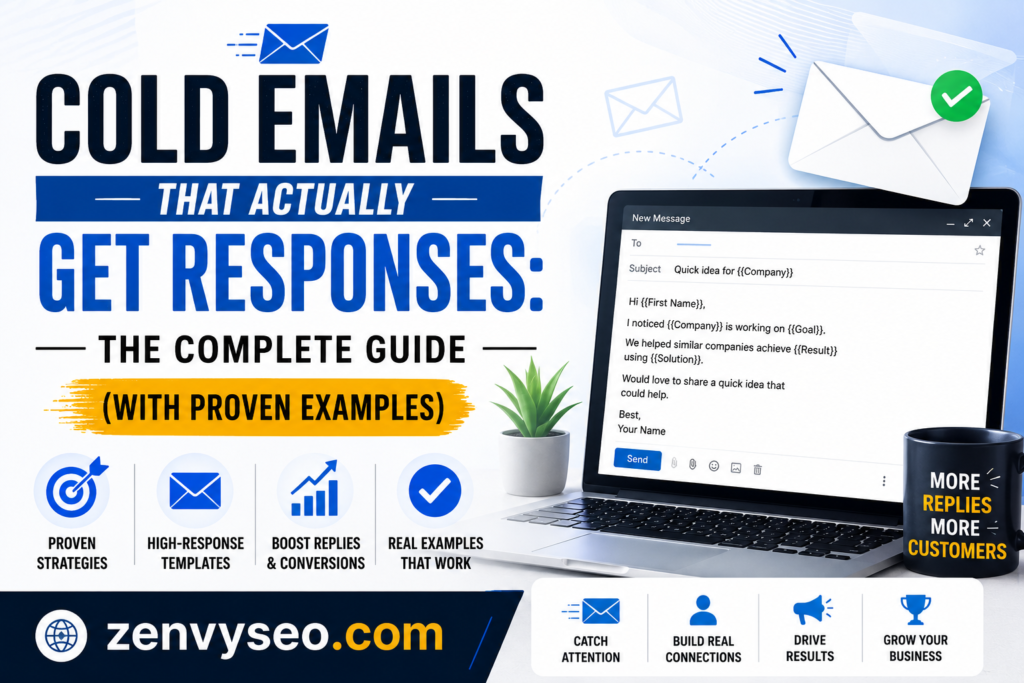
Most cold emails never get read. In fact, the average cold email response rate hovers between 1% and 8.5% — yet top-performing outreach professionals consistently achieve 15–30% reply rates. What separates them from the inbox graveyard? It’s not luck.
It’s a repeatable system built on smart subject lines, deep personalization, tight structure, and strategic follow-up.
At ZenvySEO, we’ve studied what the best cold email practitioners do differently, and this guide breaks down every piece of that system — from the first subject line to the final follow-up — so you can turn silence into conversations.
If you are new must be read “install-wordpress-manually-using-cpanel“
Crafting Subject Lines That Demand Attention
Your subject line is the gatekeeper. No matter how good your email body is, it means nothing if the subject line doesn’t earn the open.
Research-Backed Subject Line Formulas
Here are subject line structures that consistently outperform generic alternatives:
| Formula | Example |
| Specific outcome + timeframe | “3 leads in 7 days — here’s how” |
| Mutual connection drop | “Jake at Acme suggested I reach out” |
| Trigger event reference | “Congrats on the Series B — quick thought” |
| Problem-first framing | “Losing pipeline to slower follow-up?” |
| Question-based curiosity | “Are you still handling this manually?” |
The Psychology of Curiosity Gaps
The human brain is wired to resolve incomplete information. A subject line that hints at something valuable — without giving it all away — creates a psychological itch the reader wants to scratch. Phrases like “one thing your competitors are doing” or “what most [role]s miss about X” open a loop the mind wants to close.
The key is to be specific enough to be relevant but vague enough to require opening the email.
The Ideal Subject Line Length
Research points to 4–7 words as the sweet spot. Beyond that, mobile devices truncate the subject line, and readers lose context fast. Shorter lines also feel less like marketing and more like a message from a real person.
Using AI to Optimize Subject Lines
AI tools can generate 10–15 subject line variations based on recipient data in seconds. The smartest approach: let AI draft the options, then apply human judgment to pick the one that fits the recipient’s context. Data without nuance still falls flat.
Personalization Techniques That Go Beyond “Hi {First_Name}”
Mass-blast personalization is dead. Inserting a first name no longer signals effort — every automation tool does it. What actually moves the needle is relevance.
Research Methods That Won’t Eat Up Your Entire Day
Deep research doesn’t have to take an hour per prospect. A focused 5-minute scan of these sources is enough to find a meaningful opener:
- LinkedIn activity — recent posts, job changes, or company announcements
- Company newsroom — product launches, new hires, funding rounds
- Their website — recent blog posts, case studies, or open job listings
- Twitter/X — public opinions or industry takes they’ve shared
Use what you find as your opening line — not buried in paragraph three.
Using Social Proof and Mutual Connections as Personalization Elements
A mutual connection instantly reduces the “stranger anxiety” recipients feel when they see an unknown sender. Even indirect connections work: “I saw you’re connected to [Name] — I worked with their team on [X].”
Similarly, name-dropping a recognizable client or result builds instant trust: “We helped three marketing agencies like yours reduce CAC by 22% last quarter.” Specificity is everything.
Scaling Personalization Without Sacrificing Quality
The goal isn’t to hand-write every Cold Emails — it’s to build templates with personalization slots that require real research to fill:
- Research trigger event (funding, hire, product launch)
- Insert into opening line slot
- Tie to your value proposition
- Fill in industry-specific social proof
This system lets you send 50 high-quality Cold Emails a day without sacrificing the human feel.
Structuring Your Cold Email for Maximum Impact
The Science of Email Length
The sweet spot is 50–125 words. That’s roughly three to four short paragraphs. Longer emails ask too much of someone who doesn’t know you yet. Shorter Cold Emails feel dismissive. A 30-word email like Trey from FullStory’s legendary example (which opened with a GIF of the recipient’s own website) proved that brevity paired with hyper-relevance outperforms verbose pitches every time.
The AIDA Framework for Cold Emails
The AIDA framework maps cleanly onto cold email structure:
- Attention — Subject line + opening hook
- Interest — Proof of relevance (personalized observation or trigger)
- Desire — Value proposition tied to a specific outcome
- Action — One clear, frictionless CTA
Strategic Use of White Space and Formatting
Cold emails should look easy to read at a glance. Short paragraphs (1–2 sentences), no walls of text, and no excessive formatting. Bullet points are fine for lists, but a cold emails that looks like a newsletter will be treated like one.
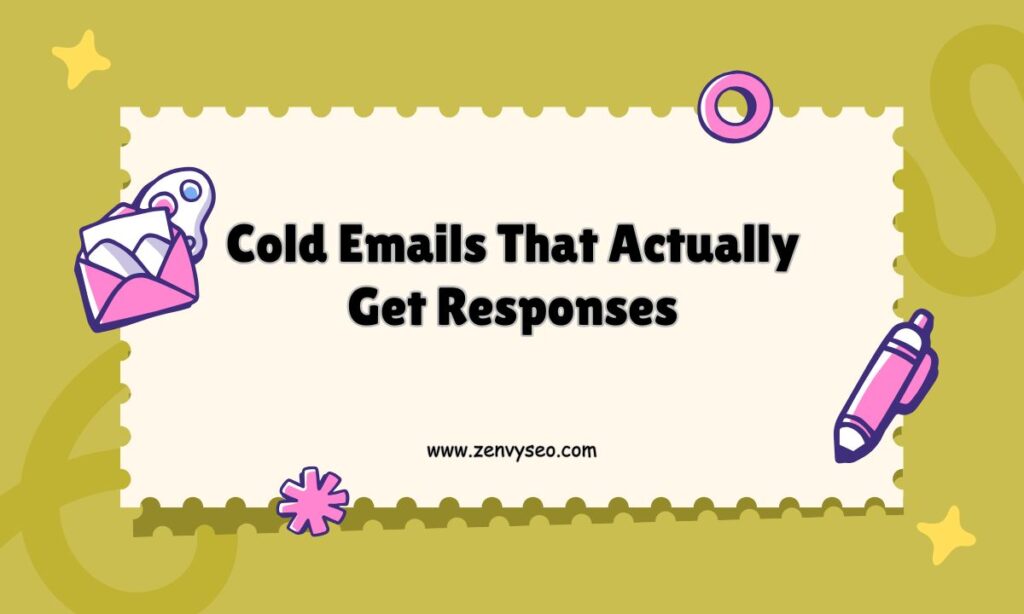
Anatomy of This Email’s Structure
Here’s a breakdown of a high-performing cold email:
Subject: Quick thought on [Company]’s SDR ramp
Hi [First Name],
Noticed you just brought on three new SDRs — congrats on the growth push.
Most teams at that stage lose 3–4 weeks of ramp time because their onboarding sequences aren’t tailored by persona. We helped [Similar Company] cut that window in half.
Worth a 15-minute call to see if it’s relevant?
[Signature]
Anatomy:
- Line 1: Trigger-based opener (signals research)
- Line 2: Problem identification tied to that trigger
- Line 3: Social proof with a specific outcome
- Line 4: Low-friction CTA (asks for a conversation, not a commitment)
Crafting a Compelling Call-to-Action
Your CTA has one job: make saying “yes” as easy as possible. “Book a 30-minute strategy call” is a big ask. “Open to swapping a couple of messages on how others are tackling this?” is almost frictionless.
Match CTA intensity to the relationship stage. A Cold Emails prospect needs a micro-commitment, not a calendar invite.
Powerful Value Propositions That Compel Responses
Techniques for Communicating Clear, Recipient-Focused Value
The cardinal rule: the value proposition must answer their question — “Why should I care?” — not yours. Lead with outcomes, not features.
❌ “Our platform uses AI to optimize pipeline management.” ✅ “Teams like yours close 18% more deals without adding headcount.”
The “So What?” Test for Evaluating Your Value Proposition
After drafting your value prop, ask “So what?” until you hit a concrete benefit the recipient actually cares about. If your first draft is “We streamline workflows,” ask: so what? It saves time. So what? Teams can focus on high-value tasks. So what? Revenue goes up without hiring. That’s your value proposition.
Framing Value Propositions for Different Industries
| Sender Type | Recipient | Value Proposition Example |
| SaaS | Marketing Agency | “We helped agencies like Horizon reduce churn by 31% in 90 days — without rebuilding their stack” |
| Consulting | Manufacturing Co. | “We’ve helped 3 mid-size manufacturers cut procurement costs by $400K annually through process restructuring” |
| HR Software | Fast-Growing Startup | “As you scale past 50 employees, compliance gaps appear fast — we close them before they become liabilities” |
Research on Decision-Making: Specific Outcomes Outperform General Benefits
Decision-makers respond to specificity. Saying “improve efficiency” triggers skepticism. Saying “reduce onboarding time by 3 weeks” triggers curiosity. Numbers, percentages, and named companies are proof points — not noise.
Testing Multiple Value Proposition Angles
Run structured A/B tests across three angles:
- Time-saving — “Cut X from 4 hours to 45 minutes”
- Revenue — “Helped [Company] add $200K ARR in one quarter”
- Risk reduction — “Avoid the compliance issues that cost [Industry] $50K on average”
Track which angle resonates with which segment and double down.
Follow-Up Strategies That Convert Initial Silence into Conversations
The Science of Optimal Follow-Up Timing
Most replies don’t come from the first Cold Emails — they come from the follow-up sequence. Here’s a timing framework that avoids becoming noise:
| Touch | Timing | Purpose |
| Email 1 | Day 0 | First contact |
| Email 2 | Day 3–4 | Add new insight or resource |
| Email 3 | Day 7–9 | Shift angle or challenge assumption |
| Email 4 | Day 12–15 | Lightweight check-in |
| Email 5 | Day 20–25 | Breakup email |
The “Adding Value With Each Touch” Methodology
Every follow-up should bring something new: a relevant case study, an industry stat, a short insight about their market. “Just following up” is a dead phrase. Treat each message as a standalone reason to respond.
Sequencing Strategies with Progressive Call-to-Action Intensity
Start with low-commitment asks and escalate gradually:
- Email 1: “Would this be relevant?” (micro-ask)
- Email 2: “Here’s a quick resource — curious your take” (value add)
- Email 3: “Open to a 10-minute call next week?” (soft ask)
- Email 4: “Should I reach out to someone else on your team?” (redirect)
- Email 5: “I’ll assume the timing isn’t right — feel free to reconnect anytime.” (graceful exit)
How to Maintain Subtlety While Creating Continuity
Reference previous Cold Emails naturally — don’t beg or apologize. “I shared something about X last week — wanted to add one more data point you might find useful” maintains continuity without desperation.
When to Stop Following Up
After five touches without a response, stop. Send a polite breakup email and move on. Persistence earns replies; harassment earns blocks and spam reports that hurt your sender reputation.
Measuring, Testing and Optimizing Your Cold Email Strategy
Beyond Open Rates: Metrics That Actually Matter
Open rates are a vanity metric when deliverability is inconsistent. Focus here instead:
| Metric | What It Tells You |
| Reply Rate | Whether your message resonates |
| Positive Reply Rate | Whether your targeting is on-point |
| Meeting Booked Rate | Whether your CTA converts |
| Bounce Rate | Whether your list is clean |
| Unsubscribe Rate | Whether your targeting is off |
Building an Effective A/B Testing Framework
Test one variable at a time. Changing the subject line, the opening line, and the CTA simultaneously gives you data you can’t interpret. A disciplined A/B framework:
- Identify your control (current best-performing version)
- Change one element (subject, opener, CTA, length, send time)
- Send to a statistically meaningful sample (minimum 100 per variant)
- Wait 72–96 hours before reading results
- Implement the winner, archive the loser, run the next test
Creating a Continuous Improvement Cycle
Cold Emailsl is not set-and-forget. Markets shift. Buyer psychology evolves. Build a quarterly review cycle: analyze metrics, retire underperforming sequences, refresh templates, and introduce new angles based on what’s moving in your industry.
Leveraging Data-Driven Insights for Continuous Improvement
Track which segments respond to which value proposition angles, which send times correlate with higher open rates, and which subject line structures drive the most replies. Over time, these patterns become your competitive edge.
Ethical Considerations and Compliance Factors
Cold Emails is legal in most markets when done correctly. Key requirements:
- CAN-SPAM (US): No deceptive subject lines, include a physical address, honor opt-outs within 10 business days
- GDPR (EU): Requires legitimate interest or prior consent for B2B outreach to individuals
- CASL (Canada): Requires express or implied consent before sending commercial email
Beyond legality, respect recipient time. If someone asks to be removed from your list, honor it immediately. Ethical outreach protects your sender reputation and your brand.
Bringing It All Together: Your Path to Cold Email Success
Effective cold email isn’t about clever tricks. It’s about treating every recipient as a person worth understanding — researching their world, speaking to their specific problems, and making it genuinely easy for them to say yes.
At ZenvySEO, the framework we’ve laid out here is built on one core principle: be so relevant and helpful that ignoring you feels like a mistake.
Start with one sequence. Test it, measure it, improve it. Then scale what works. Your response rate will follow.
Frequently Asked Questions (FAQs)
What is a good cold email response rate?
Industry averages sit around 8.5%, but well-optimized sequences with strong personalization can reach 15–30%.
How long should a cold email be?
Aim for 50–125 words. Short enough to respect their time, long enough to communicate a clear, relevant value proposition.
How many follow-ups should I send?
Send up to five follow-ups spaced 3–7 days apart. Each one should add new value, not just repeat the original ask.
Is cold emailing legal?
Yes, when you comply with applicable laws like CAN-SPAM (US), GDPR (EU), and CASL (Canada). Never use deceptive subject lines and always honor unsubscribe requests.
What is the best time to send cold emails?
Tuesday through Thursday, between 7–9 AM or 1–3 PM in the recipient’s time zone, tends to produce the highest open rates — but always test against your specific audience.