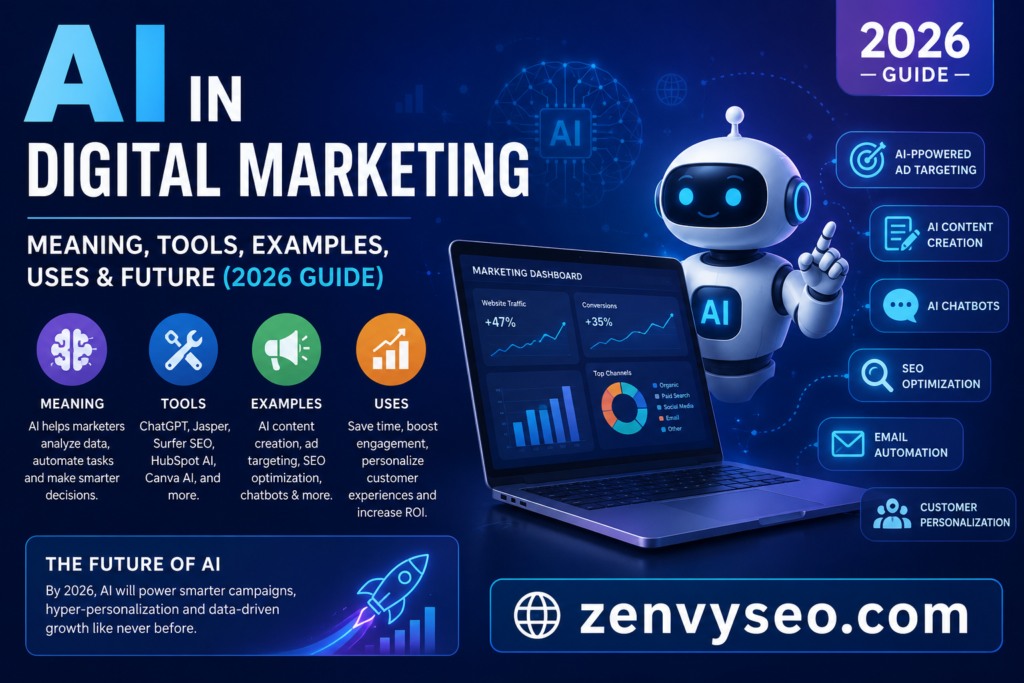
Artificial intelligence is no longer a buzzword reserved for tech giants. Today, AI in digital marketing is reshaping how brands attract customers, run ads, and build loyalty — at every budget level.
Whether you are a solo marketer, a growing agency, or a large enterprise, understanding how AI works in digital marketing is no longer optional. It is the difference between staying relevant and falling behind.
In this comprehensive guide by ZenvySEO, we break down exactly what AI in digital marketing means, how it works, which tools lead the market in 2026, and what the future holds for marketers worldwide.
What Is AI in Digital Marketing?
AI in digital marketing refers to the use of artificial intelligence technologies — including machine learning, natural language processing (NLP), and predictive analytics — to automate, improve, and personalise marketing activities across digital channels.
In simple terms, AI helps marketers make smarter decisions faster. Instead of manually analysing thousands of data points, AI tools do it in seconds and recommend the best next action — whether that is adjusting an ad bid, personalising an email, or predicting what a customer will buy next.
Featured Snippet Answer: AI in digital marketing means using smart software and machine learning to automate tasks, analyse customer data, personalise content, and optimise campaigns — helping brands reach the right audience at the right time with less manual effort.
How AI and Digital Marketing Work Together
AI does not replace your marketing strategy — it powers it. Here is how the two work hand in hand:
- Data Collection: AI gathers and processes data from websites, social platforms, CRMs, and ad campaigns simultaneously.
- Pattern Recognition: Machine learning models identify trends and audience behaviours that human analysts would miss.
- Automation: Repetitive tasks like email scheduling, bid adjustments, and A/B testing run on autopilot.
- Personalisation: AI delivers individualised content, offers, and product recommendations to each user based on their behaviour.
- Prediction: Predictive analytics forecast future customer actions, enabling proactive marketing moves.
Think of AI as a highly skilled data analyst, copywriter, and campaign manager working 24/7 — without fatigue.
Why AI Is Important in Digital Marketing Today
The numbers alone tell a compelling story:
| Metric | Data Point |
| Marketers using AI | 84% use AI for real-time personalisation (Salesforce, 2026) |
| ROI improvement | 30% higher ROI with AI-powered ad optimisation |
| Customer support | AI chatbots handle up to 80% of routine queries |
| Market size | AI in marketing projected to grow from $20.4B (2024) to $82.2B by 2030 |
| Conversion uplift | AI-driven campaigns deliver 22% higher conversion rates |
Customers now expect personalised experiences. They ignore generic ads and abandon slow support queues. AI makes it possible for brands of every size to meet those expectations — consistently and at scale.
Key Applications of AI in Digital Marketing
1. Content Creation and Optimisation
AI writing tools like ChatGPT, Jasper, and Copy.ai help marketers generate blog drafts, ad copy, social media captions, and email subject lines in minutes. Tools like Surfer SEO and MarketMuse go further — they analyse top-ranking content and tell you exactly what topics, keywords, and structure your article needs to rank.
At ZenvySEO, we combine AI content tools with human editorial review to produce content that is both search-engine-optimised and genuinely useful for readers.
How AI improves content marketing:
- Generates first drafts 10x faster than manual writing
- Identifies content gaps your competitors have already filled
- Suggests semantic keywords and NLP terms for better rankings
- Optimises headlines for click-through rate (CTR)
2. AI in SEO and Search Marketing
SEO is no longer a guessing game. AI-powered SEO tools process millions of search queries to reveal:
- Which keywords have high intent but low competition
- How Google’s algorithm is likely to score your content
- What featured snippet opportunities exist for your topic
- Which technical issues are hurting your site’s crawlability
With Google’s own AI (SGE — Search Generative Experience) now shaping search results pages, optimising for AI-driven search is essential. ZenvySEO helps brands build SEO strategies that align with how AI search engines understand and rank content in 2026.
3. AI in Paid Advertising (PPC and Media Buying)
This is where AI delivers some of its most measurable results. Platforms like Google Ads and Meta Ads now run almost entirely on AI:
- Smart Bidding automatically adjusts bids in real time based on conversion probability
- Performance Max campaigns let AI select the best ad format, placement, and audience for each impression
- Responsive Search Ads test dozens of headline and description combinations automatically
AI analyses millions of signals simultaneously — device type, location, time of day, browsing history — something no human media buyer could manage manually. The result is better ad performance with less wasted spend.
4. AI in Customer Segmentation and Targeting
Traditional segmentation divided audiences by broad categories like age or gender. AI creates micro-segments based on real behaviour:
- Users who visited the pricing page but did not convert
- Customers who purchased once but have not returned in 90 days
- Visitors showing high purchase intent based on scroll depth and time on page
This level of targeting means every campaign speaks to a specific person’s needs — not a generic demographic.
5. AI Chatbots and Customer Support
Modern AI chatbots are far more capable than the scripted bots of five years ago. Powered by large language models, they can:
- Answer complex product questions naturally
- Qualify leads and book sales calls automatically
- Resolve support tickets without human escalation
- Engage customers on WhatsApp, website chat, and social DMs simultaneously
For growing businesses, this means 24/7 customer engagement without hiring additional staff.
Top AI Tools for Digital Marketing in 2026
| Tool | Best For | Key Feature |
| ChatGPT | Content & research | Natural language generation, strategy planning |
| Surfer SEO | On-page SEO | Content scoring and NLP optimisation |
| Jasper | Ad & blog copy | Brand voice training and templates |
| HubSpot AI | CRM & email | Lead scoring and personalised email sequences |
| Google Performance Max | Paid ads | AI-driven campaign automation across all Google channels |
| Midjourney / DALL·E | Visual content | AI image generation for ads and social media |
| Sprout Social | Social media | AI scheduling and engagement analytics |
| Salesforce Einstein | Predictive marketing | Churn prediction and next-best-action recommendations |
ZenvySEO Tip: You do not need every tool on this list. Start with one AI tool that solves your biggest marketing bottleneck — whether that is content production, ad management, or lead nurturing — and build from there.
Real-World Examples of AI in Digital Marketing
Netflix and Spotify: Personalisation at Scale
Netflix saves an estimated $1 billion per year through its AI recommendation engine, which keeps viewers engaged by surfacing content tailored to each user’s viewing history. Spotify’s “Discover Weekly” playlist uses machine learning to curate 30 songs every week that feel hand-picked — for 600 million users simultaneously.
The lesson: Personalisation is not a luxury feature. It is the standard modern customers expect.
Amazon: Predictive Shipping and Dynamic Pricing
Amazon’s AI does not just recommend products — it anticipates what you will buy before you order it and pre-positions stock accordingly. Its dynamic pricing algorithm adjusts product prices millions of times per day based on demand, competitor pricing, and inventory levels.
Google Smart Bidding: Real-Time Ad Optimisation
Google’s Smart Bidding system evaluates over 70 different signals at the moment of each auction to decide the optimal bid. This real-time decision-making has helped advertisers improve conversion rates while reducing cost per acquisition.
Benefits of AI in Digital Marketing
For Businesses
- Reduces customer acquisition costs
- Scales personalised marketing without scaling headcount
- Improves campaign ROI through continuous optimisation
- Enables faster, data-driven decisions
For Marketers and Agencies
- Eliminates hours spent on manual reporting and analysis
- Generates creative ideas and copy drafts on demand
- Surfaces insights from data that would otherwise go unnoticed
- Frees up time to focus on strategy and creativity
For Customers
- Receives relevant recommendations instead of irrelevant ads
- Gets instant support answers without waiting on hold
- Experiences a more consistent and personalised brand journey
Challenges and Limitations of AI in Digital Marketing
AI is powerful, but it is not perfect. Marketers need to approach it with clear eyes.
Data Privacy and Compliance AI depends on data — and collecting that data must comply with regulations like GDPR and CCPA. Brands that use AI carelessly risk serious penalties and loss of customer trust.
Garbage In, Garbage Out If the data feeding your AI tools is outdated, incomplete, or biased, the outputs will be equally flawed. Data quality is the foundation of every effective AI marketing system.
Skill Gaps By 2026, demand for prompt engineering and AI marketing skills has outpaced supply. Many marketing teams are using AI tools without fully understanding how to get the best results from them.
Brand Consistency AI-generated content can drift from a brand’s tone and values if not reviewed by skilled human editors. The speed of AI should never come at the cost of brand integrity.
AI vs Traditional Digital Marketing
| Aspect | Traditional Marketing | AI-Powered Marketing |
| Campaign setup | Manual, time-intensive | Automated, template-driven |
| Audience targeting | Broad demographic segments | Behaviour-based micro-segments |
| Ad bidding | Manual adjustments | Real-time algorithmic bidding |
| Content production | Fully human-authored | AI-assisted with human review |
| Performance analysis | Weekly/monthly reports | Real-time dashboards and alerts |
| Personalisation | Limited by resources | Scalable, 1:1 at any volume |
The Future of AI in Digital Marketing
The trajectory is clear: AI will move from a tool marketers use to an intelligent layer that runs beneath everything they do.
Key trends shaping the future:
- Agentic AI — AI agents that do not just recommend actions but execute them: building campaigns, buying media, adjusting budgets, and reporting results autonomously.
- Hyper-personalisation — Every customer receiving a unique content and offer journey based on real-time behavioural signals.
- Voice Search Optimisation — As voice assistants grow, brands must optimise for conversational, question-based queries.
- AI-Generated Video — Short-form video content created and personalised by AI for specific audience segments.
- Predictive Customer Journeys — AI mapping the likely path of each customer and triggering the right message at precisely the right moment.
Marketers who master these capabilities now will be the ones defining digital strategy for the next decade.
Conclusion
AI in digital marketing is not a trend you can afford to observe from the sidelines. It is the operating system of modern marketing — embedded in search engines, advertising platforms, CRM systems, and customer support tools that brands already use every day.
The real opportunity is not just in adopting AI tools. It is in understanding how they work, how to feed them quality data, and how to combine AI’s analytical power with human creativity and strategy.
At ZenvySEO, we help brands navigate this shift — building AI-informed SEO strategies, content systems, and digital marketing frameworks that deliver measurable growth. Whether you are just starting to explore AI marketing or looking to scale an existing AI workflow, the right knowledge and the right tools make all the difference.
Frequently Asked Questions (FAQs)
What is AI in digital marketing?
AI in digital marketing is the use of machine learning, natural language processing, and data analytics to automate tasks, personalise campaigns, and improve marketing performance across digital channels.
How does AI improve digital marketing ROI?
AI improves ROI by optimising ad bids in real time, reducing wasted spend, personalising content to increase conversions, and automating repetitive tasks so teams focus on high-value strategy.
What are the best AI tools for digital marketing in 2026?
Top tools include ChatGPT for content, Surfer SEO for search optimisation, Google Performance Max for paid ads, HubSpot AI for CRM, and Sprout Social for social media management.
Is AI replacing digital marketers?
No — AI is replacing tasks, not people. Marketers who use AI will outperform those who do not, but human creativity, strategy, and brand judgment remain essential.
Can small businesses use AI in digital marketing?
Absolutely. Many AI tools are affordable and accessible. Small businesses can use AI to automate email marketing, generate content, improve local SEO, and run smarter ad campaigns on modest budgets.