If your business serves customers in a specific city, neighborhood, or region, then local search engine marketing isn’t optional — it’s your most direct path to growth. Whether you run a dental clinic in Houston, a law firm in Chicago, or a plumbing business in Phoenix, the way people find you has fundamentally changed. They open Google, type what they need, and choose from whoever shows up first.
This guide from ZenvySEO breaks down everything US businesses need to know about local search engine marketing in 2026 — what it is, why it works, and how to implement it the right way.
Understanding Local Search Marketing with an Example
Local search engine marketing is a targeted digital strategy that helps businesses appear in front of nearby customers when they search for products or services on Google, Maps, or other search platforms. It combines both organic tactics (local SEO) and paid advertising (local SEM) to maximize visibility across geo-specific search results.
Here’s a real-world example: Imagine a family-owned HVAC company in Dallas, Texas. When someone nearby searches “AC repair near me” or “emergency HVAC Dallas,” that company wants to appear in:
- The Google Local Pack (the map with three business listings)
- Organic search results just below the map
- Google Maps results on mobile
- Paid search ads at the top of the page
That full-funnel presence — both paid and organic — is exactly what local search engine marketing delivers. It isn’t about getting traffic from everywhere. It’s about getting the right traffic from the right zip codes at the right moment.
What Is Local Search Used For?
Local search engine marketing serves several practical purposes for US businesses. It’s not just about ranking — it’s about connecting with real buyers at the moment they’re ready to act.
Common use cases include:
- Driving foot traffic to physical store locations
- Generating phone calls from nearby customers
- Booking appointments for service-area businesses (plumbers, electricians, dentists)
- Building brand awareness in a specific city or metro area
- Competing with larger national brands by owning local search real estate
According to recent data, over 50% of Google searches carry local intent. That means roughly half of every search performed in the US is someone looking for a nearby business or service. If your business isn’t optimized for local search engine marketing, you’re invisible to that audience.
Is Local SEO Worth It in 2026?
Short answer: yes — more than ever.
In 2026, search has become more layered. Google now surfaces AI-generated overviews, map pack results, voice search answers, and zero-click results all on the same page. Customers often form an opinion about a business before they ever visit a website.
They scan your Google Business Profile, check your reviews, browse your photos, and read whatever Google chooses to show.
Here’s why local search engine marketing still delivers strong ROI for US businesses:
| Factor | Why It Matters in 2026 |
| Local Pack Influence | The Google Map Pack influences 40%+ of local clicks |
| Review Signals | Businesses with 4.5+ star ratings rank significantly higher |
| Mobile-First Behavior | Most local searches happen on smartphones |
| Cost vs. PPC | Organic local rankings compound over time; ads stop when budget runs out |
| AI Overview Visibility | Structured, authoritative content gets featured in AI-generated answers |
The businesses thriving in local search right now aren’t just doing SEO — they’re building a system. Reviews, citations, content, speed, and trust signals all work together.
Core Components of Local Search Engine Marketing
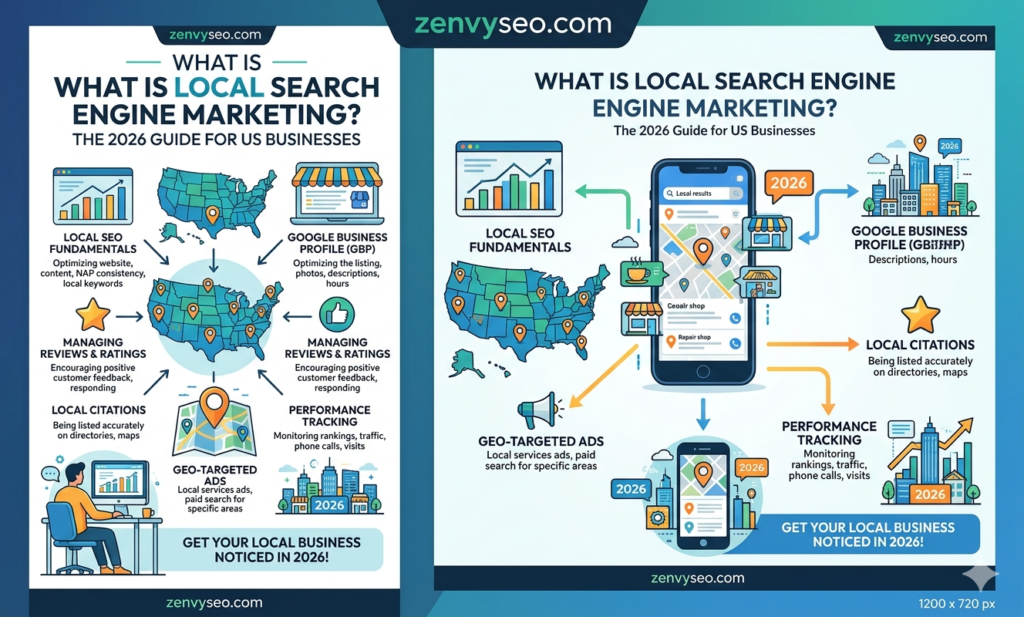
Effective local search engine marketing isn’t a single tactic. It’s a set of connected pillars that reinforce each other. At ZenvySEO, we consistently see the best results when all of these are working together:
1. Google Business Profile (GBP) Optimization Your GBP listing is the foundation of local search. It controls what appears in the Local Pack, Google Maps, and Knowledge Panel. Fill every field, add photos, post updates regularly, and keep your NAP (Name, Address, Phone) consistent.
2. On-Page Local SEO Every service page on your website should target a specific location + service combination. Use city names in title tags, meta descriptions, H1 headings, and naturally within body content.
3. Citation Building Citations are mentions of your business name, address, and phone across directories like Yelp, Yellow Pages, and BBB. Consistency across citations builds trust with Google.
4. Local Link Building Backlinks from local news sites, business associations, and community organizations signal geographic relevance and authority.
5. Online Reviews Management Reviews are both a ranking factor and a conversion driver. Encourage satisfied customers to leave Google reviews and respond to every review — positive or negative.
6. Local Paid Search (Google Ads) Geo-targeted PPC ads complement organic efforts, especially for high-competition keywords or new businesses that haven’t yet built organic authority. Local Service Ads (LSAs) are particularly effective for service-area businesses.
7. Schema Markup Adding LocalBusiness schema to your website helps Google understand your location, hours, services, and contact info — which improves your chances of appearing in rich results and AI overviews.
Local Keyword Research for US Markets
Keyword research for local search engine marketing looks different than standard SEO research. You’re not chasing high-volume national terms — you’re targeting specific phrases that buyers in your city actually use.
How to approach local keyword research:
- Start with service + city combinations: “roof repair Austin TX,” “best dentist near downtown Seattle”
- Target “near me” variations: These are high-intent and heavily used on mobile devices
- Use question-based phrases: “How much does AC repair cost in Atlanta?” — these feed featured snippets and AI overviews
- Include neighborhood-level terms: In large metros, neighborhood targeting (e.g., “plumber Brooklyn Heights”) can drive highly qualified traffic
- Mine your Google Business Profile insights for what searches already trigger your listing
Useful tools for local keyword discovery include Google Search Console, Google Keyword Planner (with location filters), and BrightLocal’s Search Grid. At ZenvySEO, we recommend building a keyword map that assigns one primary local term per page to avoid internal competition.
LSI and NLP keywords to naturally work into your content:
- geo-targeted search, local map pack, Google Business Profile, search visibility, local intent, near me searches, service area business, NAP consistency, citation authority, local pack ranking
Measuring Local Marketing Success
You can’t improve what you don’t measure. Local search engine marketing performance should be tracked across both organic and paid channels.
Key metrics to monitor:
- Local Pack ranking position for target keywords (use tools like BrightLocal or Whitespark)
- Google Business Profile views, clicks, and call volume
- Organic traffic from local landing pages (via Google Search Console)
- Conversion rate on local pages (calls, form fills, direction requests)
- Review count and average star rating
- Ad click-through rate and cost-per-lead for paid local campaigns
Set a monthly reporting cadence. Track where you rank, how many people find you, and most importantly — how many of them convert into actual customers.
Common Local SEO Pitfalls to Avoid
Even experienced marketers make mistakes with local search engine marketing. Watch out for these:
- Inconsistent NAP information across your website and directories — even small differences (St. vs Street) confuse Google
- Ignoring reviews or failing to respond — this signals poor reputation management
- Targeting the wrong keywords — going after national terms instead of local ones wastes budget and effort
- Duplicate Google Business Profile listings — these split your authority and confuse customers
- No location-specific landing pages — sending all traffic to a generic homepage kills local relevance
- Slow mobile page speed — most local searches happen on phones, and slow pages lose customers immediately
- Skipping schema markup — without it, Google has to guess what your business does and where it operates
Actionable Steps to Launch Local Search Today
Ready to take local search engine marketing seriously? Here’s where to start:
- Claim and fully optimize your Google Business Profile — fill in every field, add 10+ photos, and post an update this week
- Audit your NAP consistency across Google, Yelp, Facebook, and your website
- Create dedicated location pages for each city or neighborhood you serve
- Build a review generation system — after every job or purchase, send a follow-up asking for a Google review
- Install LocalBusiness schema on your homepage and service pages
- Run a local keyword audit using Google Search Console to find what you already rank for — then build content around it
- Launch a geo-targeted Google Ads campaign with a small test budget to generate immediate leads while your organic rankings build
- Set up monthly tracking for GBP metrics, local rankings, and conversion data
None of these steps require a massive budget. They require consistency. The businesses that win at local search engine marketing are usually the ones that show up and execute every month, not the ones with the largest ad spend.
Conclusion
Local search engine marketing is the single most effective way for US businesses to reach customers who are actively ready to buy. In 2026, with search behavior shaped by AI, voice queries, and mobile-first habits, having a strong local presence isn’t a nice-to-have — it’s a revenue driver.
The strategy isn’t complicated: optimize your Google Business Profile, build consistent citations, earn strong reviews, create location-specific content, and back it all up with geo-targeted ads when needed. Done consistently, local search engine marketing builds compounding visibility that grows month after month.
At ZenvySEO, we help US businesses build and execute local search strategies that actually convert. If you’re ready to stop watching competitors show up while you don’t — start with the steps above.
Frequently Asked Questions
What is local search engine marketing in simple terms
It’s the process of promoting your business on Google and other search engines specifically to customers in your geographic area, using both organic SEO and paid ads.
How is local SEO different from local SEM?
Local SEO focuses on organic rankings through optimization, while local SEM involves paid advertising like Google Ads — both are components of local search engine marketing.
How long does local search engine marketing take to show results?
Paid ads can generate leads within days; organic local SEO typically takes 3–6 months to show meaningful ranking improvements.
Does my business need a website for local search marketing?
A website isn’t mandatory, but it significantly improves results — a Google Business Profile alone limits your ability to rank for broader local keywords.
Is local search engine marketing worth it for small businesses?
Absolutely. It’s one of the most cost-effective strategies available, especially compared to traditional advertising, because it targets people already searching for what you offer.