
If you run a dental practice in 2026, showing up on page one of Google is no longer optional — it is how patients find you. Studies show that most people searching for a dentist click on the top three results, and the majority never scroll past the first page.
To rank #1 with local SEO, you need more than a good-looking website. You need a proven system that builds visibility, trust, and consistent patient flow from local searches.
At ZenvySEO, we have worked with dental practices across the country and know exactly what separates the clinics dominating Google Maps from those buried on page two. This guide breaks it all down, step by step.
What is Local SEO for Dentists?
Local SEO for dentists is the process of optimizing your practice’s online presence so it appears prominently when nearby patients search for dental services. This includes showing up in the Google Map Pack, standard organic results, and AI-powered search answers on platforms like Google AI Overviews and ChatGPT.
Unlike general SEO, local SEO targets people within a specific geographic area — your city, neighborhood, or zip code — who are actively looking for services like teeth cleaning, dental implants, or emergency care.
The core components of a local dental SEO strategy include:
- Google My Business (Google Business Profile) optimization
- Location-specific landing pages
- Schema markup for dental practices
- NAP (Name, Address, Phone) citation consistency
- Online review management
- On-page SEO for dental websites
- Locally relevant content publishing
When these elements work together, you rank #1 with local SEO and turn online searchers into booked appointments.
Why Local SEO for Dentists is Important
The numbers speak clearly. Over 77% of patients use a search engine before booking a healthcare appointment. When someone in your area types “dentist near me” or “emergency dentist in [city],” Google decides — in less than a second — which practices to show first.
If your clinic is not optimized, a competitor down the street gets that patient.
Also read USA’s Top 12 Search Engine Optimization Agencies to Hire
Here is why local SEO matters more than ever in 2026:
| Reason | Impact |
| 76% of mobile local searches lead to a same-day visit | More walk-ins and urgent appointments |
| Google Map Pack captures ~44% of all dental search clicks | Visibility above organic results |
| 87% of consumers read reviews before choosing a dentist | Trust built before first contact |
| AI search surfaces local businesses with strong signals | New visibility on ChatGPT and Perplexity |
| Consistent citations improve Map Pack rankings | Stronger local authority |
The dental services industry is worth over $172 billion in the US alone. Competition is fierce. To rank #1 with local SEO, your practice must give Google every signal it needs to place you at the top.
How to Do Local SEO for Dentists
Optimize the Google My Business Profile
Your Google Business Profile (formerly Google My Business) is the single most important asset for local dental SEO. It directly controls your appearance in the Map Pack — the three listings that show up above organic search results with a map.
To properly optimize your profile:
- Claim and verify your listing at business.google.com
- Set your primary category to “Dentist” — this is non-negotiable
- Add secondary categories such as “Cosmetic Dentist,” “Pediatric Dentist,” or “Emergency Dental Service” where applicable
- Fill every section — business hours, services, description, website, and booking link
- Upload high-quality photos of your clinic interior, exterior, team, and equipment
- Post weekly updates — Google rewards active profiles with higher visibility
- Respond to every review — both positive and negative — within 48 hours
Consistency matters here. Your name, address, and phone number on the GBP must match your website exactly. Even a small difference — like “St.” vs “Street” — can hurt your ability to rank #1 with local SEO.
Add Schema Markup for Dental Practices
Schema markup is structured data code added to your website that helps Google understand key details about your practice. Think of it as a “fact card” you hand directly to the search engine.
For dental practices, the essential schema types are:
- Dentist schema — identifies your business type specifically
- LocalBusiness schema — confirms your location, phone, hours, and website
- Organization schema — adds brand authority signals
- Review schema — enables star ratings to appear directly in search results
Add the schema code in JSON-LD format inside the <head> section of your homepage and service pages. Use Google’s Rich Results Test to validate it. If you are on WordPress, plugins like Rank Math or Schema Pro can simplify this process.
When your schema is correctly set up, Google can display your hours, star ratings, and appointment links directly in local results — without a user clicking your site. This visibility boost helps you rank #1 with local SEO and earns more clicks than competitors who skip structured data.
Also read White Label Web Development Services for Agencies
Create Location Optimized Landing Pages
If your practice serves multiple neighborhoods or suburbs, or if you offer distinct services, you need dedicated location landing pages — not just a homepage.
Each location page should include:
- The city or neighborhood name naturally woven into the title tag, H1, and body copy
- A list of services offered at that location
- An embedded Google Map of that specific address
- Patient testimonials mentioning the local area
- A clear call-to-action with a phone number and appointment form
Avoid copying the same content across multiple location pages. Google penalizes duplicate content. Write each page uniquely, matching the intent of local searches like “family dentist in [neighborhood]” or “Invisalign provider near [city].”
ZenvySEO consistently finds that practices with well-built location pages see the biggest jumps when trying to rank #1 with local SEO in competitive markets.
Build Consistent Local Citations
A local citation is any online mention of your practice’s name, address, and phone number (NAP). Search engines cross-reference these citations to verify your legitimacy and geographic relevance.
Key directories to list your practice:
- Google Business Profile
- Yelp
- Healthgrades
- Zocdoc
- WebMD Health Listings
- Bing Places for Business
- Apple Maps
- Foursquare
- Your local Chamber of Commerce
The golden rule: your NAP must be identical across every platform. No abbreviations, no alternate phone numbers, no outdated addresses. Inconsistencies confuse Google’s crawlers and suppress your Map Pack ranking.
Run a citation audit at least once per quarter using tools like BrightLocal or Whitespark. Cleaning up inaccurate listings is one of the fastest ways to rank #1 with local SEO without creating any new content.
Encourage and Manage Reviews
Reviews are a ranking factor and a conversion factor. Google weighs review quantity, recency, and sentiment when deciding which dental practices appear in the Map Pack. Patients read them before booking. Both matter.
How to build a steady review stream:
- Send a follow-up SMS or email within 24 hours of every appointment with a direct review link
- Train front desk staff to verbally ask happy patients to leave a Google review
- Make it easy — link directly to your Google review page, not just your homepage
- Never buy fake reviews — Google detects and penalizes this
- Respond to negative reviews professionally and offer to resolve the issue offline
A practice with 150 reviews and a 4.8-star average will almost always outrank a competitor with 30 reviews and a 4.9-star average. Volume, recency, and response rate all matter. Consistent review management is essential for clinics that want to rank #1 with local SEO long-term.
Improve On Page SEO for Dental Websites
Your website needs to earn trust from both Google and patients. On-page SEO for dental sites covers several areas:
Technical foundations:
- Fast page load speed (under 3 seconds on mobile)
- HTTPS secure connection
- Mobile-responsive design
- Clean URL structure (e.g., /teeth-whitening-chicago/)
Content optimization:
- Include location-specific keywords in title tags, H1 headings, and meta descriptions
- Create separate pages for each service (implants, whitening, Invisalign, cleanings, etc.)
- Use internal linking to connect service pages with location pages
- Add FAQs with natural language questions your patients actually ask
Google follows YMYL (Your Money or Your Life) guidelines for dental content. This means accuracy, authoritativeness, and transparency are weighted heavily. Make sure your site includes dentist bios, credentials, and clear contact information. These trust signals directly support your ability to rank #1 with local SEO in your area.
Also read Custom Web Development Services Built for Speed, Scale, and Growth
Publish Local Content Regularly
Fresh, locally relevant content tells Google your practice is active and authoritative in your area. It also attracts patients at different stages of their decision-making process.
Content ideas that work for dental practices:
- “Best tips for teeth whitening in [City]”
- “What to do in a dental emergency in [Neighborhood]”
- “How to choose the right dentist for your family in [City]”
- Seasonal oral health tips tied to local events or school calendars
- Community spotlights or dental awareness campaigns
Aim for at least two to four blog posts per month. Each piece should target a specific local keyword and genuinely answer a patient’s question. Over time, this content earns backlinks from local news outlets, community websites, and health directories — all of which strengthen the signals needed to rank #1 with local SEO.
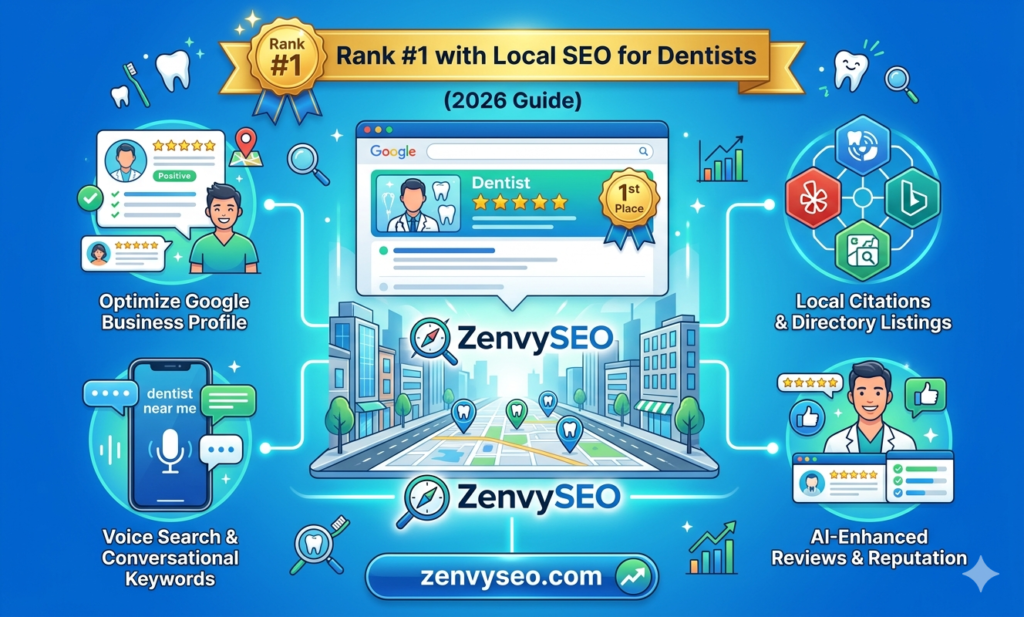
Common Mistakes Dentists Make with Local SEO
Even well-intentioned practices sabotage their own visibility. Here are the most frequent errors ZenvySEO encounters:
| Mistake | Why It Hurts |
| Inconsistent NAP information | Confuses Google; suppresses Map Pack rankings |
| Ignoring Google Business Profile | Reduces visibility in local and map results |
| No location-specific landing pages | Unable to rank for neighborhood-level searches |
| Missing or broken schema markup | Lost rich snippet opportunities |
| Not responding to reviews | Signals low engagement to Google |
| Thin or duplicate service pages | Triggers Google’s quality filters |
| No mobile optimization | Hurts rankings and user experience |
| Keyword stuffing in content | Triggers spam penalties |
The biggest mistake of all? Assuming local SEO is a one-time setup. Google’s algorithm constantly evolves. Consistent effort — not a single fix — is what helps dental practices rank #1 with local SEO and stay there.
Expert Tips for Success with Local SEO for Dentists
Based on real campaign data at ZenvySEO, here are advanced strategies that separate high-growth practices from the rest:
- Track Map Pack rankings weekly — not just website traffic. Tools like BrightLocal and Local Falcon show exactly where you rank in your service area grid.
- Use GBP Q&A proactively — add your own frequently asked questions in the Q&A section of your Google Business Profile before patients have to ask.
- Target long-tail search terms — “affordable pediatric dentist in [neighborhood]” converts better than just “dentist.”
- Build local backlinks — sponsor a local school event, partner with a nearby health clinic, or contribute to a community blog. Links from local websites carry strong geographic authority signals.
- Optimize for voice search — patients ask voice assistants questions like “who is the best dentist near me open on Saturday?” Structure your content to answer these natural-language queries.
- Leverage photo updates — Google rewards GBP profiles that regularly post photos. Aim for 2 to 4 new images per week, including treatment rooms, staff, and patient education materials.
- Monitor competitor rankings — know what the top-ranking dental practices in your area are doing differently and outpace them methodically.
Applying even half of these strategies consistently will put you well on your way to rank #1 with local SEO in your market.
Conclusion
Patients are searching for a dentist near them right now. The practices that win those patients are the ones that invest in a smart, consistent local SEO strategy. From optimizing your Google Business Profile to building citations, publishing location-specific content, and managing reviews, every piece plays a role.
At ZenvySEO, we know that the path to rank #1 with local SEO is not about quick fixes — it is about building real trust and authority in your community, one signal at a time. Start with the fundamentals in this guide, stay consistent, and your practice will become the go-to dental clinic in your area.
Frequently Asked Questions
How long does it take to rank #1 with local SEO for dentists?
Initial improvements in Map Pack visibility typically appear within 3 to 4 months. Dominating competitive terms can take 6 to 12 months of consistent effort.
Is Google My Business free for dentists?
Yes, Google Business Profile (formerly Google My Business) is completely free to claim, verify, and optimize.
How many reviews does a dental practice need to rank well?
There is no fixed number, but practices with 80 to 150+ reviews and consistent new review activity tend to outperform those with fewer and older reviews.
Does schema markup directly improve Google rankings?
Schema markup is not a direct ranking factor, but it improves click-through rates and helps Google display rich results — both of which influence your overall local visibility.
Can I do local SEO for my dental practice myself?
You can manage the basics — GBP optimization, review responses, and content — but a structured strategy managed by specialists like ZenvySEO delivers faster and more durable results.
Also read 8 Best SEO Agencies in Oxford in 2026 for High ROI