
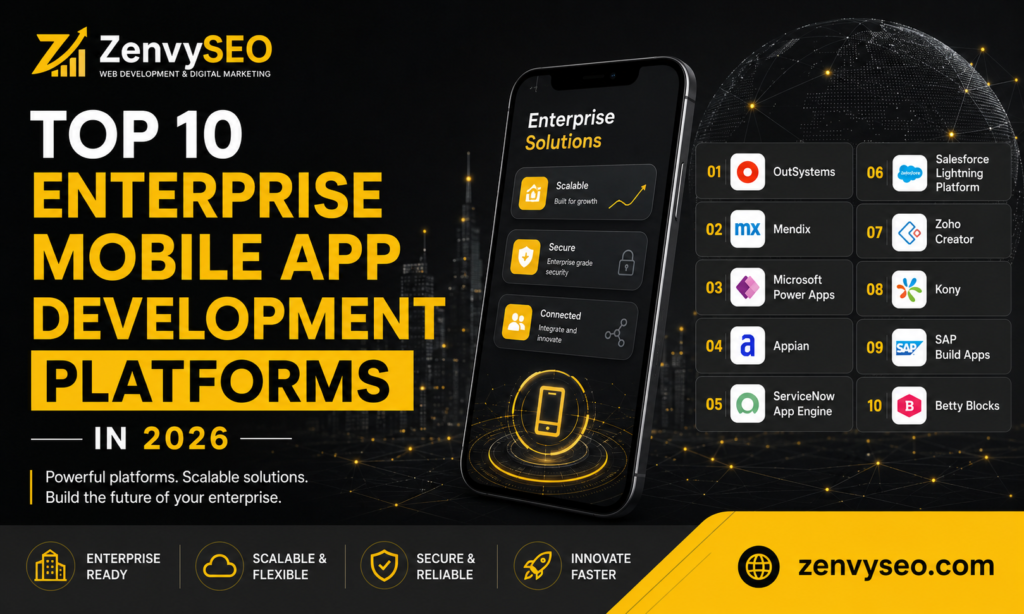
If your business is still building apps the slow, expensive, traditional way — it’s time for a rethink. Enterprise mobile app development has evolved dramatically. The right platform can cut your development timeline by 30–40%, reduce costs, and let your teams ship production-ready apps without writing thousands of lines of code from scratch.
In this guide, ZenvySEO breaks down the top 10 enterprise mobile app development platforms in 2026, what factors you should weigh before choosing one, and which platform fits your business goals best.
What is Enterprise Application Development?
Enterprise application development is the process of designing, building, and deploying large-scale software solutions that handle the complex operational needs of mid-size to large organizations. These applications typically manage critical business processes — from workforce management and supply chain tracking to customer relationship management and financial reporting.
Unlike consumer apps, enterprise apps must integrate with existing legacy systems, handle high data volumes, enforce role-based access controls, and meet strict security and compliance standards. That’s why picking the right platform matters so much.
Want to make a robust business mobile app without all the usual trouble?
The platforms on this list are built precisely for that — giving enterprise teams the tools to build fast, stay secure, and scale without breaking.
Get in Contact
Working with ZenvySEO means you get expert guidance on platform selection, app architecture, and mobile-first digital strategy — all tailored to your industry and business size. Reach out to our team and let’s talk about your next enterprise app project.
4 Factors to Consider When Choosing a Platform for Enterprise Application Development
Not all platforms are created equal. Before locking in a decision, evaluate your options against these four critical factors.
1. Faster Application Development Tools
Speed matters in competitive markets. Look for platforms that offer low-code or no-code environments, drag-and-drop builders, reusable components, and pre-built connectors. The faster your team can prototype, test, and deploy, the quicker your business reaps the benefits. Tools with built-in CI/CD pipelines and automated testing add further value.
Also read Affordable SEO Services for Small Businesses (Low Cost £99 Packages)
2. Scalability
Your enterprise mobile app should grow alongside your user base and data volumes. Choose a platform with cloud-native architecture, microservices support, and horizontal scaling capabilities. A platform that performs well at 500 users but collapses at 50,000 is a serious liability.
3. Support for Disruptive Innovations
The best platforms in 2026 go beyond basic app building. They actively support integration with AI/ML, IoT, blockchain, AR/VR, and real-time data pipelines. If your platform can’t accommodate tomorrow’s technology, you’ll be rebuilding from scratch sooner than expected.
4. Ecosystem That Accelerates Innovation
A rich ecosystem — including third-party integrations, marketplace extensions, developer communities, and vendor support — can dramatically speed up your enterprise mobile app development cycle. Platforms with mature ecosystems mean fewer custom builds, faster problem-solving, and lower long-term costs.
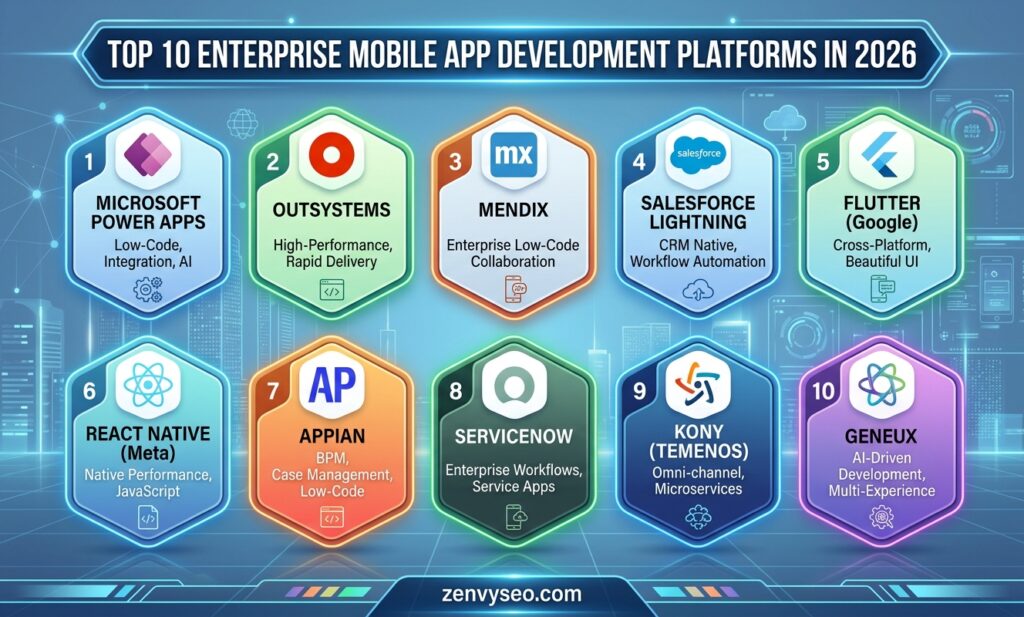
Top 10 Enterprise Mobile App Development Platforms
Here’s a breakdown of the leading platforms driving enterprise mobile app development in 2026. Each platform is evaluated on its core strengths, ideal use case, and notable features.
| Platform | Best For | Key Strength |
| Mendix | Rapid low-code dev | Visual modeling + microservices |
| OutSystems | Complex enterprise apps | Full-stack scalability |
| Microsoft Power Apps | Microsoft ecosystem | Seamless M365 integration |
| Kintone | Team collaboration | Business process apps |
| Salesforce Platform | CRM-driven apps | Customer data + analytics |
| Twilio | Communication apps | SMS, voice, video APIs |
| SAP Mobile Services | SAP-connected enterprises | Secure mobile backend |
| IBM Mobile Foundation | Regulated industries | Security + offline support |
| Zudy (Vinyl) | No-code enterprise solutions | Fast deployment |
| Appgyver | Prototyping + citizen devs | Free no-code builder |
1. Mendix
Mendix is consistently ranked as a leader in the Gartner Magic Quadrant for low-code application development. It allows enterprise teams to build web and mobile apps through visual modeling, with support for microservices architecture and cloud-native deployment options including Mendix Cloud (AWS), private Kubernetes, and SAP BTP.
Key Features:
- Drag-and-drop visual development
- Built-in templates and reusable modules
- Strong governance and version control
- Integrates with REST, OData, Kafka, SAP, and SQL
Best For: Enterprise development teams that need rapid application development at scale without sacrificing architectural control.
2. OutSystems
OutSystems is a powerhouse in enterprise mobile app development, built for organizations that need high-performance, full-stack applications with complex workflows and integrations. It’s particularly well-regarded for omnichannel delivery — letting teams build and deploy consistently across web, iOS, and Android.
Key Features:
- Visual development with advanced customization
- DevOps lifecycle management tools
- Strong integration with legacy systems and APIs
- Real-time performance monitoring
Best For: Large enterprises requiring scalable, mission-critical apps with deep system integration.
3. Microsoft Power Apps
Power Apps is Microsoft’s low-code solution within the broader Power Platform ecosystem. It’s purpose-built for teams already operating within Microsoft 365, Azure, or Dynamics environments — making integration near effortless. The Common Data Model allows logic and data to be shared across multiple apps, which is a major time-saver for enterprise operations.
Key Features:
- Seamless connectivity with SharePoint, Teams, Dataverse, Power Automate
- Strong governance and security controls
- Ideal for departmental and workflow automation apps
- Used by tens of millions of enterprise users worldwide
Best For: Organizations embedded in the Microsoft ecosystem looking to accelerate internal app development.
4. Kintone
Kintone is a collaborative business application platform designed for teams that need to manage workflows, track data, and build process-driven apps without deep technical knowledge. Its modular architecture allows business users to create custom apps, databases, and dashboards.
Key Features:
- Drag-and-drop app builder for non-developers
- Workflow automation with notification triggers
- Strong team collaboration features
- API integration support
Best For: Teams managing structured business processes that need flexibility without complex development overhead.
5. Salesforce Platform
For businesses where customer data sits at the core of operations, the Salesforce Platform is a natural fit for enterprise mobile app development. It extends Salesforce’s CRM capabilities into fully custom mobile experiences using tools like Salesforce Mobile SDK, App Builder, and the new Agentforce AI features.
Key Features:
- Deep CRM and analytics integration
- Mobile SDK for iOS and Android
- AI-powered automation via Agentforce
- AppExchange marketplace for pre-built extensions
Best For: Sales-focused enterprises, customer service teams, and CRM-dependent mobile workflows.
6. Twilio
Twilio takes a different approach — rather than a traditional app builder, it’s a cloud communications platform that lets developers add SMS, voice, video, email, and authentication capabilities to enterprise apps via APIs. It’s a go-to choice when communication is a core feature of your mobile product.
Key Features:
- Programmable SMS, voice, video, and chat APIs
- Flexible, usage-based pricing model
- Trusted by enterprises for two-factor authentication and notifications
- Extensive documentation and developer community
Best For: Enterprises building communication-heavy applications or adding real-time messaging layers to existing systems.
7. SAP Mobile Services
SAP Mobile Services is an enterprise-grade platform within the SAP Business Technology Platform (BTP) ecosystem. It’s designed specifically for organizations running SAP backends who need secure, connected mobile apps that work with their existing enterprise data.
Key Features:
- Mobile application management (MAM) and device management
- Secure backend connectivity with SAP systems
- Push notification and offline sync support
- Analytics and monitoring built in
Best For: SAP-dependent organizations building secure, data-connected mobile experiences for employees or customers.
Also read Rank #1 with Local SEO for Dentists (2026 Guide)
8. IBM Mobile Foundation
IBM Mobile Foundation is a robust enterprise platform that covers the complete mobile app lifecycle — from development and testing to deployment and security management. It’s a strong choice for organizations in regulated industries where data security, encryption, and compliance are non-negotiable.
Key Features:
- End-to-end mobile security and encryption
- Offline data synchronization
- Push notification management at scale
- Supports Cordova, React Native, iOS, and Android apps
Best For: Financial services, healthcare, and government organizations needing enterprise-grade security in their enterprise mobile app development projects.
9. Zudy (Vinyl)
Zudy’s Vinyl platform is a no-code enterprise application builder that allows organizations to deliver sophisticated apps at a fraction of the time and cost of traditional development. It connects to virtually any data source and generates fully functional apps through a configuration-driven approach.
Key Features:
- True no-code configuration (no proprietary scripting)
- Connects to any SQL, REST, or SOAP data source
- Role-based security and access management
- Rapid iteration and deployment
Best For: Enterprises that want to move fast without technical debt, especially for internal tools and operational apps.
10. Appgyver
Now part of the SAP ecosystem, Appgyver (rebranded as SAP Build Apps) is one of the most accessible no-code platforms available. It’s built around a visual logic composer that makes app development approachable for citizen developers, while still supporting complex data flows and custom JavaScript for more advanced use cases.
Key Features:
- Free no-code app builder with a powerful visual interface
- Supports complex data binding and formulas
- Cross-platform deployment (iOS, Android, Web)
- Part of SAP Build for enterprise scalability
Best For: Teams with limited development resources who need to prototype or build internal apps quickly.
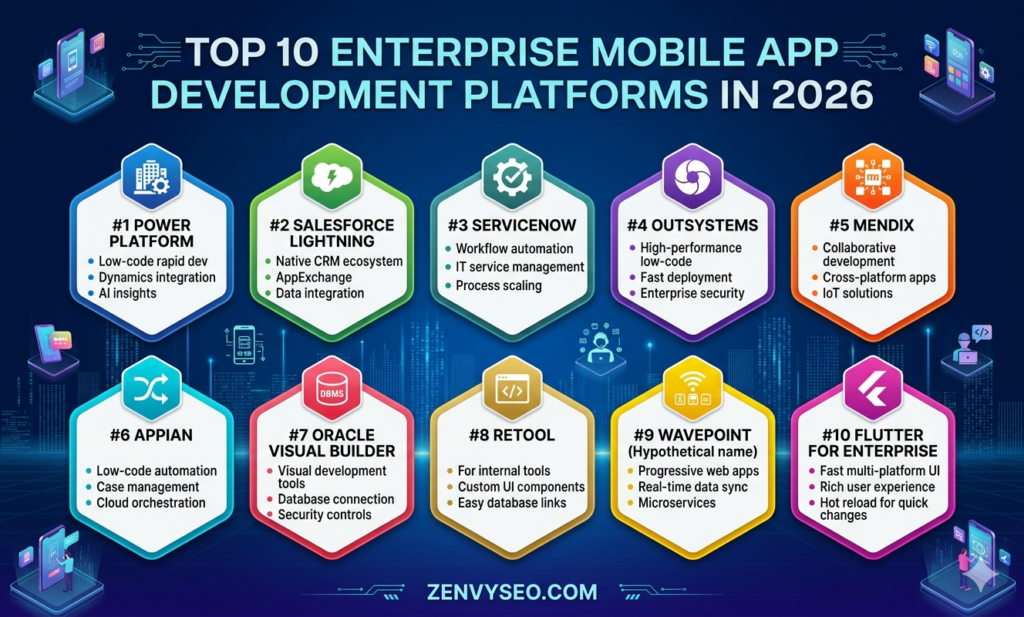
What is the Best Mobile Development Platform?
The best mobile development platform depends entirely on your organization’s specific needs. That said, based on scalability, enterprise readiness, and innovation support:
- Best overall for large enterprises: OutSystems or Mendix
- Best for Microsoft shops: Microsoft Power Apps
- Best for CRM-first organizations: Salesforce Platform
- Best for regulated industries: IBM Mobile Foundation or SAP Mobile Services
- Best for speed and no-code: Zudy (Vinyl) or Appgyver
If you’re unsure which direction fits your roadmap, ZenvySEO recommends starting with a platform audit of your existing tech stack before committing.
Which Mobile Platform is Easiest to Develop For?
For teams with limited developer resources, Mendix and Appgyver (SAP Build Apps) offer the gentlest learning curves. Both feature drag-and-drop interfaces, pre-built templates, and visual logic builders that let non-engineers contribute meaningfully to enterprise mobile app development projects.
Microsoft Power Apps is also highly accessible, particularly if your team is already familiar with Excel or Power Automate workflows — the transition feels natural and the integration setup is minimal.
Best Technology for Mobile Application Development
In 2026, the best technology choices for mobile app development include:
- Low-code platforms (Mendix, OutSystems) — for speed and scalability at enterprise level
- Cross-platform frameworks (Flutter, React Native) — for native-quality apps from a single codebase, reducing development time by up to 40%
- Cloud-native architecture — for apps that scale on demand without infrastructure headaches
- AI-augmented development — platforms like OutSystems, Mendix, and Salesforce now include AI tools that automate testing, suggest logic, and generate UI components
- API-first design — enabling seamless integration across your enterprise tech ecosystem
The market for enterprise mobile app development tools is projected to reach $44.5 billion by 2026, growing at a 19% CAGR — a clear signal that investment in the right platform pays off long term.
Work With an Experienced Mobile Enterprise Application Development Partner
Choosing a platform is only half the battle. The real competitive advantage comes from knowing how to implement it strategically — aligning app architecture with business goals, integrating with existing systems, and building for scale from day one.
At ZenvySEO, we help businesses navigate the full lifecycle of enterprise mobile app development — from platform selection and technical scoping to deployment and performance optimization. Our team brings hands-on experience across low-code platforms, cloud-native architectures, and mobile-first digital transformation.
Are you ready to pick the best mobile development platform and make an enterprise app that works well?
Whether you’re building your first enterprise app or modernizing a legacy system, we’ll help you make confident, informed decisions at every stage.
Get in Touch with Us
Connect with ZenvySEO today for a free consultation on your enterprise mobile app development strategy. Contact our team and let’s build something that scales.
Frequently Asked Questions (FAQs)
Q: What is enterprise mobile app development?
It’s the process of building secure, scalable mobile applications tailored to the complex operational and integration needs of large organizations.
Q: How long does enterprise mobile app development take?
Timelines vary widely — low-code platforms can cut delivery from months to weeks, while fully custom builds may take 6–18 months depending on complexity.
Q: What is the difference between low-code and no-code platforms?
Low-code platforms (like Mendix or OutSystems) allow some custom coding alongside visual tools, while no-code platforms (like Appgyver or Zudy) rely entirely on configuration and visual logic.
Q: Is enterprise mobile app development expensive?
Costs depend on the platform, team size, and complexity. Low-code platforms significantly reduce costs compared to traditional development by minimizing manual coding and shortening timelines.
Q: Which enterprise mobile app development platform is best for security?
IBM Mobile Foundation and SAP Mobile Services are industry leaders for security, particularly for regulated industries like healthcare, finance, and government.
Also read USA’s Top 12 Search Engine Optimization Agencies to Hire