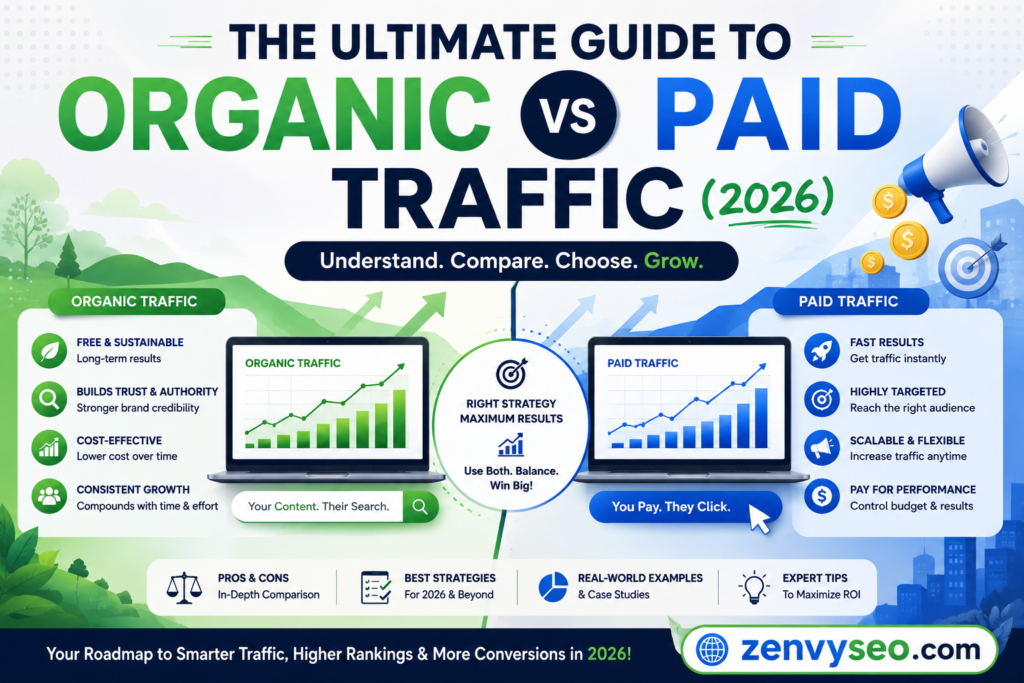
If you’ve ever wondered why some businesses dominate Google overnight while others quietly build unstoppable momentum over months — the answer almost always comes down to Organic vs Paid Traffic strategy.
At ZenvySEO, we work with businesses every day to help them make smarter decisions about where and how to attract website visitors. And the most fundamental question we hear? Should I focus on organic or paid traffic?
This guide cuts through the noise and gives you a clear, honest breakdown of both — so you can build a strategy that actually works for your goals and budget.
What We Mean When We Talk About Traffic
Before diving into the debate, let’s get on the same page. In digital marketing, “Organic vs Paid Traffic” simply refers to the visitors who land on your website. Think of it like foot traffic to a physical store — the more people who walk in, the more potential customers you have.
Website traffic is typically divided into several categories: Organic vs Paid Traffic, direct, referral, and social. But for the purposes of growth strategy, organic and paid are the two that matter most. They are the primary levers businesses pull when they want to grow online visibility and drive conversions.
What Is the Main Difference Between Paid Traffic and Organic Traffic?
The core distinction is simple: Organic vs Paid Traffic is bought.
| Factor | Organic Traffic | Paid Traffic |
| Cost | No cost per click | Pay per click or impression |
| Speed | Slow (months to build) | Immediate |
| Longevity | Long-lasting | Stops when budget ends |
| Trust | Higher user trust | Lower (labeled as “Ad”) |
| Effort | Content + SEO investment | Budget + ad management |
| Click-Through Rate | ~27.6% for #1 spot | ~6.42% average (Google Ads) |
Both approaches have a legitimate role to play. The real question isn’t which is better — it’s which is right for you, right now.
Organic Traffic: An Overview
Organic traffic refers to visitors who arrive at your website through unpaid search results on platforms like Google, Bing, or Yahoo.
When someone types a question into a search engine and clicks on your listing — not an ad — that’s organic traffic. According to recent data, organic search accounts for approximately 53% of all website traffic, making it the single largest traffic source on the internet.
The key thing to understand about organic traffic is that it’s fundamentally about relevance and authority. Search engines reward websites that consistently publish helpful, well-structured content that answers real user questions.
Organic Traffic and Search Engine Optimization
Organic traffic doesn’t happen by accident. It’s the result of a deliberate, ongoing practice known as Search Engine Optimization (SEO). SEO involves:
- Keyword research — understanding exactly what your audience is searching for
- On-page optimization — structuring your pages so search engines can understand them
- Technical SEO — ensuring your site loads fast, is mobile-friendly, and is easy to crawl
- Link building — earning backlinks from authoritative websites in your niche
- Content creation — publishing valuable, in-depth content that matches search intent
At ZenvySEO, we treat SEO not as a one-time task but as an ongoing investment — because that’s exactly what it is.
What Types of Content Are Best for Organic Traffic?
Not all content drives equal organic results. Based on both Organic vs Paid Traffic search engine behavior and real-world performance data, these formats tend to rank best:
Informative Blog Posts
Blog posts that answer common questions, address pain points, and provide actionable advice are the workhorses of organic traffic. Companies that maintain active blogs receive 55% more organic traffic and 97% more inbound links compared to those that don’t.
A well-researched blog post targeting a specific long-tail keyword can quietly send hundreds of visitors per month for years.
Engaging Infographics
Visual content gets shared. Infographics simplify complex data into digestible visuals, and when distributed across platforms like Pinterest or industry publications, they generate both traffic and high-quality backlinks — two things that directly improve your search rankings.
Educational Videos
Video is the fastest-growing content format online. Educational videos hosted on YouTube and embedded on your website give you a presence across two powerful search platforms simultaneously.
YouTube is the world’s second-largest search engine, and ranking a video there can funnel substantial organic traffic back to your site.
Comprehensive Guides and E-Books
Long-form, detailed content signals expertise to both readers and search engines. Pillar pages and comprehensive guides tend to earn strong rankings for competitive keywords because they cover a topic more thoroughly than shorter alternatives.
Case Studies and Success Stories
Case studies build credibility while targeting high-intent search queries. When a potential customer searches for proof that a solution works, a detailed case study can be exactly what converts them — and it ranks well for niche, commercially-minded keywords.
Interactive Content
Quizzes, calculators, and interactive tools drive engagement and reduce bounce rate — both signals that tell Google your content is genuinely useful. Interactive content also earns natural backlinks because other sites reference it as a resource.
Pros of Organic Traffic
Long-Term Traffic
Once your content ranks, it keeps delivering — often for months or years — without any additional spend per click. A well-optimized article published today could still be generating thousands of monthly visitors in 2028. Unlike paid ads, the traffic doesn’t stop the moment your budget does.
Your Rankings Will Improve Over Time
SEO is cumulative. As you build domain authority through consistent content and backlinks, new content ranks faster and for more competitive terms. The longer you invest in organic, the stronger your position becomes.
Stronger Credibility and Trust
Users inherently trust organic results more than paid ads. Ranking at the top of search results signals that Google considers your site an authoritative source — and that perception transfers to your audience. The top organic result on Google is ten times more likely to receive clicks than the tenth-position result.
Improved ROI
The return on investment for organic traffic is among the highest in all of marketing. SEO leads convert at rates significantly higher than outbound strategies, and 49% of marketers identify organic search as their best-performing marketing channel in terms of ROI. The upfront investment pays dividends for far longer than any ad campaign.
Cons of Prioritizing Organic Traffic
Slower Results
This is the most significant drawback. For most websites, meaningful organic traffic growth takes 3 to 6 months minimum, and competitive niches may take much longer. If you need revenue tomorrow, SEO alone won’t save you.
Changes to Search Algorithms
Google updates its search algorithm thousands of times per year — with several major core updates that can shift rankings significantly. A page that ranks #1 today might drop if Google changes how it evaluates content quality, backlinks, or user experience signals.
Dependence on Search
Organic vs Paid Traffic is largely dependent on how search engines perceive your content. If Google decides your niche doesn’t warrant as many featured results, or if zero-click searches rise in your space, your traffic can fluctuate even without any change on your end.
Paid Traffic: An Overview
Paid traffic is exactly what it sounds like: visitors who arrive at your website because you’ve paid to put your content or ads in front of them. When you run a Google Ads campaign and a user clicks your ad, that’s paid traffic. You’ve effectively purchased a shortcut past the organic queue.
What Are the Different Types of Paid Traffic Sources?
Social Media Ads
Platforms like Meta (Facebook/Instagram), LinkedIn, TikTok, and Pinterest offer powerful audience targeting tools. You can reach users based on demographics, interests, behaviors, job titles, and even lookalike audiences built from your existing customers.
Social media ads are especially effective for brand awareness, product launches, and retargeting campaigns.
Paid Ad Campaigns (PPC/SEM)
Pay-per-click campaigns on Google Ads and Microsoft Ads place your listings at the very top of search results — labeled as “Sponsored.” You bid on specific keywords, and every time someone clicks your ad, you pay.
The advantage is immediate visibility for high-intent searches. The average Google Ads click-through rate sits around 6.42%, and campaigns can be paused, scaled, or modified in real time.
Banner Ads
Display advertising through the Google Display Network, programmatic platforms, or direct publisher partnerships puts visual ads on third-party websites your target audience already visits.
While banner ads typically have lower CTRs than search ads, they’re excellent for building awareness and keeping your brand top-of-mind through retargeting.
Paid Traffic and SEO Efforts
Here’s something many businesses miss: paid traffic and SEO aren’t competitors — they’re complements. Running paid campaigns while your organic strategy matures lets you test which keywords convert best.
That data then informs which content to prioritize for SEO. At ZenvySEO, we often use PPC insights to identify the most valuable organic keyword opportunities for clients.
Pros of Paid Traffic
Immediate Results
There’s no waiting period. Launch a campaign today, and you can have targeted visitors on your site within hours. For product launches, seasonal promotions, or any situation where timing matters, paid traffic is unmatched in speed.
Targeted Reach
Paid platforms offer precision targeting that organic search simply can’t match. You can show your ads specifically to 35–45-year-old professionals in a specific city who’ve visited your competitor’s website in the last 30 days.
That level of specificity means less waste and better conversion rates when campaigns are well-managed.
Competitive Advantage
Even if a competitor outranks you organically, you can appear above them with a well-structured paid campaign. Paid traffic lets newer businesses punch above their weight and compete for visibility while their organic authority is still developing.
Cons of Paid Traffic
Paid Traffic Sources Can Get Expensive
Cost-per-click in competitive industries can reach $10, $20, $50, or more per click. Without careful optimization, ad budgets can disappear quickly with limited return. And unlike organic, the moment you stop paying, the traffic stops completely — there’s no residual benefit.
Limited Real Estate
Ad placements are finite. Only a handful of spots appear at the top of each search results page, and you’re competing with every other business in your niche for those positions. Increased competition drives up bidding costs, particularly in saturated markets like legal, finance, and insurance.
Organic vs. Paid Traffic: Which Is Better for Your Business?
Here’s the honest answer: neither strategy wins in isolation. The most effective digital marketing strategies combine both Organic vs Paid Traffic, using paid traffic for immediate results and testing, while building organic momentum for long-term, cost-efficient growth.
Choose to prioritize paid traffic when:
- You need immediate visibility or revenue
- You’re launching a new product or entering a new market
- You want to test messaging and conversion before committing to organic content
Choose to prioritize organic traffic when:
- You’re building for long-term, sustainable growth
- You want to establish authority and credibility in your space
- Your budget is limited and you need strong ROI over time
Use both together when:
- You want to dominate both paid and organic search positions
- You want to use PPC data to guide your SEO keyword strategy
- You’re scaling and need consistent traffic across all stages of the funnel
At ZenvySEO, we help businesses at every stage build traffic strategies that make sense for their goals — not just their budget. Whether you’re just starting or scaling aggressively, the right blend of Organic vs Paid Traffic is the answer.
Conclusion
The organic vs. paid traffic debate doesn’t have a universal winner — it has a right answer for your business at your stage of growth. Organic traffic builds compounding authority, earns long-term trust, and delivers exceptional ROI over time. Paid traffic gives you speed, precision targeting, and flexibility. Together, they form a complete strategy.
Start by understanding your timeline and your goals. If you need results fast, invest in paid campaigns while laying the groundwork for SEO. If you’re playing the long game, content and organic search should be at the core of everything you do.
The businesses that win online aren’t the ones who pick a side — they’re the ones who understand how to use both intelligently. Organic vs Paid Traffic
FAQs
What is the difference between organic and paid traffic?
Organic vs Paid Traffic comes from unpaid search results earned through SEO efforts, while paid traffic comes from ads you pay for on platforms like Google Ads or Meta.
Which is better for a new website — organic or paid traffic?
New websites often benefit most from starting with paid traffic for immediate visibility while building organic authority in parallel through consistent SEO and content creation.
How long does it take to see results from organic traffic?
Most websites begin seeing meaningful organic traffic growth between 3 to 6 months, though competitive niches may take 9 to 12 months or longer.
Does paid traffic help SEO?
Not directly — paid ads don’t improve organic rankings. However, PPC data about converting keywords and audience behavior is extremely valuable for informing and refining your SEO strategy.
Is organic traffic really free?
Organic traffic has no cost per click, but it isn’t truly free — it requires investment in content creation, SEO tools, technical optimization, and link building, all of which take time and money.