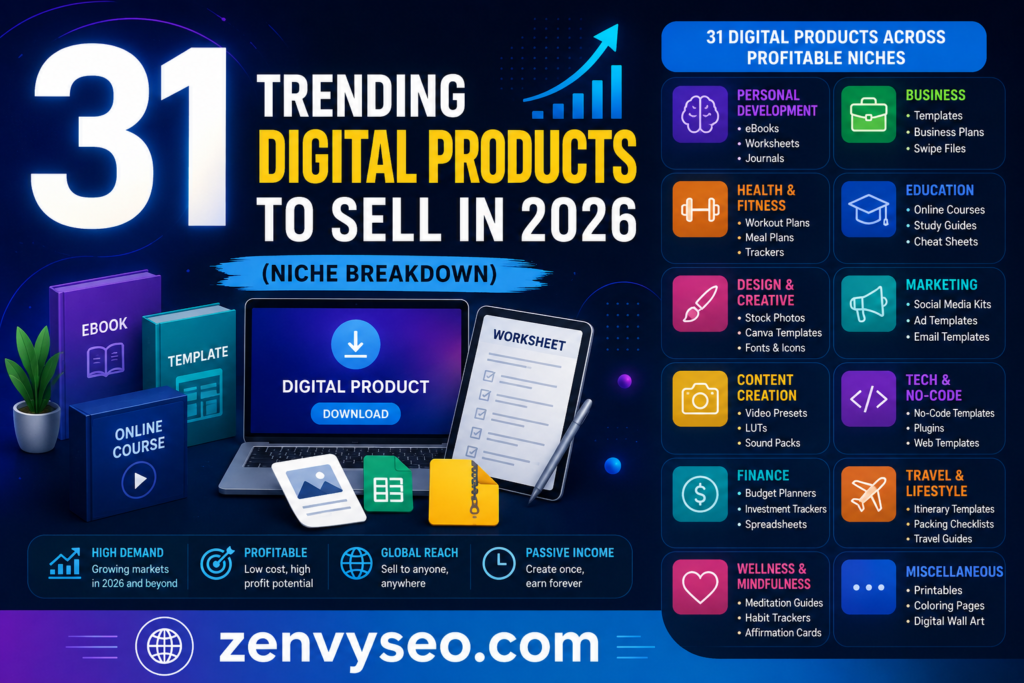
The digital products economy has officially entered its prime. No warehouses. No shipping delays. No inventory headaches. Just a product that gets created once and sells indefinitely. But here is what most beginner sellers miss: the niche you choose matters more than the product itself.
This guide breaks down 31 trending digital products niches for 2026 — organized by product type, backed by real buyer demand data, and designed to help you launch faster with less guesswork. Whether you are an ebook creator, course designer, or template seller, there is a proven spot here for you.
31 Niches at a Glance
Before diving deep, here is a quick-reference overview of the 31 niches Digital Products covered in this guide:
| Product Type | Top Niches |
| Ebooks | AI productivity, personal finance, gut health, career transitions |
| Templates & Printables | Notion dashboards, social media kits, wedding planners, habit trackers |
| Courses & Workshops | AI for non-techies, freelance skills, content creation, coding basics |
| Audio & Audiobooks | Self-help narrations, business summaries, meditation scripts |
| Bundles & Stacks | PLR packs, niche starter kits, done-for-you content systems |
Why Niche Selection Matters for Digital Products
Selling “a productivity ebook” in 2026 is like opening a coffee shop with no name and no menu. Technically, it exists — but no one is walking in.
The digital marketplace is more crowded than ever, which means broad topics lose and specific audiences win. A guide titled “Productivity for Freelance Designers with ADHD” will consistently outsell “How to Be More Productive” — because it speaks directly to a person with a real, urgent problem.
At ZenvySEO, we consistently see this pattern: the sellers generating $3,000–$10,000/month from digital products are not the ones who picked the widest topics. They picked the sharpest ones.
Here is what good niche selection achieves:
- Lower competition — fewer sellers are targeting the exact same buyer
- Higher conversion rates — specific buyers act faster when they feel understood
- Better SEO rankings — long-tail keywords in niche topics are easier to rank for
- Stronger repeat purchases — niche audiences buy multiple products in the same space
Top Ebook Niches for 2026 (Ranked by Buyer Demand)
Ebooks remain one of the lowest-barrier, highest-margin digital products available. They are fast to create, easy to update, and can be sold on a dozen platforms simultaneously. The key in 2026 is micro-specificity.
1. AI Productivity Guides for Professionals
Searches for AI-related guides have more than doubled year-over-year. But the opportunity is not in teaching AI itself — it is in showing specific professionals how to use AI tools in their daily workflow.
Think: “AI Tools for HR Managers” or “Using ChatGPT for Legal Research.” These ebooks price well ($15–$30) because they deliver direct professional ROI.
2. Personal Finance for Specific Demographics
Generic budgeting ebooks are saturated. But personal finance content tailored to Gen Z first-jobbers, freelancers managing inconsistent income, or divorced women rebuilding savings? That is a different market entirely. Buyers feel seen, and that drives purchases.
3. Gut Health, Sleep Optimization & Micro-Wellness
Health ebooks remain perennially strong, but the opportunity has shifted to sub-niches. Broad “fitness” guides face brutal competition.
Gut health for people over 40, sleep optimization for shift workers, or anti-inflammatory eating for busy moms — these micro-niches convert well and face far less noise.
4. Career Transition Playbooks
With job markets shifting and remote work becoming standard, career change guides are booming. Ebooks built around pivoting from a specific role (nurse to UX designer, teacher to corporate trainer) create high reader identification and drive impulse purchases.
5. ADHD, Anxiety & Mental Health for Specific Situations
Self-help psychology was the number one non-fiction e-book category in recent publishing data. The smart play is narrowing the angle — not just “anxiety management” but “managing anxiety as a new parent” or “ADHD systems for remote work.” These ebooks price at $4.99–$12.99 and bundle well with workbooks.
Best-Selling Ebook Categories and Genres
| Category | Competition Level | Avg. Price Range | Best Platform |
| AI & Automation Guides | Medium | $15–$30 | Gumroad, Etsy |
| Personal Finance | High (broad) / Low (niche) | $7–$20 | Amazon KDP, Gumroad |
| Self-Help / Psychology | High (broad) / Low (micro) | $4.99–$12.99 | Amazon KDP |
| Career Transitions | Low–Medium | $10–$25 | Gumroad, own site |
| Gut Health / Micro-Wellness | Low | $9.99–$19.99 | Etsy, Gumroad |
| Romance & Fiction | High | $2.99–$7.99 | Amazon KDP |
| Parenting & Family | Medium | $5–$15 | Amazon KDP, Etsy |
High-Demand, Low-Competition Ebook Niches
If you want to find your sweet spot quickly, aim for niches where buyer intent is strong but established sellers are thin. The following niches currently fit that profile:
- AI workflows for specific job roles (e.g., AI for accountants, AI for real estate agents)
- Remote work optimization systems for parents or introverts
- Minimalist personal finance — debt payoff, FIRE movement for low income
- Menopause & hormonal health — rapidly growing, significantly underserved
- Neurodivergent productivity — ADHD, autism-friendly systems for daily life
- Solopreneur legal basics — contracts, invoicing, taxes for freelancers
Each of these areas draws real search traffic from buyers with urgent needs — and the content that exists is often outdated, thin, or too generic.

Top Template and Printable Niches
Templates and printables offer something ebooks do not: immediate usability. Buyers do not read them — they use them today. That urgency drives faster purchasing decisions and fewer refund requests.
6. Notion Dashboards & Productivity Templates
The Notion template market has matured, but niche dashboards still dominate. A generic “Notion life planner” competes with thousands.
A “Notion CRM for independent insurance agents” or “freelance video editor client portal” faces almost none. Hyper-niche templates on Gumroad regularly generate $5,000–$50,000/month for top sellers.
7. Social Media Content Calendars & Kits
Content creators, coaches, and small businesses constantly need done-for-you post templates, caption formulas, and editorial calendars. Monthly or quarterly social media kits have strong repeat purchase potential — especially when tailored to a specific industry.
8. Wedding & Event Planning Printables
This evergreen niche renews itself every year with new couples. Editable budget trackers, seating chart templates, and timeline planners sell consistently on Etsy. The key is offering both printable and editable digital versions to maximize appeal.
9. Habit Trackers & Wellness Journals
Simple one-page printables — daily habit trackers, gratitude journals, water intake logs — sell individually at $3–$7 or in value bundles at $15–$29. They are fast to design, easy to vary, and searchable on Etsy with strong organic traffic.
10. Teacher & Homeschool Resource Packs
Educational printables are one of the most stable categories on digital marketplaces. Lesson plan templates, worksheet bundles, and classroom organizers have dedicated buyer communities and low seasonal dependency.
Top Course and Workshop Niches
The global online education market is projected to reach over $200 billion in 2026. But buyers have become more selective — they want transformation, not just information. The winning courses in 2026 deliver measurable outcomes fast.
11. AI for Non-Technical Professionals
This is arguably the single hottest course niche right now. Lawyers, HR professionals, healthcare workers, and small business owners all want to use AI — but don’t know where to start. A course that bridges that gap for one specific profession has enormous pricing power ($97–$297+).
12. Freelance Business Foundations
New freelancers need practical systems: client acquisition, project management, invoicing, and contracts. A course built around one freelance specialty — copywriting, design, bookkeeping — converts well because the audience has a specific, urgent goal.
13. Content Creation & Monetization
Short-form video strategy, newsletter growth, podcast launching, and YouTube SEO all fall under this umbrella. These courses sell consistently because the creator economy continues to attract newcomers every month.
14. Canva Design for Business Owners
Non-designers who run businesses are an enormous, permanently growing audience. A workshop on creating branded templates, social media graphics, and marketing materials in Canva is low competition and high perceived value.
15. Coding Basics for a Specific Outcome
“Learn to code” is saturated. “Build a client-ready Shopify store in a weekend” or “Automate your invoicing with Google Sheets macros” is not. Outcome-specific coding workshops attract buyers who want results, not education for its own sake.
Must read “cold-emails-that-actually-get-responses“
Top Audio and Audiobook Niches
Audiobooks are one of the fastest-growing digital products formats globally. The format suits busy professionals, commuters, and people who simply prefer listening over reading.
16–20. Top Audio Product Niches for 2026
- Self-help narrations — Audio versions of short ebooks or guides in the mental health, productivity, and finance spaces
- Business book summaries — 20–30-minute audio summaries of popular business titles (ensure copyright compliance)
- Guided meditation scripts — High repeat-listen value; pairs well with wellness ebooks
- Language learning audio packs — Phrase guides, pronunciation exercises, dialect-specific content
- Bedtime stories for adults — Stress-reduction audio; growing niche with minimal competition
Capitalise on Audiobook Demand
If you have already written an ebook, converting it to audio is one of the highest-leverage moves in digital products. The content is done — you simply need narration and basic audio production. Platforms like ACX, Findaway, and Gumroad allow direct audiobook distribution with strong royalty rates.
How to Validate a Digital Product Niche
Before you spend a week building a Digital Products, spend 30 minutes validating the idea. Here is the framework ZenvySEO recommends:
Step 1: Search Volume Check Use Google Trends or a keyword tool to confirm your core topic gets 1,000–10,000 monthly searches. Higher is great; lower suggests the market may be too small.
Step 2: Marketplace Proof Search your niche on Etsy and Gumroad. If you see products with 500+ reviews, that is proof of demand. If you see nothing — that is either opportunity or a warning sign. Dig deeper before deciding.
Step 3: Competitor Analysis Look at the top 5 sellers in your niche. Are their products outdated? Are reviews mentioning gaps? That is your entry point — build the version buyers are already asking for.
Step 4: Product-Niche Fit Match the format to the problem type:
| Buyer Need | Best Product Format |
| Understanding a concept | Ebook or guide |
| Taking action quickly | Template or printable |
| Guided implementation | Mini-course or workshop |
| On-the-go learning | Audiobook or audio guide |
Step 5: Score It Rate your niche on: demand (1–5), competition gap (1–5), pricing power (1–5), build speed (1–5), and upsell potential (1–5). A score of 18+ means build now. Below 14 — niche down further or move on.
Trending Niches by Platform
Different platforms attract different buyers. Matching your niche to the right marketplace significantly impacts your organic reach and sales velocity.
| Platform | Best-Performing Niches |
| Etsy | Printables, planners, wedding templates, educational packs, SVG files |
| Gumroad | Notion templates, ebooks, AI guides, design assets, code resources |
| Amazon KDP | Romance, self-help, personal finance, parenting, hobby guides |
| Teachable / Udemy | Skills courses, business foundations, design, coding, marketing |
| Own Website / Shopify | Premium bundles, membership content, high-ticket courses |
The Product Stack Strategy
The smartest digital products sellers do not build one product. They build a stack — a sequence of products within a single niche that moves buyers from free to paid, and from entry-level to premium.
A well-built stack looks like this:
- Free lead magnet — A short PDF or checklist that captures email addresses and demonstrates your expertise
- Low-ticket ebook ($7–$20) — The first paid product; validates demand and builds buyer trust
- Mid-ticket template bundle ($20–$60) — Actionable tools that complement the ebook and increase buyer transformation
- High-ticket course or membership ($97–$497+) — The premium offer for serious buyers who want full implementation support
Each product feeds the next. The lead magnet sells the ebook. The ebook creates demand for the templates. The templates warm up course buyers.
This structure turns one-time buyers into repeat customers — and that is what separates a passive income stream from a passive income business.
Build Your Product Stack with AI
One of the biggest shifts in 2026 is that AI tools have dramatically shortened the time from niche idea to finished product. Ebooks that once took weeks now take days.
Template sets that required design expertise now have accessible starting points. Course outlines that needed hours of structure work can be drafted in minutes.
The barrier to entry has dropped — which means your niche clarity and marketing are now the real competitive advantages. Use AI to accelerate creation; use research and positioning to ensure it actually sells.
Conclusion
The digital products market in 2026 is not a question of whether there is opportunity — there is more than ever. The only question is whether you pick the right niche and execute with intention.
Start specific. Choose one product type that fits your existing knowledge or skills. Validate it with search data and marketplace research. Launch a minimum viable version. Then build the stack around it.
At ZenvySEO, our advice is always the same: a small, focused product for a specific buyer will beat a broad, polished product for everyone — every single time. Pick your niche, validate your idea, and start building this week.
Frequently Asked Questions
What are the most profitable digital products to sell in 2026?
The most profitable categories are AI skill guides, niche ebooks, Notion and productivity templates, social media content kits, and outcome-focused mini-courses — particularly when tailored to a specific audience.
How do I find a low-competition digital product niche?
Use Google Trends to confirm search demand, then check Etsy and Gumroad for existing products. If you see high demand but few high-quality offerings, that is your gap.
Can beginners realistically make money selling digital products?
Yes. Printables, templates, and short ebooks are beginner-friendly formats that require minimal production cost and can be tested quickly on platforms like Etsy and Gumroad.
What is the product stack strategy?
It is a system where you create a series of related products — from a free lead magnet to a premium course — all within the same niche, so each product naturally leads buyers to the next.
Which platform is best for selling digital products?
It depends on your niche. Etsy works best for printables and templates. Gumroad suits ebooks and creator tools. Amazon KDP is best for longer-form ebooks and audiobooks. For higher-ticket products, your own website or Shopify gives you full control over pricing and customer relationships.