
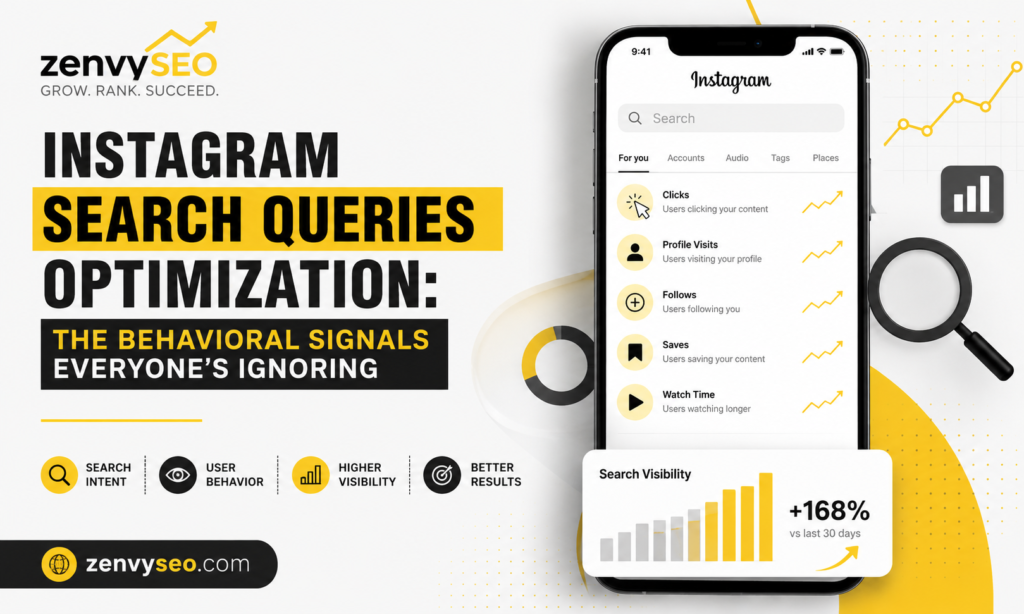
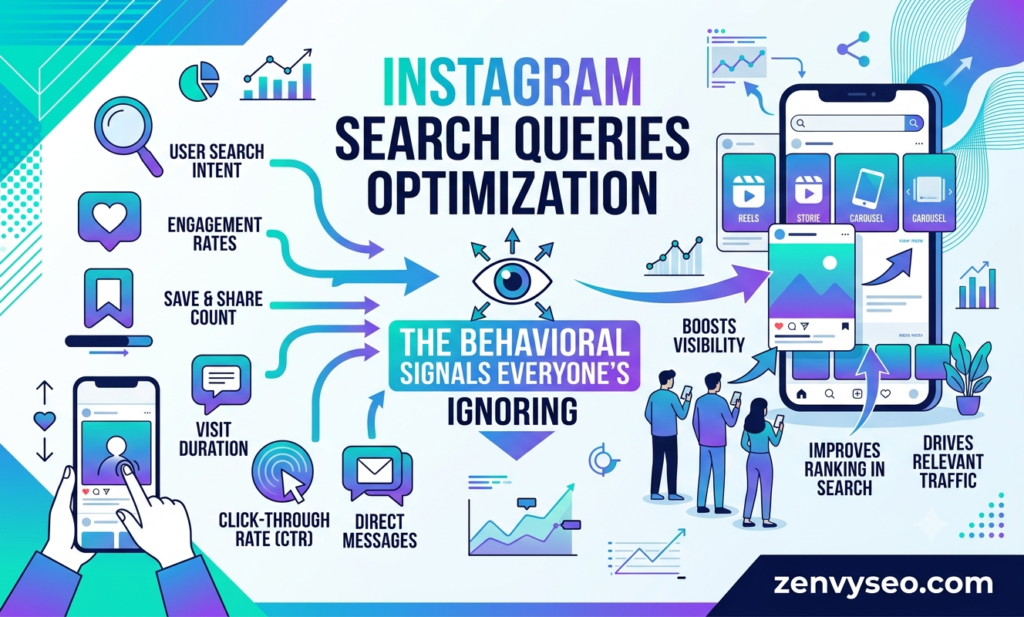
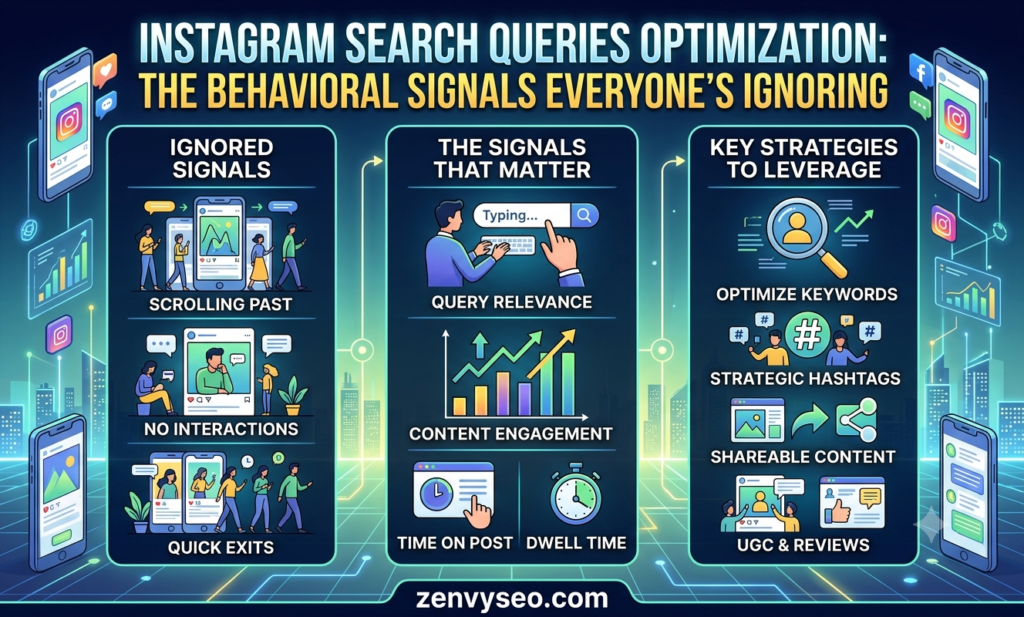
Most people think Instagram Search Queries Optimization is only about hashtags and keywords. But Instagram also watches how users behave after they search. Clicks, profile visits, follows, saves, and watch time can affect visibility.
Content that keeps people engaged often ranks higher in search results. Understanding these behavioral signals can help you reach more people organically. Smart creators optimize for user actions, not just search terms.
Why Search Intent Mapping Fails Without User Behavior Context
Most marketers approach Instagram search queries optimization the same way they approach keyword research for a blog — find a term, use it in your caption, repeat. The problem? That’s only half the equation.
Instagram’s search environment is behavioral at its core. The algorithm doesn’t just evaluate whether your content contains the right words. It tracks what users do after they find you. Did they save the post? Visit your profile? Watch your Reel through to the end? Or did they swipe away in two seconds and search again with different phrasing?
That post-discovery behavior is the data that actually determines your long-term search visibility. Get the keyword right but fail to satisfy the searcher, and your ranking quietly drops over time.
The Difference Between Keyword Matching and Intent Satisfaction
Keyword matching gets your content indexed. Intent satisfaction keeps it ranked.
Think of it this way: if someone searches “content strategy tips” and finds your post, but immediately backs out and refines their search to “content strategy tips for freelancers,” Instagram registers a mismatch. Your content showed up but didn’t deliver. Over time, your post loses visibility for that query — not because of the words you used, but because of the behavior you triggered.
This is why Instagram search queries optimization built purely on keyword logic tends to plateau. The algorithm is measuring search completion, not just search presence. A genuine Instagram SEO strategy needs to account for both.
| Signal Type | What It Measures | Why It Matters for Search |
| Keyword relevance | Caption, bio, alt text match | Gets you indexed |
| Save rate | Content utility | Signals intent was satisfied |
| Watch time | Reel retention | Indicates value delivery |
| Search refinement | Post-click dissatisfaction | Reveals content gaps |
| Profile visits | Deeper interest beyond one post | Builds topical authority |
What Instagram’s Algorithm Actually Looks At (And It’s Not What You Think)
Here’s what the top-performing accounts understand about Instagram search queries optimization that most people miss: the algorithm processes behavioral signals across your entire account, not just individual posts.
Instagram’s ranking system has moved well beyond hashtag matching. Today, it analyzes semantic relevance through what industry observers describe as vector embeddings — meaning the algorithm understands content context, not just keywords. It reads your captions, processes your on-screen text, interprets your audio, and scans your visuals. Then it cross-references all of that against what the searcher has previously watched, saved, and engaged with.
The four core ranking signals in play right now are:
- Keyword relevance — Your bio, display name, captions, and alt text alignment with searched terms
- Engagement quality — Saves and DM shares carry far more weight than likes
- Recency and consistency — How recently and how often you’ve posted on a given topic
- Personalization — Whether the person searching already engages with content similar to yours
No two users see identical search results. A brand search for “email marketing tips” returns different accounts for a digital agency owner versus a small business baker. Instagram is running individualized ranking for every query, which makes the behavioral layer of Instagram search queries optimization non-negotiable.
Also read 9 Growth Navigate Startup Tools That Will Actually Scale Your Business in 2026
Cross-Signal Validation and Topical Consistency
One underrated aspect of Instagram search queries optimization is what you might call cross-signal validation — the process by which Instagram confirms your expertise by checking whether your engagement signals, content themes, and keyword usage all point to the same topic.
An account that posts consistently about skincare, uses skincare-related keywords in every caption, earns saves from people who also follow skincare creators, and gets DM shares between people discussing routines — that account builds topical authority fast. The signals don’t just add up; they compound.
The opposite is also true. Posting across wildly different topics sends conflicting signals. Instagram doesn’t know what category to recommend you in, so you end up ranking for nothing consistently.
Practical implication: Define two to three content pillars and hold them. Every post should strengthen at least one pillar. This isn’t creative limitation — it’s how Instagram search queries optimization actually works at the algorithm level.
How Engagement Recency Compounds Search Visibility
Recency is a ranking signal that most Instagram growth guides mention briefly and move past. It deserves more attention.
When a post earns saves, shares, and comments close to its publish date, Instagram reads that as a sign of current relevance. That recent engagement boosts the post’s search visibility — not just on day one, but for weeks afterward if the signals stay strong.
Here’s the compounding effect: a post with strong early engagement gets surfaced in search results. New searchers find it, some of them engage, which refreshes the engagement recency signal, which maintains the ranking, which brings in more searchers. This is how smaller accounts with 3,000 followers can consistently outrank accounts with 50,000 on specific queries.
Instagram search queries optimization strategies that chase follower counts are missing this. You’re building the wrong metric.
How to Structure Content Around Search Completion Patterns
Open Instagram. Type a broad keyword into the search bar. Stop before you hit enter.
Those autocomplete suggestions — that’s your research. Every completion that appears represents a real, high-volume search pattern from real users. Instagram’s autocomplete is its equivalent of Google’s “People Also Search For.” It shows you what users actually type, not what you assume they search for.
For Instagram search queries optimization, these completion patterns are gold because they reveal intent before you create a single piece of content.
Identifying High-Intent vs. Informational Completion Patterns
Not all search completions carry the same commercial weight. Understanding the difference helps you prioritize your content calendar.
High-intent completions suggest the user is ready to act:
- “Instagram growth service”
- “best SEO tools for Instagram”
- “Instagram analytics app”
- “how to grow Instagram fast for business”
Informational completions suggest the user is learning:
- “Instagram algorithm explained”
- “what is Instagram SEO”
- “how does Instagram search work”
- “Instagram tips for beginners”
Both matter for Instagram search queries optimization, but they require different content formats and different calls to action. High-intent queries deserve content that moves people toward a decision. Informational queries deserve content that builds trust and keeps people on your profile.
A strong optimization strategy addresses both — and connects them. An informational Reel about how Instagram search works can reference a saved carousel about the tools that help you act on it. That internal content journey signals topical depth to the algorithm.
Layering Secondary Keywords Through Related Patterns
Single-keyword optimization is a ceiling. The accounts that dominate Instagram search queries optimization build content around keyword clusters — groups of related search patterns that all serve the same underlying intent.
Take “Instagram content strategy” as a seed term. Related completion patterns might include:
- “Instagram content strategy for small business”
- “Instagram content strategy 2026”
- “Instagram content strategy template”
- “Instagram content strategy tips”
One well-structured carousel can address all four variations naturally. The caption opens with the primary term, the slide content covers the sub-topics, and the alt text uses the long-tail phrasing. You’re not stuffing keywords — you’re covering a topic thoroughly, which is exactly what search intent satisfaction requires.
At ZenvySEO, this is what we call topical breadth within a single asset: one post, multiple search entry points, one coherent piece of content that satisfies users however they arrive.
Also read 23 AI Website Classification Types That Actually Drive Business Decisions (Not Just Data)
Why People Refining Their Searches Is Your Biggest Opportunity
Search refinement is what happens when a user types something, doesn’t find what they need, and tries again with a more specific phrase. It’s a frustration signal — but for the brand that creates the right content, it’s a traffic opportunity hiding in plain sight.
When someone searches “Instagram tips,” scans the results, finds nothing useful, and refines to “Instagram tips for real estate agents” — that refined query almost always has less competition and higher conversion intent than the original.
This is where most brands fail. They optimize for the broad, competitive term. They miss the refined niche query entirely.
Tracking Refinement Patterns Without Native Tools
Instagram doesn’t give you a search refinement dashboard. That doesn’t mean you can’t track them.
Three practical methods:
- Autocomplete mining over time — Search your target keyword weekly and note which completions change or get added. New completions often reflect emerging refinement patterns.
- Non-follower reach analysis — In Instagram Insights, look at your non-follower impressions by content theme. Topics that spike in non-follower reach are likely benefiting from search traffic. Compare which posts in that category are over- or under-performing to infer what queries they’re ranking for.
- Comment and DM language analysis — When someone finds your content through search, they often phrase their comment using the language they searched. Reading comment patterns across a 30-day window reveals how new audiences are describing their problems — which is how they’re likely searching.
None of these methods are perfect. But combined, they give you enough directional signal to identify content gaps worth filling.
Building Search-Optimized Content That Doesn’t Feel Optimized
The worst thing you can do for Instagram search queries optimization is make your content feel like it’s been engineered. Forced keyword placement reads as inauthentic to users — and in 2026, inauthenticity is punished fast.
The goal is content that earns strong engagement signals naturally, because that’s what actually drives search ranking over time. Optimization is structural; it shouldn’t be visible.
Using Conversational Keywords Over Formal Phrases
Formal keyword language: “Optimal social media content strategy methodologies”
Conversational keyword language: “how to actually build a content strategy that works on Instagram”
The second version is how people search. It’s also how people talk. When your captions use the same phrasing your audience types into the search bar, you create a natural alignment between your content and their queries — without the awkward over-optimization that triggers spam filters and puts people off.
This is the single biggest shift in Instagram search queries optimization for 2026: write for voice, not for indexing. Ask yourself what your target audience would literally type on their phone, then use that phrasing in your caption’s opening lines.
Where Optimization Actually Matters (and Where It Doesn’t)
Not every element of a post needs keyword optimization. Trying to optimize everything dilutes the impact of the places where it genuinely moves the needle.
| Content Element | Optimization Priority | What to Do |
| Display name | Critical | Include your primary keyword/niche descriptor |
| Bio first line | Critical | State who you help and how, using searched terms |
| Caption opening | High | Lead with your core topic phrase naturally |
| Alt text | High | Describe visuals using relevant keywords |
| Hashtags | Medium | Use 3–5 precise topical tags, not broad ones |
| Story text | Low | Conversational; optimize only when directing traffic |
| Audio name | Low | Rename original audio to reflect the topic |
Concentrate your optimization effort on display name, bio, caption opening, and alt text. Those four surfaces account for the majority of how Instagram categorizes and ranks your content in search results.
Tracking Search Performance Without Native Analytics
Instagram doesn’t hand you a keyword ranking dashboard. This frustrates brands who want precise data — but it doesn’t mean you’re flying blind. You just have to build proxy measurements.
Also read “Group Buy” SEO Tools — Pros, Cons, and Better Alternatives to Consider
Creating Content Experiments to Isolate Search Performance
The cleanest way to measure Instagram search queries optimization performance is to run controlled content experiments. Here’s a simple framework:
- Pick a specific keyword cluster (e.g., “Instagram growth tips for small business”)
- Create two posts targeting that cluster with different caption structures — one leading with the keyword phrase, one leading with a hook that implies it
- Post them 5–7 days apart at similar times
- Compare non-follower reach in Insights at the 2-week mark
The post that earns significantly more non-follower reach is likely performing better in search. Over multiple experiments, patterns emerge about which caption structures, formats, and keyword placements drive the most search-sourced traffic.
This takes time to build a dataset, but it’s the most reliable method available without third-party tools.
Using Story Stickers to Gather Search Intelligence
Story question boxes and poll stickers are underused research tools for Instagram search queries optimization.
When you use a poll sticker asking “Which of these would you search for first?” and give two keyword options, you’re collecting real data about how your audience phrases their search intent. Run this consistently across different topics and you build a picture of the exact language your followers use — which closely mirrors how non-followers in the same niche search.
Question box stickers reveal something even more valuable: what your audience can’t find on Instagram. The questions people ask you directly are often the queries they’ve already searched and found unsatisfying. That’s a content calendar built from real search gaps.
At ZenvySEO, we recommend running at least one search intelligence Story per week. It costs five minutes and returns audience language data that informs your Instagram search queries optimization strategy for months.
The Search Optimization Reality Check
Here’s what nobody in this space says clearly enough: there is no fast track with Instagram search queries optimization.
The accounts consistently outranking competitors on Instagram search aren’t doing anything exotic. They’ve identified a tight niche, created content that genuinely answers real search intent, built engagement recency through consistent posting, and let the behavioral signals accumulate over months.
What they’re not doing:
- Chasing follower counts as a proxy for authority
- Stuffing captions with keyword variations
- Posting generic content across unrelated topics
- Ignoring post-search behavior data
- Treating hashtags as their only discoverability strategy
Instagram search queries optimization in 2026 is behavioral SEO applied to a social platform. The mechanics are different from Google, but the underlying logic is identical: match the right content to the right intent, deliver on that intent once the user arrives, and build signals of trust and authority over time.
The brands winning right now on Instagram search aren’t the largest. They’re the most consistent, the most specific, and the most committed to understanding what their audience actually searches for — then creating content that genuinely satisfies that search.
FAQs
What is Instagram search queries optimization?
It’s the process of structuring your Instagram profile, captions, and content so the algorithm surfaces your account when users search for relevant terms — combining keyword placement with behavioral signal optimization.
How does Instagram’s search algorithm rank content?
Instagram ranks content based on keyword relevance (bio, captions, alt text), engagement quality (saves and DM shares), posting recency and consistency, and personalized user behavior data.
Why do saves matter more than likes for Instagram search?
Saves signal that content solved a real need — making them a strong indicator of intent satisfaction. Likes indicate passive appreciation but don’t confirm the search was completed successfully.
What are search completion patterns on Instagram?
They’re the autocomplete suggestions Instagram shows when a user starts typing a query. These patterns represent high-volume real searches and are one of the most actionable research tools for Instagram search queries optimization.
How do I track Instagram search performance without native tools?
Use Instagram Insights to monitor non-follower reach by content theme, run controlled content experiments with different caption structures, and use Story question stickers to gather search language directly from your audience.
Also read How to Write the Best Guest Blog for Someone Else’s Website