
Most companies buy AI classification tools and then try to figure out what to do with the data. That’s completely backwards. The businesses winning right now started with the decisions they needed to make — then chose the right AI website classification types to support those decisions.
At ZenvySEO, we’ve watched companies spend six figures on classification tools only to end up with beautifully organised data graveyards. Classifications exist, dashboards are full, but nothing changes. No budget shifts. No strategy pivots. No competitive advantage gained.
This guide covers all 23 AI website classification types — what they actually measure, how accurate they are, and critically, which business decisions they enable. Read this before you invest in another AI intelligence platform.
TL;DR
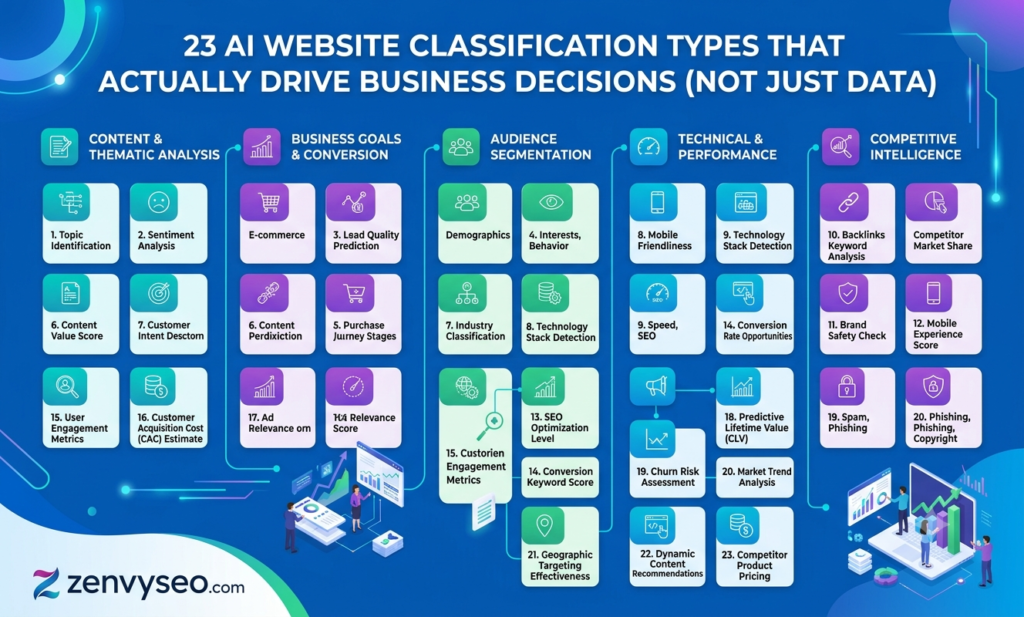
AI website classification types fall into four strategic layers: content, behavioral/technical, compliance/risk, and business intelligence. Most organisations need three to five types maximum. Start with the specific decisions you need to make, then work backwards to the classification types that inform those decisions. Everything else is expensive noise.
| Classification Layer | Types Covered | Primary Business Use |
| Content-Based | Types 1–7 | Audience targeting, content strategy |
| Behavioral & Technical | Types 8–13 | UX benchmarking, competitive analysis |
| Compliance & Risk | Types 14–18 | Legal protection, brand safety |
| Business Intelligence | Types 19–23 | Revenue growth, market strategy |
Why Most Businesses Get AI Website Classification Wrong
There’s a predictable pattern in how organisations fail with AI website classification. They treat it as a data collection exercise rather than a decision-making tool.
The result? Expensive dashboards full of classifications that don’t connect to strategy. The question to ask before selecting any AI website classification type isn’t “what can we measure?” It’s “what decision does this help us make?”
Three common mistakes ZenvySEO sees repeatedly:
- Collecting too many classification types — more data doesn’t equal better decisions
- Choosing classification before defining the question — backward logic that wastes budget
- Prioritising accuracy over explainability — 85% accuracy you understand beats 95% accuracy you can’t explain
With that framing established, here are the 23 AI website classification types that actually matter.
Content-Based Classification: The Foundation Layer
Content-based AI website classification analyses what a website says — its topics, tone, quality, and intent. These types form the bedrock of any classification strategy.
Also read “Group Buy” SEO Tools — Pros, Cons, and Better Alternatives to Consider
1. Industry Vertical Classification
This classifies websites into industry categories: SaaS, healthcare, finance, legal, e-commerce, and so on. Modern NLP models using architectures like BERT achieve accuracy between 83–92% across industry classes.
Business decision enabled: Which prospects belong in which sales pipeline? Which ad placements are contextually relevant?
2. Content Topic Taxonomy
This goes deeper than vertical classification, mapping the specific subjects a website covers within its industry. A healthcare website might cover oncology, paediatrics, or telehealth — topic taxonomy tells you which.
Business decision enabled: Content gap analysis, partnership targeting, editorial planning.
3. Content Sentiment and Tone Analysis
AI website classification for sentiment evaluates whether content is positive, negative, neutral, authoritative, conversational, or promotional. This matters more than most marketers realise — placing ads alongside negative content destroys brand perception.
Accuracy range: 78–88% for nuanced tone detection.
Business decision enabled: Ad placement safety, partnership suitability, competitor messaging analysis.
4. Content Quality and Authority Scoring
This AI website classification type scores websites on E-E-A-T signals: depth of expertise, author credentials, citation quality, factual accuracy, and content freshness. Google’s own quality raters use similar frameworks.
Business decision enabled: Which sites to pursue for backlinks? Which publishers should you avoid associating with?
5. Content Maturity and Age-Appropriateness
Classification systems evaluate whether content is suitable for general audiences, adult users, or specific age groups. This is foundational for parental control platforms, advertising networks, and any brand with family-oriented positioning.
Business decision enabled: Audience safety, ad targeting restrictions, regulatory compliance.
6. Content Format and Media Type
This type identifies whether a website primarily delivers text articles, video content, podcasts, interactive tools, infographics, or a combination. Format classification informs content strategy and platform partnerships.
Business decision enabled: Which content formats does your target audience prefer? Where should you build distribution partnerships?
7. Semantic Intent Classification
Semantic intent AI website classification goes beyond topic to understand why content exists. Is it informational, transactional, navigational, or commercial? This maps directly to buyer journey stages.
Business decision enabled: Matching advertising messaging to audience intent, identifying high-intent prospects.
Behavioral and Technical Classification: Reading Between the Lines
Behavioral and technical AI website classification types reveal how websites operate rather than what they say. These classifications often expose the strategic intent behind a site’s design choices.
8. User Experience and Accessibility Classification
This evaluates site speed, mobile responsiveness, navigation clarity, accessibility compliance (WCAG standards), and overall usability. UX quality correlates strongly with conversion performance.
Business decision enabled: Competitive benchmarking, acquisition targeting (poorly performing sites with good content represent acquisition opportunities), partnership quality assessment.
9. Conversion Architecture Classification
One of the most commercially valuable AI website classification types, this analyses landing page structure, CTA placement, funnel design, and persuasion elements. You can reverse-engineer what’s working across competitor sites.
Accuracy range: 82–89% for identifying high-performing conversion patterns.
Business decision enabled: CRO strategy, competitor analysis, acquisition targeting.
10. Security and Trust Signal Detection
This classification type identifies SSL certificates, trust badges, security headers, GDPR compliance signals, and other indicators of site credibility. For B2B buyers, these signals matter significantly in vendor selection.
Business decision enabled: Partnership vetting, ad placement quality, vendor due diligence.
11. Technology Stack Identification
Technology detection is among the highest-accuracy AI website classification types, achieving 95–99% accuracy. It identifies CMS platforms, analytics tools, marketing automation systems, CDN providers, and ecommerce frameworks.
Business decision enabled: Prospect qualification (if a prospect uses your integration partner’s tools, they’re a warmer lead), competitive intelligence, partnership targeting.
12. Traffic Pattern and Audience Classification
This classifies websites by audience demographics, geographic distribution, traffic sources, and engagement patterns. Note: this is also among the lower-accuracy classification types (around 70–78%) due to data limitations.
Business decision enabled: Media buying, audience targeting, partnership audience analysis.
13. Monetization Model Detection
AI website classification for monetization identifies how a site generates revenue: advertising, subscriptions, lead generation, affiliate marketing, e-commerce, or SaaS. This reveals strategic priorities and business model signals.
Business decision enabled: Partnership opportunity assessment, competitive business model analysis, acquisition targeting.
Also read How to Write the Best Guest Blog for Someone Else’s Website
Compliance and Risk Classification: Protection Before Problems
These AI website classification types are the ones businesses most commonly underinvest in — until something goes wrong. Compliance classification protects budget, brand, and legal standing.
14. Regulatory Compliance Classification
This evaluates whether websites meet industry-specific regulatory requirements: GDPR for European audiences, HIPAA for healthcare, FTC guidelines for advertising, COPPA for children’s content. Accuracy is high (88–94%) for major regulatory frameworks.
Business decision enabled: Partnership vetting, ad placement compliance, vendor qualification.
15. Brand Safety and Suitability Scoring
Brand safety AI website classification assesses whether content surrounding ad placements is suitable for your brand. This goes beyond blocking obvious inappropriate content — suitability scoring evaluates tone, controversial topics, and contextual risk.
This is non-negotiable for programmatic advertising. ZenvySEO has seen clients waste significant budget on technically safe but strategically unsuitable placements.
Business decision enabled: Programmatic ad targeting, publisher allowlist/blocklist management, sponsorship vetting.
16. Data Privacy Practice Classification
This type classifies websites based on their data collection practices, cookie policies, privacy policy quality, and data handling disclosures. With privacy regulations tightening globally, this classification has moved from nice-to-have to essential.
Business decision enabled: Partnership risk assessment, vendor due diligence, regulatory risk management.
17. Legal Risk and Liability Classification
AI website classification for legal risk identifies signals of copyright infringement, defamation risk, misleading claims, undisclosed advertising relationships, and other liability indicators. This protects organisations from legal exposure through association.
Business decision enabled: Publisher partnership decisions, content syndication risk assessment, acquisition due diligence.
18. Misinformation and Credibility Scoring
This classification type evaluates factual accuracy, citation quality, source credibility, and misinformation risk. In an era where content credibility significantly impacts brand trust, associating with low-credibility sites carries real risk.
Accuracy range: 80–87% — improving but still imperfect.
Business decision enabled: Publisher vetting, ad placement quality, partnership credibility assessment.
Business Intelligence Classification: Where Strategy Meets Execution
These are the AI website classification types that convert data into competitive advantage. They’re the reason ZenvySEO positions classification as a strategic tool, not a data collection exercise.
Also read 12 Creative Project Ideas for Web and Mobile Developers
19. Competitive Intelligence Classification
This AI website classification type maps the competitive landscape: identifying direct and indirect competitors, analysing their content strategies, positioning signals, audience targeting, and messaging gaps.
Businesses that use competitive intelligence classification effectively don’t react to competitor moves — they anticipate them.
Business decision enabled: Market positioning, content strategy, pricing strategy, sales intelligence.
20. Lead Quality and Sales Readiness Scoring
This classifies websites based on signals that indicate purchase intent and sales readiness: pricing page existence, product detail depth, trial or demo offers, case study presence, and contact accessibility.
Accuracy range: 85–91% — high enough to meaningfully prioritise sales outreach.
Business decision enabled: SDR prioritisation, ABM targeting, sales territory planning.
21. Market Trend and Emerging Pattern Detection
This AI website classification monitors shifts in content topics, emerging industry terminology, new competitor categories, and changing audience interests across a defined market landscape.
Think of it as an early warning system. By the time a trend shows up in your analytics, competitors who used trend classification are already six months ahead.
Business decision enabled: Product roadmap planning, content strategy pivots, investor reporting, market expansion decisions.
22. Partnership and Collaboration Opportunity Identification
This classification type identifies websites that serve complementary audiences, offer non-competing products, and share strategic alignment signals. Business complementarity often transcends obvious categorisations — this is one of the AI website classification types where explainability matters most.
Business decision enabled: Business development targeting, distribution partnership identification, co-marketing opportunity assessment.
23. Customer Journey Stage Classification
The final and arguably most strategically powerful AI website classification type maps websites to buyer journey stages: awareness, consideration, decision, and retention.
A site with extensive educational content and no pricing clearly targets awareness. A site with detailed comparison pages, transparent pricing, and multiple CTAs clearly targets the decision stage. AI models achieve 85–91% accuracy here when trained on sufficient examples across journey stages and industries.
Business decision enabled: Content strategy alignment, ad targeting by funnel stage, partner audience stage matching.
How to Choose Classification Types That Matter for Your Business
The mistake most organisations make is selecting AI website classification types based on what’s available rather than what’s needed. Here’s the ZenvySEO framework for making smarter choices:
Step 1 — Define the decision, not the data
List three to five specific business decisions that better intelligence would improve. “Which prospects are worth our sales team’s time?” is a decision. “Understanding our competitive landscape better” is not.
Step 2 — Map decisions to classification types
Each decision maps to specific AI website classification types. Sales prioritisation maps to lead quality scoring and technology stack identification. Ad placement maps to brand safety, sentiment analysis, and industry vertical classification.
Step 3 — Evaluate accuracy requirements
Some decisions tolerate 75% accuracy (trend detection is useful even when imperfect). Others demand higher thresholds (regulatory compliance classification needs 90%+ before you’d rely on it for legal decisions).
Step 4 — Choose real-time vs. batch processing
| Requirement | Best Approach | Trade-off |
| React to competitor changes immediately | Real-time classification | Higher cost |
| Quarterly strategic planning | Batch processing | Lower cost, delayed data |
| Ongoing campaign management | Hybrid approach | Moderate cost |
| One-time market research | Batch processing | Most cost-effective |
Step 5 — Prioritise explainability
For any AI website classification type that will influence significant budget decisions, choose explainable models over pure accuracy. A classification system that tells you why a site was flagged is far more actionable than one that just gives you a score.
The maximum you actually need: Most businesses require three to five AI website classification types. More than that and you’re collecting data that won’t influence decisions — expensive dashboard decoration.
Okay, Wrapping This Up
Here’s what this all comes down to: AI website classification types are only valuable when they’re tied directly to decisions your business needs to make.
The 23 types covered here span four layers — content, behavioral/technical, compliance/risk, and business intelligence. Each layer serves a different strategic function. Most businesses don’t need all 23. They need the three to five that connect most directly to their most important unanswered questions.
At ZenvySEO, our approach is always decision-first. What are you trying to decide? What’s the cost of deciding it wrong? Which AI website classification types give you enough confidence to act? Answer those questions, and the right classification strategy becomes obvious.
The organisations that will win with AI intelligence aren’t the ones collecting the most data. They’re the ones converting the right classifications into the right actions faster than their competitors.
Frequently Asked Questions
What are AI website classification types?
AI website classification types are machine learning-powered frameworks that categorise websites based on content, behaviour, compliance signals, or business characteristics. They help organisations make faster, more accurate decisions about advertising, sales targeting, partnerships, and competitive strategy.
How accurate are AI website classification systems?
Accuracy varies significantly by classification type. Technology stack identification achieves 95–99% accuracy. Regulatory compliance classification runs at 88–94%. Traffic pattern and audience classification is lower, around 70–78%, due to data availability limitations.
How many AI website classification types does a business need?
Most businesses need three to five classification types. More than five typically results in data that doesn’t influence real decisions. Start with the specific business questions you need to answer and select only the classification types that address those questions directly.
What is the difference between brand safety and brand suitability classification?
Brand safety classification filters out clearly inappropriate content (violence, adult material, hate speech). Brand suitability goes further, evaluating whether content is contextually appropriate for your specific brand positioning — even technically safe content can be strategically unsuitable.
Can AI website classification types be used for SEO?
Yes. Several classification types directly support SEO strategy: content quality scoring informs link building target selection, semantic intent classification guides content planning, and competitive intelligence classification reveals content gaps and positioning opportunities.
Also read Custom Mobile App Development: What You Need to Know