
Every digital action you take — clicking a button, searching on Google, making a bank transfer — generates data. Yet most people have only a surface-level understanding of what data actually is, how it works, and why it matters so deeply in today’s world.
At ZenvySEO, we believe that understanding the fundamentals of data is just as important as the strategies built on top of it. Whether you’re running an SEO campaign, building a website, or making a business decision, data is the engine behind every smart move.
This guide breaks down what is data, its types, characteristics, importance, and how it is stored and managed — in plain, actionable language.
What Is Data?
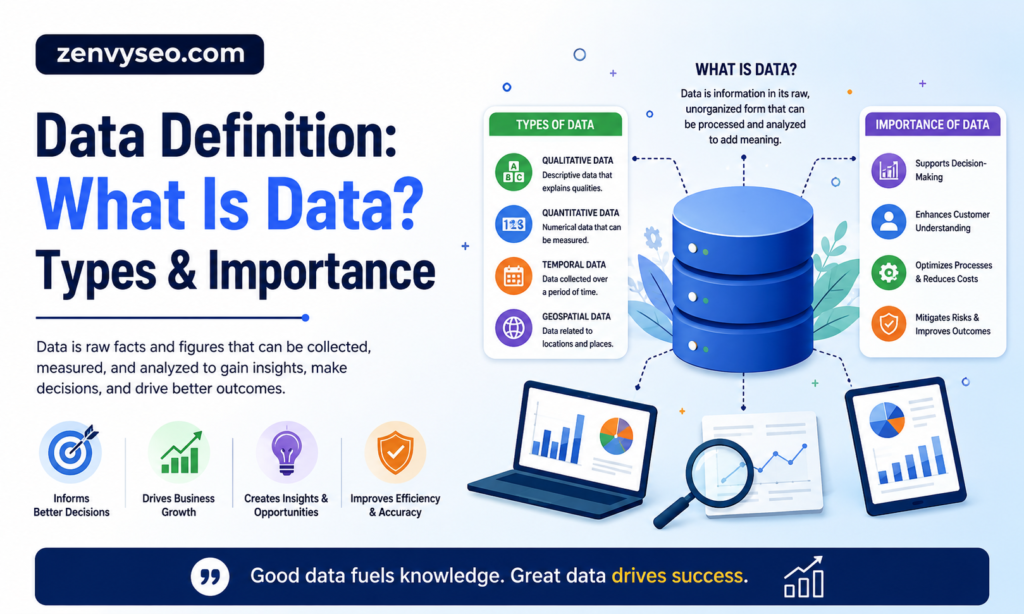
What is data? In the simplest sense, data is a collection of raw facts, figures, symbols, or observations that have not yet been interpreted or given meaning. On its own, a number like “42” means nothing. But when you attach context — 42 sales, 42 degrees Celsius, 42 clicks — it becomes useful information.
What is data in computing terms? In a digital system, data is anything that can be stored, processed, or transmitted by a computer. It can be text, numbers, images, audio, video, or binary code. Computers store everything as binary data — sequences of 0s and 1s known as bits.
What is data in a business context? It is the raw material that businesses convert into insights, strategies, and competitive advantages. Sales figures, customer behaviour patterns, website traffic metrics — all of it starts as data.
Quick Definition: Data is raw, unprocessed information collected from observations, measurements, transactions, or interactions. It becomes “information” once it is processed and given meaning.
Also read Top 10 SEO Experts in London for 2026 | Proven Results & Expertise
Characteristics of Data
Not all data is the same quality or usefulness. Understanding what makes data valuable helps you collect and use it properly.
| Characteristic | Description |
| Accuracy | Data should correctly represent the real-world facts it is meant to capture |
| Completeness | All required data points must be present for valid analysis |
| Consistency | The same data should not contradict itself across different systems |
| Timeliness | Data should be current and available when it is needed |
| Relevance | Only data that serves a specific purpose should be collected and stored |
| Recordability | Data can be captured, stored, and retrieved at a later time |
| Context-dependency | A data point only gains meaning when attached to context |
These characteristics directly impact data quality — a concept central to effective data management, SEO reporting, and business intelligence.
Types of Data
Understanding what is data also means understanding its different forms. Data is broadly classified in several ways:
1. By Structure
- Structured Data — Organized in rows and columns, like an Excel spreadsheet or a SQL database table. Easy to search and analyze. Examples: customer names, order IDs, transaction amounts.
- Unstructured Data — Has no predefined format. Examples include emails, social media posts, video files, and audio recordings. This type makes up roughly 80–90% of all enterprise data.
- Semi-structured Data — A middle ground. It has some organizational properties but does not fit neatly into a relational database. Examples: JSON files, XML, and email headers.
2. By Nature (Statistical Classification)
- Qualitative (Categorical) Data — Descriptive data that groups subjects into categories. Subdivided into:
- Nominal data — Labels with no order (e.g., eye colour, country names)
- Ordinal data — Categories with a meaningful order (e.g., satisfaction ratings: low, medium, high)
- Quantitative (Numerical) Data — Data that can be measured and expressed as a number. Subdivided into:
- Discrete data — Countable values (e.g., number of website visitors)
- Continuous data — Values that can fall anywhere within a range (e.g., page load time in milliseconds)
3. By Source
- Primary Data — Collected directly from first-hand sources (surveys, interviews, observations)
- Secondary Data — Gathered from existing sources (published reports, government databases, third-party research)
4. By Processing State
- Raw Data — Unprocessed, as collected
- Processed Data — Cleaned, organized, and ready for analysis
- Derived Data — Created by applying formulas or transformations to existing data
Also read WordPress SEO Agency
Importance of Data
Understanding what is data naturally leads to the question: why does it matter so much? Here is why data has become the most valuable asset in the modern economy.
1. Informed Decision-Making
Data removes guesswork. Instead of making choices based on gut instinct, organizations use historical data and real-time analytics to predict outcomes and choose the most effective path forward.
2. Competitive Advantage
Businesses that collect and analyze data faster than their competitors can identify market opportunities sooner, respond to customer needs more accurately, and avoid costly mistakes.
3. Personalization at Scale
What is data used for in marketing? Primarily, personalization. E-commerce platforms, streaming services, and digital advertisers all use data to deliver experiences tailored to individual users — driving higher engagement and conversion rates.
4. Operational Efficiency
Data reveals where resources are wasted. Supply chains, logistics networks, and customer service departments all use data analytics to cut costs and improve productivity.
5. Risk Management and Compliance
Financial institutions, healthcare providers, and legal firms rely on data to detect fraud, manage risk, and remain compliant with regulations like GDPR and CCPA.
6. Scientific and Social Progress
From climate research to vaccine development, what is data’s role in society? It is the foundation of evidence-based knowledge. Every major scientific discovery in the modern era is rooted in the collection and analysis of data.
How Data Is Stored and Processed in Computers
Knowing what is data is only half the story. Understanding how computers handle it gives you a much clearer picture of why architecture and infrastructure decisions matter.
1. Where Data Lives: Storage Fundamentals (From Bits to Systems)
At the lowest level, a computer stores data as bits — binary digits of 0 or 1. Eight bits form a byte, and from bytes, all higher units are built:
| Unit | Size |
| Bit | 1 binary digit (0 or 1) |
| Byte | 8 bits |
| Kilobyte (KB) | 1,024 bytes |
| Megabyte (MB) | 1,024 KB |
| Gigabyte (GB) | 1,024 MB |
| Terabyte (TB) | 1,024 GB |
| Petabyte (PB) | 1,024 TB |
Data is physically stored using several technologies:
- RAM (Random Access Memory) — Temporary, fast storage used during active processing. Cleared when power is off.
- HDD (Hard Disk Drive) — Magnetic storage, slower but affordable for large volumes.
- SSD (Solid State Drive) — Flash-based storage, significantly faster than HDD.
- Cloud Storage — Remote servers accessed over the internet (AWS S3, Google Cloud, Azure Blob).
- Data Warehouses — Centralized repositories optimized for structured analytical queries.
- Data Lakes — Large-scale stores for raw, unstructured, and semi-structured data.
The type and purpose of the data dictate which storage system is best suited. For example, structured transactional data typically lives in a relational database, while raw social media content belongs in a data lake.
Also read How Much Does SEO Cost in the UK?
2. How Data Is Processed: Turning Bytes Into Insight
Processing is what transforms raw data into actionable information. The typical data processing cycle includes:
- Collection — Gathering data from sources: forms, APIs, sensors, transactions, web scraping
- Preparation / Cleaning — Removing duplicates, fixing errors, standardizing formats
- Input — Loading cleaned data into a processing system
- Processing — Applying algorithms, calculations, or queries to extract patterns
- Output — Presenting results in dashboards, reports, or automated responses
- Storage — Saving processed data for future retrieval and auditing
Modern tools used in this pipeline include SQL databases, Python (pandas, NumPy), Apache Hadoop, Apache Spark, and cloud-native platforms like Google BigQuery and AWS Redshift.
Batch processing handles large volumes of data at scheduled intervals, while stream processing analyzes data in real time as it is generated — critical for applications like fraud detection or live website analytics.
3. Architecture Choices That Affect Outcomes (Practical Design & Governance)
How you architect your data environment determines how quickly and reliably you can draw insights from it. Key design decisions include:
- Centralized vs. Decentralized Architecture — A centralized data warehouse gives consistency but can become a bottleneck. A decentralized data mesh distributes ownership across teams, improving agility.
- ETL vs. ELT Pipelines — ETL (Extract, Transform, Load) transforms data before loading. ELT loads first and transforms within the destination system, which suits modern cloud warehouses.
- Data Governance Framework — Establishes policies for who can access, modify, and share data. Includes role-based access control (RBAC), data lineage tracking, and compliance auditing.
- Metadata Management — Data about data. Helps teams discover, understand, and trust available datasets.
Poor architecture leads to data silos, inconsistent reporting, and wasted analytical effort. Good architecture ensures that what is data in your organization is always traceable, trustworthy, and accessible.
Challenges in Data Management
What Is Data Management? | Definition, Importance & Processes
Data management is the practice of collecting, organizing, protecting, and storing an organization’s data so it can be analyzed and used effectively. It covers the full data lifecycle — from creation and acquisition through processing, analysis, and eventual deletion or archiving.
Effective data management enables organizations to make confident decisions, achieve regulatory compliance, and maintain a single source of truth across teams.
Core processes in data management include:
- Designing data architecture and storage configurations
- Building data models that reflect business workflows
- Capturing data in real time or through batch ingestion
- Integrating data from multiple sources into a unified repository
- Running data quality checks and correcting inconsistencies
- Implementing governance policies and access controls
Computer Data Management: Process in Information Technology
In IT environments, data management is an operational discipline that spans hardware, software, and human processes. It includes:
- Database administration (DBA) — Managing database performance, backups, and access
- Data backup and recovery — Protecting against data loss through redundant copies and disaster recovery plans
- Data security — Encrypting data at rest and in transit, enforcing authentication, and monitoring for breaches
- Data lifecycle management (DLM) — Automating the movement of data between storage tiers based on age, usage frequency, and business value
- Master data management (MDM) — Ensuring a single, consistent version of critical business entities (customers, products, locations) across all systems
Compliance with regulations like GDPR and CCPA adds another layer of complexity, requiring organizations to document what data they hold, how it is used, and how individuals can request deletion.
Data Management Solutions | Tools, Software & Systems
Organizations rely on a growing ecosystem of tools to manage data effectively. Here is a breakdown of categories and leading solutions:
| Category | Tools / Platforms |
| Relational Databases | MySQL, PostgreSQL, Microsoft SQL Server, Oracle |
| Cloud Data Warehouses | Google BigQuery, Amazon Redshift, Snowflake |
| Data Lake Platforms | AWS S3 + Glue, Azure Data Lake, Databricks |
| ETL / Data Integration | Apache Kafka, Talend, Fivetran, dbt |
| Data Governance | Collibra, Alation, IBM Data Governance |
| Data Quality | Great Expectations, Informatica, Ataccama |
| Business Intelligence | Tableau, Power BI, Looker |
| MDM Platforms | Informatica MDM, SAP MDG, TIBCO EBX |
Choosing the right solution depends on your data volume, team size, existing infrastructure, and compliance requirements. At ZenvySEO, when we build data-driven SEO strategies for clients, we evaluate the client’s data stack first — because insights are only as good as the data pipeline feeding them.
Common challenges organizations face in data management:
- Data silos — Different departments storing data in incompatible systems, preventing unified analysis
- Poor data quality — Errors, duplicates, and outdated records that corrupt analytics results
- Scalability — Legacy systems that cannot handle growing data volumes efficiently
- Security threats — Breaches, ransomware, and insider threats targeting sensitive data assets
- Skills gaps — Shortage of data engineers and data scientists qualified to manage modern data infrastructure
- Regulatory complexity — Keeping pace with evolving privacy laws across multiple jurisdictions
Conclusion
What is data? It is the raw material of the modern world — collected from every system, interaction, and transaction happening around us. Understanding what is data, how it is categorized, how it moves through computer systems, and how it must be managed is not optional knowledge anymore. It is foundational.
Whether you are a marketer trying to understand campaign performance, an IT professional designing a data pipeline, or a business owner making strategic decisions, your ability to harness data will define your results.
At ZenvySEO, data is at the heart of every SEO strategy we build — from keyword analysis and content gap identification to technical audits and performance tracking. The businesses that win are the ones that treat data not as a byproduct, but as a strategic asset.
Frequently Asked Questions (FAQs)
Q1: What is data in simple terms?
Data is a collection of raw facts, figures, or observations that a computer can store, process, and analyze to produce meaningful information.
Q2: What are the main types of data?
The main types are structured, unstructured, and semi-structured data — and within those, data is further classified as qualitative or quantitative, primary or secondary, and raw or processed.
Q3: What is the difference between data and information?
Data is raw and unprocessed. Information is data that has been organized, analyzed, and given context — making it meaningful and useful for decision-making.
Q4: Why is data important in business?
Data enables smarter decisions, identifies growth opportunities, improves customer experiences, and reduces operational waste — all of which directly impact revenue and competitiveness.
Q5: What is data management and why does it matter?
Data management is the set of practices and technologies used to collect, store, organize, and protect data throughout its lifecycle. Without it, organizations risk poor data quality, compliance violations, and unreliable analytics.
Also read SEO Audit Services