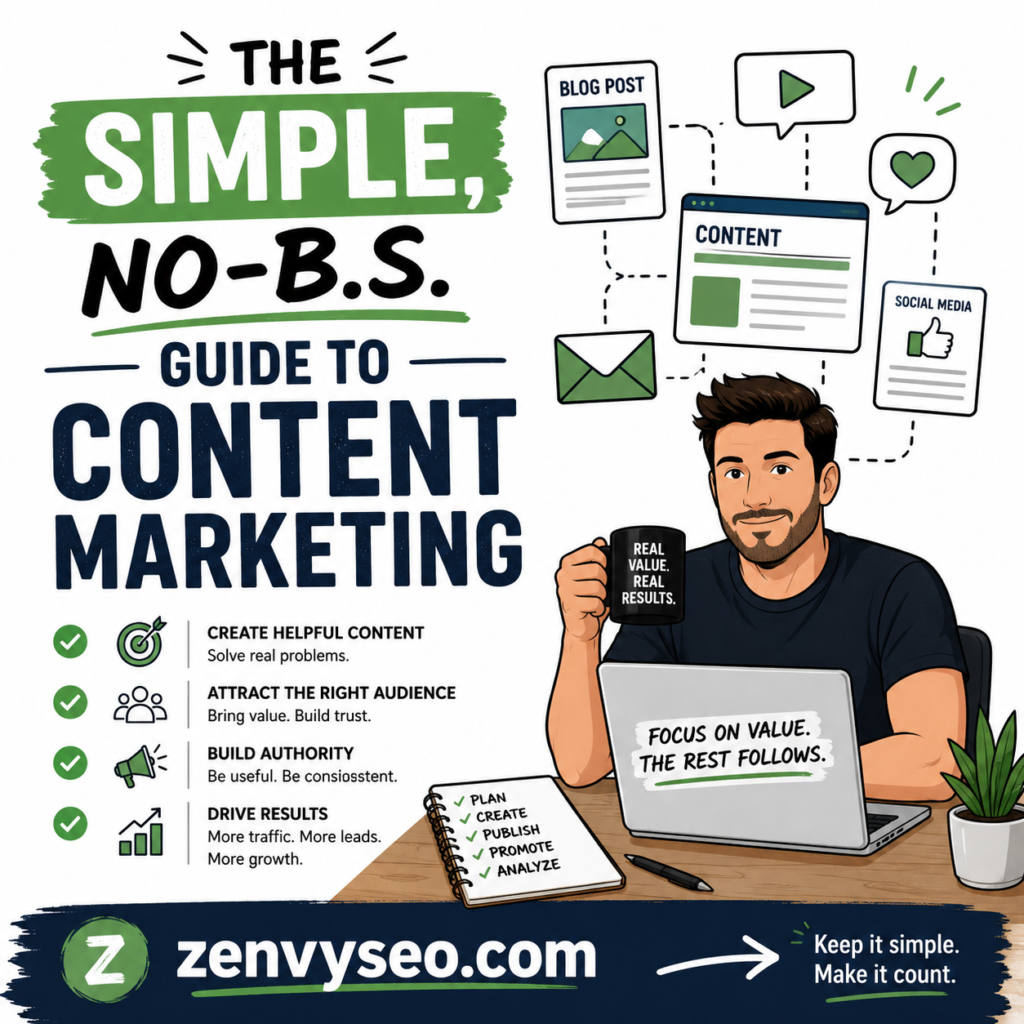
You’ve probably heard “content is king” so many times it’s lost all meaning. Here’s the truth: content strategy is king, and there’s a massive difference. Brands that pump out blog posts with no direction don’t grow. Brands that build a focused, audience-driven content engine? They dominate their niche.
This guide cuts straight to what actually matters — no fluff, no filler. Whether you’re starting from scratch or trying to fix a strategy that isn’t converting, ZenvySEO has you covered.
WTF is content marketing? 🫢
Let’s start with the basics, because most definitions out there are either too academic or too vague to be useful.
Content marketing is the practice of creating and distributing valuable, relevant content to attract and retain a defined audience — and ultimately drive profitable action.
That’s it. It’s not about writing articles to fill your blog. It’s about solving real problems for real people at the right moment in their journey.
Content marketing includes:
- Blog posts and long-form articles
- Videos and podcasts
- Email newsletters
- Social media content
- Case studies, whitepapers, and ebooks
- Infographics and interactive tools
The key word throughout all of this is valuable. Content that doesn’t help, educate, or entertain your audience is just noise. And the internet already has plenty of that.
A successful content marketing strategy is all about addressing the audience
Here’s where most brands go wrong: they create content about themselves instead of their audience.
A successful content marketing strategy flips that equation. Before you write a single word, you need to deeply understand:
- Who your audience is
- What problems they’re trying to solve
- Where they spend time online
- When they’re most likely to engage
- Why they should trust your brand over anyone else
Modern content marketing is audience-first. This means discovering where your target readers hang out, what questions they’re typing into Google at 11pm, and what kind of content actually changes how they think or act.
Think of it this way: your content should feel like a helpful conversation with a trusted expert — not a sales pitch in disguise.
Buyer journeys are messy within your marketing strategy – that’s the truth! 🤷
Every marketing textbook will show you a tidy funnel: Awareness → Consideration → Decision. Neat, clean, linear.
Reality? It’s a tornado.
Real buyers bounce between stages constantly. Someone might discover your brand through a blog post (awareness), disappear for three months, stumble on your YouTube channel, read two case studies, unsubscribe from your emails, and then buy.
Here’s what this means for your content strategy:
| Funnel Stage | Buyer Mindset | Content That Works |
| Awareness (TOFU) | “I have a problem but I’m not sure what it is” | Blog posts, social videos, podcasts |
| Consideration (MOFU) | “I know my problem, what are my options?” | Comparison guides, webinars, case studies |
| Decision (BOFU) | “I’m ready to buy, convince me” | Testimonials, demos, free trials, pricing pages |
| Retention | “I bought, now make me feel good about it” | Onboarding emails, tutorials, community content |
The goal isn’t to force people through a funnel. It’s to be present and helpful at every point where they might need you — on their terms, not yours.

Drilling it down in content marketing – from audience segmentation to buyer personas
Knowing your “target audience” isn’t enough. “25-40 year old small business owners” tells you almost nothing useful.
Effective content marketing requires segmentation — breaking your broad audience down into specific groups based on shared characteristics, behaviors, and needs. From there, you build buyer personas: detailed, research-based profiles of your ideal customers.
A buyer persona isn’t just a demographic snapshot. Think of it more like a character sketch. A good persona for a B2B SaaS product might look like:
“Marketing Manager Maria”
- 32 years old, works at a mid-size e-commerce brand
- Struggles with proving content ROI to leadership
- Prefers video content and podcast learning
- Makes decisions based on peer recommendations and reviews
- Pain point: her team is stretched thin and needs tools that save time
When every content creator on your team has Maria in mind, the content becomes sharper, more targeted, and more effective.
Things to consider when developing your buyer personas
Use these inputs to build data-backed personas — not guesses:
- Customer interviews — talk to your actual buyers about their challenges
- Sales call recordings — listen to the exact words prospects use to describe their problems
- CRM and analytics data — what pages do high-value customers visit before converting?
- Social listening — what questions and complaints show up repeatedly in forums, Reddit, LinkedIn?
- Support tickets — recurring questions reveal gaps in awareness or understanding
Keep personas updated. The person who bought from you in 2021 may have very different priorities in 2025. Treat personas as living documents, not a one-time exercise.
The importance of nurturing in digital marketing
Most people who find your content aren’t ready to buy. That’s not a failure — that’s just reality.
Lead nurturing is the process of building a relationship with these potential buyers over time, delivering the right message at the right stage, until they’re ready to take action.
Without nurturing, you’re leaving money on the table. With it, you’re turning casual readers into loyal customers — and loyal customers into advocates.
An effective nurturing strategy includes segmented email sequences triggered by specific behaviors, retargeting campaigns, progressive content that moves readers from educational to product-focused, and personalized follow-ups based on journey stage.
Nurturing isn’t pushy — it’s patient and strategic. The goal is to be genuinely helpful until the prospect is ready to move forward on their own terms.
Setting clear goals and objectives for your content marketing strategy
One of the fastest ways to waste a content budget is to start creating without knowing what success looks like.
Before launching any content program, define your goals using the SMART framework:
| Goal Type | Example |
| Brand Awareness | Increase organic traffic by 40% in 6 months |
| Lead Generation | Generate 200 new email subscribers per month |
| Engagement | Achieve an average time-on-page of 3+ minutes |
| Revenue | Attribute $50K/month in pipeline to content |
| Retention | Reduce churn by 15% using onboarding content |
Your goals will shape every other decision: what content to create, what channels to prioritize, and what metrics to track. Without clear objectives, you’re just publishing into the void.
Measuring the success of your content marketing efforts
You can’t improve what you don’t measure. Content marketing without analytics is guesswork with a content calendar.
Here are the core metrics worth tracking:
Traffic & Discoverability: Organic search sessions, keyword rankings, and click-through rate from search results.
Engagement: Average time on page, scroll depth, and social shares.
Conversion: Email sign-up rate, content-to-lead conversion rate, and assisted conversions from blog content.
Business Impact: Revenue attributed to content, customer acquisition cost from organic channels, and return on content investment.
Tools like Google Analytics 4, Google Search Console, and your CRM are your best friends here. Pick 4-5 metrics that align with your goals and review them monthly for trends.
Content marketing success in B2B
B2B content marketing plays by slightly different rules. Buying cycles are longer, decision-making involves multiple stakeholders, and the stakes are higher. A single piece of content rarely closes a deal — but it can be a crucial step in a 6-month sales process.
What separates winning B2B content from the rest:
- Specificity over breadth — niche, detailed content outperforms generic guides
- Social proof at every stage — case studies, ROI data, and client testimonials do heavy lifting
- Multi-stakeholder content — address economic buyers, technical evaluators, and end users separately
- Thought leadership — positioning your brand as the most credible voice in your space builds trust that ads can’t buy
Companies with well-documented buyer personas consistently see significantly higher conversion rates from marketing qualified leads. In B2B, that’s a transformational difference.
Optimization and iteration are needed for creating high-quality content
Publishing great content once is not a strategy. Publishing, measuring, learning, and improving consistently — that’s a strategy.
The best content teams treat every article as a hypothesis. You publish it, see how it performs, and use that data to make the next piece better.
A basic content optimization loop:
- Publish — launch the piece with proper on-page SEO (title tag, meta description, internal links, schema where relevant)
- Monitor — track rankings, traffic, and engagement for 60-90 days
- Audit — identify underperforming content and diagnose why (weak heading structure? Thin content? Poor keyword targeting?)
- Update — refresh outdated stats, expand thin sections, improve internal linking
- Repeat — treat content like a product, not a one-time deliverable
A well-optimized existing article will almost always outperform a brand-new one. The path to content mastery runs through iteration, not just creation.
Aiming for content mastery in digital marketing
Content mastery isn’t about publishing the most. It’s about creating the most useful, the most trusted, and the most intentional.
At ZenvySEO, we define content mastery across four pillars:
| Pillar | What It Means |
| Experience | Content written by people who have actually done the thing they’re writing about |
| Expertise | Deep subject knowledge that goes beyond surface-level summaries |
| Authoritativeness | Being cited, linked to, and referenced by others in your industry |
| Trustworthiness | Accurate, transparent, and consistently helpful content that builds long-term credibility |
These aren’t just buzzwords — they’re Google’s E-E-A-T framework, and they directly influence how your content ranks and how your audience perceives your brand.
The brands that win long-term in content marketing are the ones who commit to these principles at every level: in how they write, who they hire, how they structure their content, and how they respond when they get something wrong.
Content mastery is a compounding asset. The more you invest in it, the greater the return over time. Start building now.
FAQs
What is the main goal of content marketing?
The primary goal is to attract, engage, and retain a defined audience by consistently delivering valuable content — ultimately driving profitable customer action.
How long does content marketing take to show results?
Most content marketing efforts take 3–6 months to show meaningful organic traction. SEO-driven content compounds over time, with the strongest ROI typically seen after 12+ months.
What’s the difference between content marketing and SEO?
SEO is about optimizing content so search engines can find and rank it. Content marketing is about creating content worth finding in the first place. The two are most effective when used together.
How do I know what content my audience wants?
Use keyword research tools, customer interviews, social listening, and your own search analytics. Your audience is already telling you what they need — you just have to listen.
Is content marketing worth it for small businesses?
Absolutely. Content marketing levels the playing field. A well-written, deeply useful blog post from a small business can outrank a Fortune 500 competitor if it better addresses the reader’s intent.