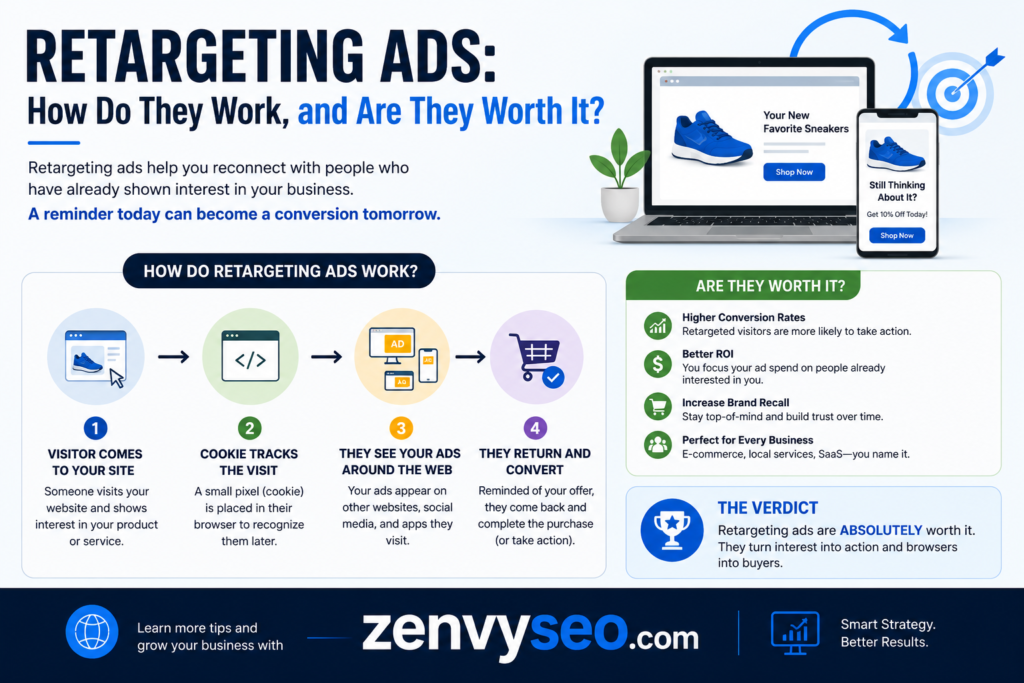
You spend money driving traffic to your website. A visitor arrives, browses your products, and then — nothing. They leave. No purchase, no sign-up, no conversion. Sound familiar?
This is the reality for most websites. On average, only 2–3% of visitors convert on their first visit, which means the vast majority of your hard-earned traffic walks out the digital door without spending a cent. Retargeting ads exist to fix exactly that problem.
At ZenvySEO, we work with businesses every day on improving their digital marketing ROI — and retargeting consistently comes up as one of the highest-leverage tools available. In this guide, we break down what retargeting ads are, how they work, who should use them, and whether they are genuinely worth the investment.
What is Retargeting?
Retargeting is a paid advertising strategy that re-engages users who previously visited your website but left without taking a desired action — whether that is making a purchase, filling out a form, or booking a call.
Instead of targeting a cold audience that has never heard of your brand, retargeting ads focus on warm prospects: people who already know you exist, have already shown interest, and are much closer to converting. The goal is simple — stay visible until they are ready to act.
Think of it as a friendly follow-up rather than a cold pitch. The visitor looked at your pricing page but did not sign up. Retargeting ads remind them why they were interested in the first place, sometimes with a discount, a testimonial, or simply a well-timed reminder.
Retargeting vs Remarketing
These two terms are used interchangeably so often that the difference has become blurry — but there is a meaningful distinction worth knowing.
Retargeting ads are ad-based. They use tracking pixels and cookies to serve paid ads across display networks, social media platforms, and search results to past visitors. Remarketing, in contrast, usually refers to email-based re-engagement — sending follow-up messages to users whose email addresses you already have.
| Feature | Retargeting Ads | Remarketing |
| Channel | Paid display, social, search ads | Email campaigns |
| Tracking method | Pixel, cookies, device IDs | Email list / CRM data |
| Audience | Anonymous website visitors | Known contacts / subscribers |
| Best for | Re-engaging cold traffic | Re-engaging warm leads |
| Cost | CPC / CPM-based ad spend | Email platform costs |
In practice, both strategies can work together. A visitor abandons their cart, retargeting ads follow them across the web, and a remarketing email arrives in their inbox the next morning. Combined, they are a powerful recovery system.
How Do Retargeting Ads Work?
The mechanics of retargeting ads are built around a small but powerful piece of code called a tracking pixel. Here is how the entire process unfolds:
| Step | What Happens |
| 1. Visitor arrives | A user lands on your website and browses products or pages |
| 2. Pixel fires | A tracking pixel drops a cookie on their browser, recording the visit |
| 3. User leaves | The visitor exits without converting — no purchase, no sign-up |
| 4. Ad follows | The pixel data triggers your retargeting ads on other sites, apps, or social media |
| 5. User returns | Reminded of your offer, the visitor clicks the ad and completes the action |
Most major ad platforms — including Google Ads, Meta (Facebook and Instagram), LinkedIn, and TikTok — have their own pixels and retargeting infrastructure. You install the pixel once, and the platform handles audience building and ad delivery automatically.
Beyond pixel-based retargeting, list-based retargeting allows you to upload a customer email list directly to a platform like Google or Meta. The platform matches those emails to active users and serves them your retargeting ads — no pixel needed.
A Quick Note on Third-Party Cookies
If you have been following digital marketing news, you have probably heard about the ongoing changes around third-party cookies. Here is the plain-English summary:
• Google originally planned to phase out third-party cookies in Chrome entirely but reversed that decision in mid-2024.
• Safari and Firefox have long blocked third-party cookies by default, which limits pixel tracking on those browsers.
• Google’s Privacy Sandbox initiative — designed as an alternative — was officially discontinued in October 2025 due to low adoption.
• First-party data (your own pixel running on your domain, or customer email lists) is unaffected and remains the most reliable foundation for retargeting ads.
The practical takeaway: pixel-based retargeting still works for the majority of web traffic, particularly on Chrome. However, savvy marketers are increasingly building first-party data strategies — collecting emails, using server-side tracking, and leveraging tools like Meta’s Conversions API — to future-proof their retargeting campaigns.
Why Are Retargeting Ads Effective?
Retargeting ads consistently outperform standard display advertising by a wide margin. The reason is straightforward: intent. You are not interrupting a stranger. You are following up with someone who already raised their hand.
The numbers back this up:
• Website visitors who are retargeted are 70% more likely to convert than those who see a cold ad.
• Retargeted ads on Facebook achieve a click-through rate nearly 94% higher than standard display ads.
• Retargeting campaigns deliver an average return on ad spend (ROAS) of 4.2x, according to 2025 data.
• Three out of four consumers report noticing retargeting ads — meaning your brand stays top of mind even when they do not click immediately.
There is also a psychological element at play. Repeated exposure to a brand builds familiarity, and familiarity builds trust. When a prospect sees your retargeting ads multiple times, they are more likely to perceive your brand as established and credible — even if they have only visited your site once.
Additionally, retargeting ads tend to be more cost-effective than prospecting campaigns. Because you are targeting a smaller, warmer audience, click-through rates are higher, cost per click is often lower, and wasted spend is dramatically reduced.
Who Should Use Retargeting Ads?
The short answer: almost any business with a website and an advertising budget. But some scenarios produce especially strong results:
• E-commerce stores — Cart abandonment retargeting is one of the highest-ROI use cases in all of digital marketing. Reminding shoppers of the exact product they left behind, sometimes with a small discount, consistently drives them back to complete the purchase.
• SaaS and subscription businesses — Users who visited your pricing page or started a free trial but did not convert are prime candidates. Retargeting ads can address objections, highlight key features, or offer an incentive.
• Service businesses and agencies — If a potential client visited your services page or read a case study but did not reach out, retargeting ads keep you in their consideration set while they compare options.
• Lead generation campaigns — B2B and professional services companies can use retargeting ads to guide prospects through a longer decision cycle, delivering testimonials, whitepapers, or social proof at each stage.
• Local businesses — Even brick-and-mortar stores benefit from retargeting. Someone who checked your restaurant’s menu or salon’s pricing page is clearly interested. A well-timed retargeting ad can be the nudge that gets them through the door.
If your site gets at least a few hundred visitors per month, you have enough data to build a meaningful retargeting audience and see real results.
Making Your Retargeting Work — Without Being Weird
Retargeting ads have a reputation for being creepy. We have all had the experience of looking at a product once and then seeing it everywhere for the next two weeks. Done poorly, retargeting feels invasive. Done well, it feels helpful.
Here is how to stay on the right side of that line:
10. Set frequency caps. Limit how many times a single user sees your retargeting ads per day or week. Seeing the same ad five times a day is annoying; seeing it twice a week is a useful reminder.
11. Segment your audiences. Not every visitor deserves the same ad. Someone who visited your homepage once is different from someone who added a product to their cart. Build separate audiences and tailor your messaging accordingly.
12. Exclude converters. Always exclude users who have already purchased or converted from your retargeting ads. Continuing to show them an offer they have already taken wastes budget and creates a poor brand experience.
13. Rotate your creative. Ad fatigue is real. If users see the same retargeting ad week after week, they tune it out. Refresh your creatives regularly to maintain engagement.
14. Match the message to the stage. Early-stage visitors might need educational content or social proof. Cart abandoners need a direct reminder or a small incentive. The right message at the right time makes all the difference.
15. Respect time limits. Most retargeting audiences should have a lookback window of 30–90 days. Someone who visited six months ago is not a warm lead anymore — refreshing that audience keeps your targeting relevant.
Is It Worth It?
Let us address the question directly: are retargeting ads worth the budget?
For most businesses, yes — often significantly so. The core reason is that you are spending money on people who have already shown interest in what you sell. Compared to prospecting campaigns that target cold audiences, retargeting ads typically produce lower cost per acquisition, higher conversion rates, and stronger ROI.
That said, retargeting ads are not a magic fix. They work best when:
• Your website already has decent traffic (ideally 500+ monthly visitors to build a usable audience).
• Your underlying offer, pricing, and product quality are solid — retargeting can remind people, but it cannot rescue a bad offer.
• Your landing pages are optimized — there is no point bringing visitors back if the page they land on still does not convert.
• You have proper tracking in place — a misconfigured pixel means wasted spend and unreliable data.
When those conditions are met, retargeting ads are one of the most efficient lines in your marketing budget. At ZenvySEO, we regularly see clients recover significant portions of lost revenue simply by implementing a well-structured retargeting campaign for the first time.
Never Miss a Purchase
The goal of any digital marketing effort is to turn interest into action. But the reality of buying behaviour is that most people do not convert the first time. They get distracted, they compare options, they wait for payday, or they simply forget.
Retargeting ads are how you bridge that gap. By staying visible to the people who have already shown interest, you give yourself multiple chances to earn that conversion — without constantly paying to find new audiences from scratch.
Whether you run a small e-commerce shop or a growing B2B brand, a well-built retargeting strategy means fewer lost visitors, better use of your ad budget, and more predictable revenue. In a competitive digital landscape, that is not just a nice-to-have. It is a baseline expectation.
Ready to build a retargeting strategy that actually works? At ZenvySEO, we help brands implement data-driven paid campaigns that close the gap between interest and conversion. Start with your pixel, build your audiences, and let the ads do the follow-up work for you.
Frequently Asked Questions
What is the difference between retargeting and remarketing?
Retargeting uses paid ads (display, social) to re-engage past visitors tracked via pixels. Remarketing typically refers to email campaigns sent to users already in your database.
How much do retargeting ads cost?
Costs vary by platform and audience size, but retargeting ads are generally more cost-efficient than cold-audience campaigns because click-through rates are higher and audiences are warmer.
How long should I run retargeting ads?
A 30–90 day audience window works best for most businesses. Beyond that, visitors are likely no longer in an active buying mindset.
Do retargeting ads work on mobile?
Yes — platforms like Meta and Google serve retargeting ads across desktop and mobile devices seamlessly, though first-party data is more reliable on mobile due to cookie restrictions.
Can small businesses use retargeting ads?
Absolutely. Even with modest traffic, retargeting ads can recover lost leads and deliver strong ROI. You need at least 100–500 monthly visitors to build a workable audience.