
Whether you run a five-person startup or a 500-person enterprise, technology keeps everything moving. And when technology breaks down, so does your business. That is exactly why IT support services have become one of the most critical investments any organization can make today.
But what exactly are IT support services? How do they work in practice? And which type is right for your business?
This guide answers all of that — clearly and without the jargon. At ZenvySEO, we believe that understanding your tools is the first step to using them well. So let’s break it all down.
What Are IT Support Services?
IT support services are professional solutions that help businesses manage, maintain, monitor, and troubleshoot their technology systems. They cover everything from fixing a frozen laptop to managing an entire cloud infrastructure across multiple locations.
In simple terms, IT support services ensure that your hardware, software, networks, and data stay operational, secure, and optimized — so your team can stay focused on doing actual work.
Modern IT support is no longer just a “break-fix” model where someone shows up after something goes wrong. Today, it is a proactive, strategic partnership. Providers continuously monitor systems, apply patches, address vulnerabilities, and align your technology with your business goals — before problems have a chance to disrupt your operations.
Featured Snippet Answer: IT support services are professional technical solutions that help businesses manage, maintain, and troubleshoot their technology systems — including hardware, software, networks, and cybersecurity — to ensure smooth and secure operations.
Also read Top 10 Software Development Tools & Platforms [2026 Update]
Why IT Support Services Matter for Modern Businesses?
Technology is no longer a department function — it is the backbone of operations. From cloud platforms to remote work environments and SaaS tools, today’s IT infrastructure is more complex than ever. Without structured support, even small issues can snowball into costly downtime.
Here is why investing in reliable IT support services matters:
- Minimizes downtime: Proactive monitoring catches issues early, before they impact productivity. A slow system or failed login left unchecked can ripple across an entire team.
- Strengthens cybersecurity: Data breaches, ransomware, and phishing attacks are rising every year. Close to 40% of small businesses in the US have experienced a cyberattack — and most were not prepared. Professional IT support keeps your defenses current.
- Reduces operational costs: Fixing a major system failure is far more expensive than preventing it. Managed IT support helps businesses avoid costly emergency repairs, lost revenue, and compliance penalties.
- Boosts employee productivity: When IT issues are resolved quickly, employees lose less time waiting for systems to respond. Faster resolution means better focus and output.
- Supports business scalability: As your company grows, your IT needs evolve. The right IT support services scale with you — from adding new users to migrating to cloud infrastructure.
- Ensures compliance and data security: Many industries require strict data handling standards (HIPAA, GDPR, ISO). IT support ensures your systems remain compliant and audit-ready.
Companies with strong IT support make better use of technology. They adapt faster, innovate more confidently, and deliver better customer experiences. In short, IT support is not just about fixing problems — it is about enabling growth.
6 Core Types of IT Support Services
Not all businesses need the same kind of IT help. The right support model depends on your company size, industry, internal capabilities, and growth stage. Below are the six most common and impactful types of IT support services available today.
1. Helpdesk Support
Helpdesk support is the frontline of IT assistance. When an employee cannot log in, a printer stops working, or a software application throws an error — the helpdesk is the first point of contact.
Helpdesk technicians can remotely access devices, walk users through troubleshooting steps, reset passwords, resolve software conflicts, and escalate complex issues to senior specialists. Most helpdesk support operates on a tiered model:
| Tier | Description |
| Level 1 | Self-service: FAQs, knowledge bases, user guides |
| Level 2 | Helpdesk technicians handle common issues remotely |
| Level 3 | Senior engineers resolve complex, escalated problems |
Best for: Businesses of all sizes that need reliable, everyday technical assistance for their employees.
2. Remote IT Support Services
Remote IT support services allow technicians to access your systems over the internet and resolve issues without being physically present. This is especially valuable for companies with distributed or remote teams.
Remote support can handle software installations, system configuration, malware removal, performance optimization, and more — usually within minutes of a ticket being raised. The speed and accessibility of remote support makes it one of the most cost-effective options available.
Best for: Teams that work remotely, businesses with multiple office locations, or any organization that needs fast response times without waiting for an on-site visit.
3. On-Site Support
Some technical issues simply cannot be fixed remotely. Hardware failures, physical server installations, network cabling, workstation setups, and large-scale infrastructure upgrades all require hands-on expertise.
On-site IT support sends qualified technicians directly to your location. This type of service is particularly important for industries like manufacturing, healthcare, and legal, where physical infrastructure is critical and downtime is expensive.
Best for: Businesses undergoing system upgrades, new office setups, or those dealing with hardware-specific issues that require in-person attention.
4. Managed IT Services
Managed IT services represent the most comprehensive model in the IT support services landscape. Rather than calling for help only when something breaks, a managed services provider (MSP) takes full responsibility for your IT environment on an ongoing basis.
This includes:
- 24/7 system monitoring and alerting
- Patch management and software updates
- Network security and firewall management
- Data backup and disaster recovery
- IT strategy and technology planning
- Vendor management and licensing
Managed IT services operate on a proactive model — preventing problems before they happen. This translates to less downtime, lower long-term costs, and greater peace of mind for business owners and leadership teams.
Best for: Businesses that want fully outsourced IT management without sacrificing control, quality, or strategic oversight.
Also read Data Definition: What Is Data? Types & Importance
5. Cloud Support Services
As businesses migrate to platforms like AWS, Microsoft Azure, and Google Workspace, the need for dedicated cloud IT support services has grown dramatically. Cloud environments come with their own unique set of security, compliance, performance, and integration challenges.
Cloud support services help businesses:
- Configure and manage virtual servers and cloud storage
- Optimize cloud performance and control costs
- Maintain uptime and availability for cloud-hosted applications
- Ensure data synchronization across platforms
- Handle cloud security and compliance requirements
Whether you run a SaaS product, a hybrid infrastructure, or rely on Microsoft 365 for daily operations, expert cloud support ensures everything stays connected, accessible, and secure.
Best for: Companies relying on cloud platforms (SaaS, PaaS, IaaS) that require high availability, flexibility, and continuous performance optimization.
6. Cybersecurity Support
Cybersecurity has become one of the most urgent areas within IT support services. Threats are growing in frequency and sophistication — from phishing emails and ransomware to supply chain attacks and insider threats.
Cybersecurity IT support includes:
- Vulnerability assessments and penetration testing
- Firewall configuration and intrusion detection
- Endpoint protection and antivirus management
- Security awareness training for employees
- Incident response and breach remediation
- Compliance monitoring (HIPAA, GDPR, SOC 2, ISO 27001)
A cybersecurity breach does not just cost money — it damages your reputation and erodes customer trust. Having dedicated cybersecurity support as part of your IT strategy is no longer optional; it is essential.
Best for: Every business that handles sensitive data, processes payments, or operates in regulated industries.
In-House IT support services Team vs. Outsourced IT Support
One of the biggest decisions businesses face when it comes to IT support services is whether to build an internal team or partner with an external provider. Both models have distinct advantages — and the right choice depends on your specific situation.
In-House IT Team: Control and Customization
An in-house IT team works exclusively for your organization. They understand your systems deeply, are embedded in your company culture, and can respond to issues with first-hand context.
Advantages:
- Deep institutional knowledge of your specific environment
- Immediate physical presence for hardware issues
- Easier alignment with internal processes and priorities
- Direct control over staffing, training, and tools
Limitations:
- High fixed costs (salaries, benefits, training, equipment)
- Limited expertise — one team cannot cover every specialization
- Coverage gaps during nights, weekends, and holidays
- Slower to scale during growth periods
In-house IT works well for large enterprises with the budget to staff a full team across multiple disciplines — helpdesk, security, cloud, infrastructure, and strategy.
Outsourced IT Support: Flexibility and Expertise
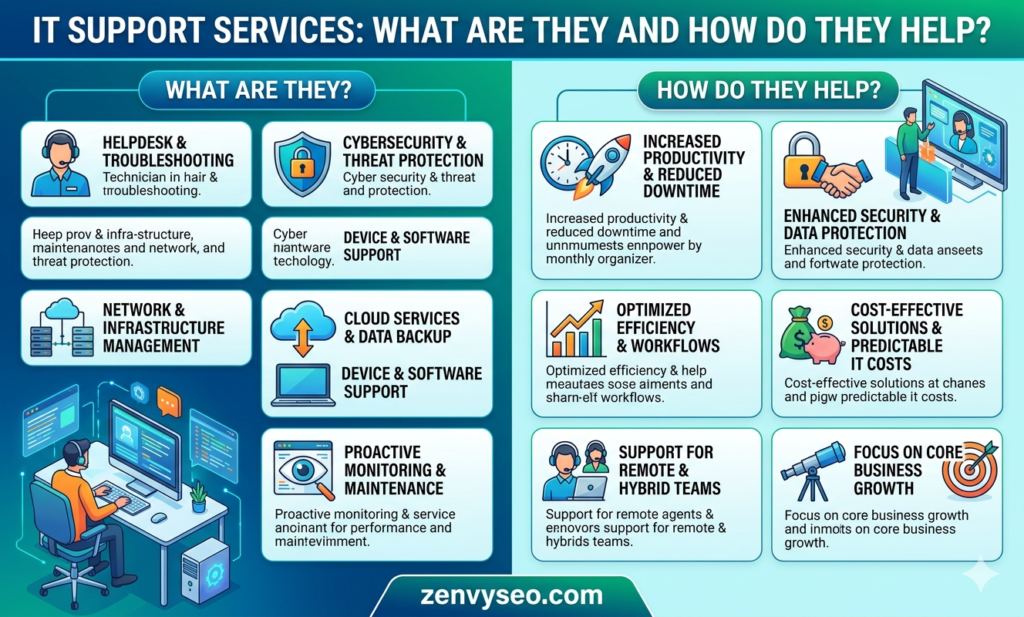
Outsourced IT support services give businesses access to a full team of specialists — often at a fraction of the cost of hiring in-house. You get the depth of expertise across multiple domains without the overhead of employing each specialist individually.
Advantages:
- Access to a broad range of specialists (cloud, security, networking, etc.)
- 24/7 monitoring and support coverage
- Predictable monthly costs with clear SLAs
- Scales easily as your business grows
- Faster implementation of new technologies
Limitations:
- Less day-to-day familiarity with your internal culture
- Requires a clear onboarding process and documentation
- Response to physical on-site issues may take longer
| Comparison Factor | In-House IT Team | Outsourced IT Support |
| Cost | High fixed costs | Predictable monthly fee |
| Expertise breadth | Limited to team size | Multi-specialist access |
| Availability | Business hours | 24/7 coverage |
| Scalability | Slow | Fast and flexible |
| Cybersecurity depth | Varies | Often enterprise-grade |
| Best for | Large enterprises | SMBs and growing businesses |
For most small and mid-sized businesses, outsourced IT support services offer the better value proposition — more expertise, better coverage, and lower costs than hiring internally.
Also read Top 10 SEO Experts in London for 2026 | Proven Results & Expertise
Why Choose Serdao for IT Support Services?
Choosing the right IT support partner is not just about resolving tickets faster. It is about finding a provider that understands your business, anticipates your needs, and grows with you.
Here is what makes Serdao stand out in the crowded market of IT support services:
- Full-spectrum expertise: From daily helpdesk support to cloud infrastructure management, cybersecurity, and strategic IT consulting — Serdao delivers everything under one roof. No juggling multiple vendors. No gaps in coverage.
- 24/7 proactive monitoring: Serdao does not wait for problems to surface. Their team continuously watches your systems, catches anomalies early, and resolves issues before they affect your operations.
- Scalable support models: Whether you are a startup with ten employees or an enterprise with five hundred, Serdao builds a support model that fits your size, budget, and trajectory.
- Cybersecurity-first approach: In a threat landscape that changes daily, Serdao brings dedicated security expertise to every client engagement — from compliance audits to real-time threat monitoring.
- Transparent communication: You always know what is happening with your IT environment. Serdao provides clear reporting, regular updates, and strategic recommendations — not just reactive fixes.
- Business-aligned IT strategy: Great IT support goes beyond technical fixes. Serdao works with you to align technology decisions with your actual business goals — driving efficiency, reducing risk, and enabling growth.
At ZenvySEO, we consistently recommend that businesses treat IT support as a strategic investment rather than a cost center. The right provider, like Serdao, becomes an extension of your leadership team — not just your tech team.
Conclusion
Technology is the engine of modern business — and IT support services are what keep that engine running. Whether you need a helpdesk to support your employees, a managed service provider to oversee your entire infrastructure, or specialized cloud and cybersecurity expertise, having the right IT support in place is one of the smartest investments you can make.
The question is no longer whether your business needs IT support services — it is which model fits your goals, your size, and your budget best.
At ZenvySEO, we hope this guide gave you a clear, practical foundation for making that decision. If you are exploring providers, Serdao offers the kind of full-spectrum, business-aligned IT support that turns technology from a liability into a competitive advantage.
Frequently Asked Questions (FAQs)
What do IT support services include?
IT support services typically include helpdesk assistance, remote and on-site troubleshooting, network management, cybersecurity, cloud support, data backup, and strategic IT planning.
How much do IT support services cost?
Costs vary based on the scope of services, number of users, and support model. Managed IT services typically range from $100 to $250 per user per month for comprehensive coverage.
What is the difference between IT support and managed IT services?
IT support is generally reactive — fixing problems when they occur. Managed IT services are proactive, covering ongoing monitoring, maintenance, and strategy alongside issue resolution.
Why should small businesses invest in IT support services?
Small businesses are frequently targeted by cyberattacks and face more disruption from downtime relative to their size. Professional IT support reduces these risks and allows small teams to focus on growth instead of technical issues.
Can IT support services be provided remotely?
Yes. Most helpdesk and monitoring tasks can be handled remotely. However, hardware installations, physical upgrades, and certain network setups require on-site technicians.
Also read WordPress SEO Agency