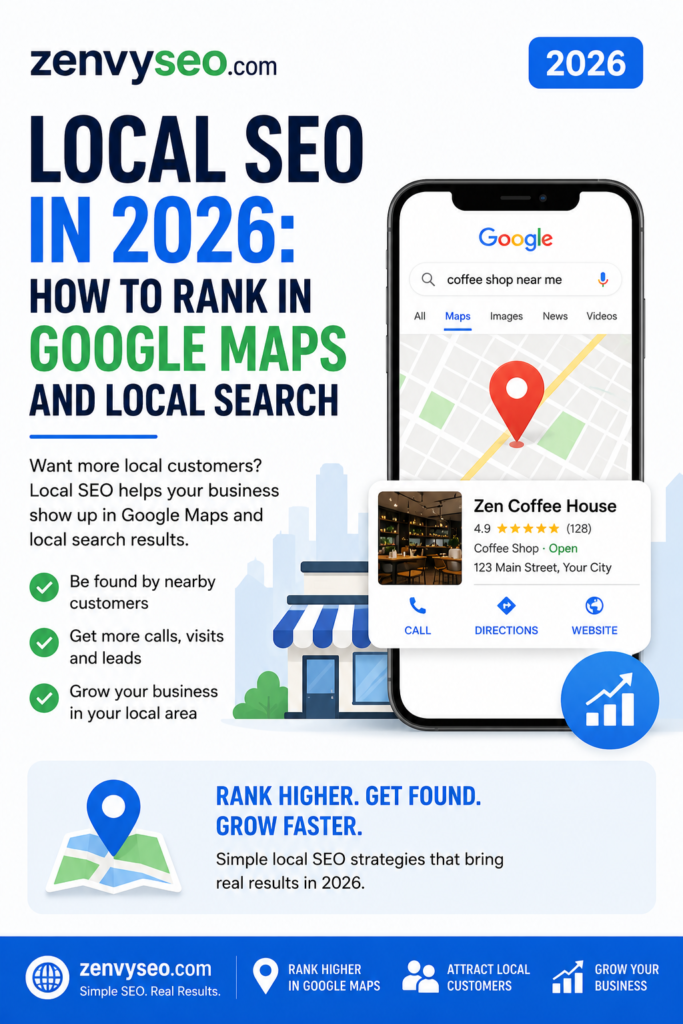
If your business isn’t showing up on Google Maps, you’re not just missing clicks — you’re losing customers to competitors who are. Local SEO in 2026 has become the single highest-ROI digital marketing channel for location-based businesses, and the game has changed more in the past 12 months than in the previous five years combined.
This guide from ZenvySEO covers everything you need — from optimising your Google Business Profile to winning in AI-powered search results — so you can rank where it matters most.
A Quick Guide to Local SEO
Local SEO is the practice of optimising your online presence so customers can find you when they search for products or services in your area. It covers your Google Business Profile, NAP (Name, Address, Phone) citations, reviews, local link building, and location-specific content.
Done right, local SEO puts your business in the Google Maps 3-Pack — the map results that appear above all organic listings and capture over 70% of clicks for local queries.
Why Local SEO Matters More Than Ever in 2026
The Scale of Local Search Opportunity
The numbers speak for themselves:
| Statistic | Figure |
| Google searches with local intent | 46% of all queries |
| People who visit a business after a local mobile search | 76% within 24 hours |
| Local searches that result in a purchase | 28% |
| Monthly destination visits driven by Google Maps | 1.5 billion+ |
Nearly half of every search Google receives has a local component. If your business isn’t optimised for local search, you’re invisible to roughly half your potential customer base.
Mobile Dominance in Local Discovery
Over 70% of all searches now happen on mobile devices, and that figure climbs even higher for local and “near me” queries. A user searching “plumber near me” on their phone isn’t browsing — they’re ready to call. That intent makes local search traffic among the most valuable of any digital channel.
The Competitive Advantage of Local SEO Investment
Here’s what most businesses miss: the investment required to rank locally is substantially lower than competing for national organic rankings. While your competitors rely on word of mouth, businesses that consistently invest in local SEO gain a compounding advantage that’s difficult for latecomers to overcome.
How Google Ranks Local Businesses
The Three Pillars of Local Rankings
Google publicly acknowledges three core factors that determine where your business appears in Maps and local results:
- Relevance — How well your Google Business Profile and website match what the searcher is looking for
- Distance — How close your business is to the searcher or the location they specified
- Prominence — How well-known and authoritative your business is, based on links, reviews, citations, and overall online presence
You can’t control distance. But you have complete control over relevance and prominence — and those two factors are where local SEO work pays off.
The Whitespark Local Search Ranking Factors Survey
The 2026 Whitespark survey, compiled from analysis by 47 top local SEO professionals, breaks down ranking influence like this:
| Ranking Category | Local Pack / Maps | Local Organic |
| Google Business Profile signals | 32% | 16% |
| On-page signals | 19% | 33% |
| Link signals | 17% | 24% |
| Review signals | 16% | 8% |
| Citation signals | 7% | 7% |
| Behavioural signals | 6% | 8% |
For the Map Pack, your GBP is the single most powerful lever. For organic rankings, on-page content and links carry more weight. A strong local SEO strategy targets both.
Optimising Your Google Business Profile
Your Google Business Profile (GBP) is the foundation of local visibility. Think of it as your digital storefront — Google actively crawls it to power both Maps and AI features.
Complete Every Section Thoroughly
- Business name: Must match your legal business name exactly — no keyword stuffing (a direct suspension risk)
- Primary category: This is the most important GBP field; choose carefully
- Secondary categories: Add all relevant service categories
- Description: 750 characters explaining what you do, naturally including your main service keywords
- Services and products: List every service with descriptions and pricing where applicable
- Website URL: Link to a location-specific landing page, not just your homepage
Visual Content and Regular Updates
Businesses that post weekly on Google Business see up to a 100–300% increase in monthly profile views and calls. Upload real photos of your team, premises, and completed work. Geo-tagged images add an additional relevance signal. Use Posts to share offers, news, and updates — Google treats active profiles as more trustworthy.
Accurate Business Hours and Attributes
An often-overlooked ranking factor: industry data shows rankings can shift depending on whether a business is listed as open at the time of search. Keep your hours current, including public holidays. Attributes like “wheelchair accessible,” “free Wi-Fi,” or “women-led business” improve both relevance matching and click-through rates.
The Critical Role of NAP Consistency
NAP stands for Name, Address, Phone number — the three data points Google uses to verify your business’s location and legitimacy.
Why Consistency Matters
Inconsistencies in your NAP across directories — even minor ones like “St” vs “Street” — send conflicting signals to Google’s algorithm. This directly suppresses your map pack rankings. NAP consistency across 50+ directories is the minimum standard for competitive local markets.
Building Consistent Citations
Citations are any online mention of your business’s NAP information. The most important directories to claim include:
- Tier 1: Google Business Profile, Bing Places, Apple Maps, Facebook
- Tier 2: Yelp, TripAdvisor, Foursquare, BBB, Yell
- Tier 3: Industry-specific directories (e.g., Houzz for contractors, Zocdoc for healthcare)
Managing and Auditing Citations
Use tools like BrightLocal or Moz Local to audit your existing citations, identify inconsistencies, and track new listings. At ZenvySEO, we recommend a citation audit every six months for businesses in competitive local markets — things change, and outdated data costs rankings.
Key insight from the 2026 Whitespark survey: Three of the top five ranking factors for AI search visibility are citation-related. As AI Overviews appear on a growing share of local queries, citation quality has become an AI visibility strategy, not just a local SEO tactic.
Review Management Strategy
Reviews are no longer just social proof — they’re a ranking input and, increasingly, an AI summarisation input. Google’s AI Overviews extract themes from your reviews and use them to describe your business in search results.
Review Recency as a Ranking Signal
Fresh reviews carry more weight than old ones. A business with 20 reviews from the past three months will generally outrank a competitor with 200 reviews from three years ago. Build a consistent review acquisition process, not a one-time push.
Quality Over Quantity
Detailed, specific reviews that mention your services and location outperform generic five-star ratings. Encourage customers to describe their experience naturally — “The team at [Business] fixed my boiler in Leeds within two hours” is far more valuable than “Great service!”
Review Response Best Practices
Respond to every review — positive and negative. For positive reviews, acknowledge the specific service mentioned. For negative reviews, stay professional, address the concern, and offer to resolve it offline. Keyword-rich responses (done naturally) can reinforce your service and location signals.
Building Reviews Across Multiple Platforms
Don’t rely solely on Google. Build your presence on:
- Google (primary)
- Trustpilot or Reviews.io
- Industry-specific platforms (TripAdvisor, Houzz, Checkatrade, etc.)
Multi-platform review presence strengthens your overall prominence score and appears in AI Overviews.
Local Link Building
The Value of Local Links
Links from locally relevant, authoritative websites tell Google that your business is embedded in its community. In 2026, local link building is gaining weight as a differentiator specifically when GBP signals are similar between competitors.
Effective Local Link Building Tactics
- Local business associations: Chamber of commerce memberships typically include a directory listing and backlink
- Local press coverage: Pitch story ideas to regional newspapers and blogs — a single editorial mention from a trusted local publication carries significant authority
- Sponsorships: Sponsor local events, sports teams, or charity initiatives for natural editorial links
- Supplier and partner pages: Ask business partners to link to your website from their “partners” or “recommended suppliers” page
- Local resource guides: Create genuinely useful local guides (e.g., “Best Wedding Venues in [City]”) and earn links from local bloggers
Analysing Competitor Link Profiles
Use tools like Ahrefs or Semrush to analyse where your top-ranking local competitors earn their backlinks. Identify opportunities they’ve captured that you’ve missed, then replicate and improve on their approach.
Voice Search and Local SEO
Voice Search Behaviour Explained
Voice search queries are fundamentally different from typed searches. When someone types, they might search “dentist Manchester.” When they speak, they say “What’s the best dentist near me that’s open on Saturdays?” That conversational phrasing requires a different content approach.
Optimising for Voice Results
- Use FAQ-style content with complete question-and-answer formatting
- Target long-tail, conversational keywords that match how people actually speak
- Ensure your GBP hours, services, and attributes are complete (voice assistants pull from this data)
- Implement FAQ schema markup so voice assistants can surface your answers directly
Local Voice Search Opportunities
Searches like “open now near me,” “best [service] in [city],” and “how far is [business name]” are all voice-driven local queries. Businesses that appear in the Maps 3-Pack are the most likely to be read aloud by Google Assistant, Siri, and Alexa.
AI Search Visibility for Local Businesses
Current AI Search Landscape
Google’s AI Overviews now appear on a significant share of local search queries, and tools like ChatGPT and Perplexity are increasingly used for local business discovery. This has expanded what “local SEO” means — it’s no longer just about ranking on Google Maps. It’s about being the business that AI trusts enough to recommend.
Optimising for AI Discovery
AI systems favour businesses with:
- Consistent, accurate NAP data across all online directories
- Structured data (schema markup): LocalBusiness, Service, FAQ, and Review schemas make it far easier for AI crawlers to extract facts about your business
- High-quality, contextually rich content that directly answers local search questions
- Strong review signals — AI Overviews read and summarise reviews to describe your business to searchers
Implementing proper schema markup increases your chances of appearing in rich snippets and AI-generated results by a significant margin.
Multi-Platform Visibility
Appearing in “BEST OF” and “TOP LOCAL” listings (from sites like local blogs, directories, and magazines) is now a confirmed ranking signal in the 2026 Whitespark data. Being cited as a top local business by authoritative third-party sources feeds directly into AI visibility.
On-Page Optimisation for Local SEO
Location-Specific Content
Every location you serve needs its own landing page — not a duplicate page with the city name swapped in, but genuinely unique content covering:
- The specific services you offer in that area
- Local landmarks, neighbourhoods, or context
- Customer testimonials from that location
- A locally embedded Google Map
Technical Foundations
| Technical Element | Why It Matters |
| HTTPS / SSL | A baseline ranking signal; non-negotiable in 2026 |
| Mobile-responsive design | 70%+ of local searches are on mobile |
| Page speed (under 3 seconds) | 53% of mobile users abandon slow-loading pages |
| Embedded Google Map | Reinforces location relevance |
| LocalBusiness schema | Helps search engines and AI extract your business details |
Content Strategy for Local Relevance
Beyond location pages, build content that demonstrates local expertise:
- Area guides and neighbourhood spotlights
- Case studies from local clients
- Coverage of local events or news relevant to your industry
- Blog posts targeting “service + city” keyword combinations
Measuring Local SEO Success
Key Performance Indicators
Track these metrics monthly to understand whether your local SEO is working:
- Google Maps 3-Pack ranking positions for your primary keywords
- GBP profile views (search views vs. maps views)
- Direction requests and phone calls from GBP
- Website clicks from your Google Business Profile
- Keyword ranking positions for local organic results
Review Metrics
- Monthly review volume (aim for consistent acquisition, not spikes)
- Average star rating (4.0+ is the competitive threshold)
- Review response rate
Conversion Tracking
Set up goal tracking in Google Analytics 4 for phone calls, contact form submissions, and booking completions that originate from local search traffic. This connects your local SEO effort directly to business revenue.
Common Local SEO Mistakes to Avoid
1. Inconsistent Information
Mismatched NAP across directories confuses Google’s algorithm and suppresses rankings. Even a slight variation — “Road” vs. “Rd” — creates conflicting signals.
2. Neglecting Reviews
Businesses that ignore review acquisition fall behind quickly. A competitor with a steady stream of fresh, detailed reviews will outrank you, even with a weaker GBP profile.
3. Generic Content
Thin location pages with swapped city names don’t rank. Google’s algorithms — and its AI systems — can identify and discount low-quality, templated content.
4. Mobile Neglect
A site that loads slowly or displays poorly on mobile is a conversion killer. With the majority of local searches happening on phones, mobile performance is a direct ranking and revenue factor.
5. Ignoring Structured Data
Schema markup is no longer optional. Without it, AI Overviews and rich snippets have no structured way to surface your business information — you’re leaving significant visibility on the table.
Ready to Dominate Local Search?
Local SEO in 2026 rewards businesses that treat it as a long-term, strategic investment rather than a one-time setup. The businesses winning in Google Maps right now are the ones that have built a consistent, interconnected presence across their GBP, citations, reviews, website content, and structured data.
At ZenvySEO, we build local SEO strategies that work across traditional search, AI Overviews, and voice results — because your customers are searching on all of them.
Most businesses start seeing measurable improvements within 60–90 days. Competitive markets may take six months. But the result — a steady stream of high-intent local customers who find you first — compounds over time in a way no paid ad campaign can replicate.
Start with your Google Business Profile. Audit your citations. Build your reviews. Then let your content and links carry you to the top.
Frequently Asked Questions
What is local SEO and why does it matter in 2026?
Local SEO is the process of optimising your online presence to appear in location-based searches on Google. In 2026, with AI Overviews and a growing share of mobile searches, local visibility is the most direct path to high-intent customers.
How long does it take to rank in Google Maps?
Most businesses see improvements within 60–90 days of consistent optimisation. Highly competitive markets may take six to twelve months for sustained 3-Pack rankings.
What is the Google Maps 3-Pack?
The 3-Pack (also called the Local Pack) is the group of three business listings with a map that appears above organic results for local queries — capturing over 70% of clicks.
Does NAP consistency really affect rankings?
Yes, significantly. Inconsistent business name, address, or phone number data across directories directly suppresses your map pack visibility because it creates conflicting signals for Google’s algorithm.
How important are reviews for local SEO in 2026?
Reviews are now both a ranking signal and an AI summarisation input. Fresh, detailed reviews from real customers improve your ranking in Maps and increase the likelihood of appearing in AI-generated search overviews.