Even If You’ve Never Done Marketing
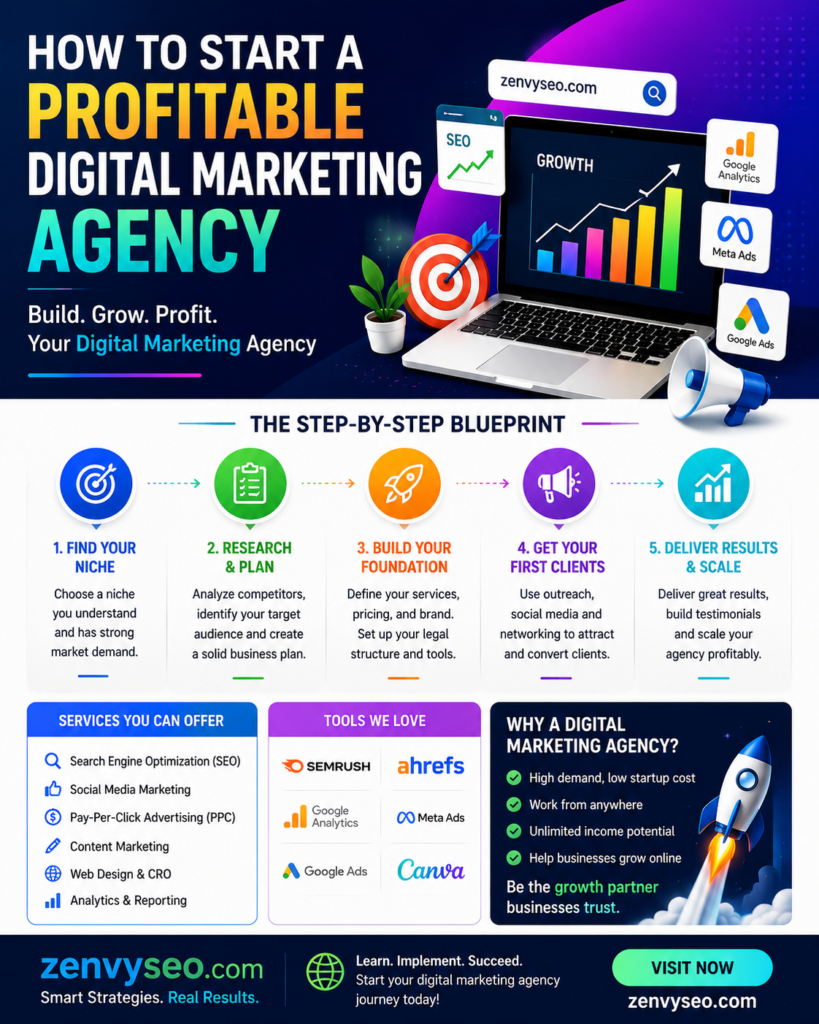
By digital marketing, you don’t need an MBA. You don’t need a decade of corporate experience. And you definitely don’t need a pile of startup cash sitting in your bank account. What you do need is a clear roadmap, the right skills, and the discipline to follow through — and that’s exactly what this guide from ZenvySEO gives you.
The digital marketing industry is projected to exceed $786 billion by 2026, and businesses of every size are desperately searching for marketing help they can afford and trust. That’s your window. Whether you’re a complete beginner or someone with a loose idea of how online marketing works, this step-by-step guide will show you exactly how to launch your own agency and turn it into a real income stream.
Let’s start from the very beginning.
What Is a Digital Marketing Agency — and Why Start One?
A digital marketing agency is a business that helps other companies grow their online presence through services like SEO, social media management, paid advertising, content marketing, email campaigns, and web design. In exchange, the agency earns a fee — monthly retainer, project rate, or performance commission.
The appeal is real. Compared to brick-and-mortar businesses, a digital agency has almost no overhead. You can run it from a laptop. You can start solo, scale gradually, and serve clients on the other side of the world. ZenvySEO has seen first-time founders go from zero to $5,000/month in recurring revenue within six months — with no formal marketing background.
Acquire Key Skills and Build a Solid Foundation
The biggest myth in the industry is that you need years of experience before launching an agency. You don’t. But you do need to know what you’re selling. The smartest move for any beginner is to master one or two core disciplines first, then expand as the business grows.
Core Skills to Focus On
- Search Engine Optimization (SEO): Helping websites rank higher on Google is one of the most in-demand, high-value services you can offer.
- Social Media Marketing: Managing content and paid ads on platforms like Instagram, LinkedIn, and Facebook.
- Pay-Per-Click (PPC) Advertising: Running Google Ads or Meta Ads campaigns that drive measurable results.
- Content Marketing: Creating blogs, videos, and email newsletters that attract and convert audiences.
- Email Marketing: Designing automated sequences that nurture leads and drive repeat business.
Where to Learn — For Free
| Platform | What You’ll Learn | Cost |
| Google Digital Garage | Fundamentals of digital marketing + Google Analytics | Free |
| HubSpot Academy | Inbound marketing, content, email, CRM | Free |
| Meta Blueprint | Facebook & Instagram paid ads | Free |
| Coursera / Udemy | SEO, Google Ads, social media in-depth | Low Cost |
| Semrush Academy | SEO, keyword research, site audits | Free |
ZenvySEO Tip: Don’t try to learn everything at once. Pick one skill, complete a free certification, and immediately apply it — even if it’s just on your own blog or a friend’s social media page. Practice beats theory every time.
Determine a Target Market (Niching Down Is Not Optional)
One of the fastest ways to fail in the agency world is trying to serve everyone. One of the fastest ways to win is to get incredibly specific. Your niche is your superpower — it makes you easier to find, easier to trust, and easier to sell.
How to Choose Your Niche
Think about this intersection:
- What industries interest you or do you already understand?
- What service do you feel most confident delivering?
- Who has budget to pay for marketing help consistently?
For example, instead of launching as a “general digital marketing agency,” you could position as an SEO agency for local dental clinics or a social media management agency for e-commerce fashion brands. Specificity wins trust faster.
Popular & Profitable Niches for New Agencies
| Niche | Best Service to Lead With | Why It Works |
| Local small businesses | Local SEO + Google My Business | High demand, low competition at local level |
| E-commerce brands | Meta Ads + email flows | Clear ROI, repeat retainer potential |
| Real estate agents | Social media + lead gen | Large commissions = willingness to invest in marketing |
| Healthcare / clinics | Local SEO + content | Consistent patient acquisition need |
| B2B SaaS startups | LinkedIn ads + content | High contract value, scalable |
Build a Robust Business Plan and Ensure Regulatory Compliance
A business plan doesn’t need to be a 40-page document. But having one — even a lean, one-page version — separates serious founders from people who give up after month two.
What Your Business Plan Should Include
- Mission Statement: What does your agency do, for whom, and why does it matter?
- Service Offerings: List your core services and what results they deliver.
- Target Client Profile: Industry, business size, budget range, pain points.
- Pricing Model: Retainer, project-based, hourly, or performance-based?
- Revenue Projections: Realistic monthly income goals for months 1–12.
- Marketing Strategy: How will you find and sign clients?
Pricing Models at a Glance
| Model | Best For | Typical Range |
| Monthly Retainer | Ongoing SEO, social media management | $500–$5,000/month |
| Project-Based | Website builds, one-time audits | $300–$10,000/project |
| Hourly Rate | Consulting, ad-hoc work | $25–$250/hour |
| Performance-Based | Lead generation, e-commerce ads | % of revenue or ad spend |
Legal Setup and Compliance
Before you land your first paying client, get your legal foundation right. This protects you — and signals professionalism to clients.
- Register your business as an LLC or sole proprietorship (LLC is preferred for liability protection)
- Open a dedicated business bank account
- Use client contracts for every engagement — scope, deliverables, payment terms, ownership of assets
- Understand local tax obligations and set aside income accordingly
- Consider basic professional liability insurance as you scale
Establish Your Online Visibility
Here’s an uncomfortable truth: if your agency doesn’t look credible online, you’ll struggle to convince businesses to trust you with their online presence. Your digital footprint is your first impression — make it count.
Build a Professional Agency Website
Your website is your 24/7 salesperson. It should clearly communicate what you do, who you serve, and what results you’ve delivered. At minimum, include:
- A clear homepage that communicates your value proposition instantly
- A services page with specific offerings and pricing (or at least a starting price)
- An about page that builds trust with your story and credentials
- A portfolio or case studies section — even early mock projects count
- A contact page with a simple inquiry form
Platforms like WordPress (with Kadence theme), Wix, or Webflow make this achievable for beginners without coding skills.
List Your Digital Marketing Agency
Getting found beyond your website requires being listed in the right places. This drives inbound leads from people actively searching for agencies.
- Google Business Profile: Essential for local visibility and trust signals
- Clutch.co & Agency Vista: Top directories where businesses search for agencies
- LinkedIn Company Page: Critical for B2B credibility and outreach
- UpCity, Sortlist, and Bark.com: Lead generation platforms for agencies
- Upwork & Fiverr: Great for building early portfolio and reviews
Build Your Social Presence
You don’t need to be everywhere. Pick one or two platforms where your ideal clients spend time, and post consistently. Share client results (with permission), quick tips, behind-the-scenes content, and case study breakdowns. Social proof compounds over time.
Leverage Free and Economical Tools
One of the biggest advantages of starting a digital marketing agency today is that you can deliver serious results without spending thousands on software. Here’s a battle-tested stack for beginners:
Essential Tools by Category
| Category | Free Tool | Paid Upgrade (When Ready) |
| SEO Research | Google Search Console, Ubersuggest (free tier) | Ahrefs, Semrush |
| Social Media Scheduling | Buffer (free), Meta Business Suite | Hootsuite, Publer |
| Email Marketing | Mailchimp (up to 500 contacts), ConvertKit | ActiveCampaign, Klaviyo |
| Design & Creatives | Canva (free tier) | Canva Pro, Adobe Express |
| Project Management | Trello, Notion (free) | ClickUp, Asana |
| Analytics & Reporting | Google Analytics 4, Looker Studio | AgencyAnalytics |
| CRM / Lead Tracking | HubSpot CRM (free) | GoHighLevel, Pipedrive |
| Video & Content | CapCut (free), ChatGPT (free tier) | Descript, Jasper |
How to Maximize Your Output With Tools Efficiently
Tools only create value when used with intention. At ZenvySEO, we recommend the following habits for early-stage agency owners:
- Batch your work: Schedule all social media content in one session per week using Buffer or Meta Business Suite
- Template everything: Create reusable Canva templates for client reports, social posts, and proposals
- Automate reporting early: Use Google Looker Studio to pull GA4 data into client-friendly dashboards automatically
- Use free trials strategically: When landing a new client, start a Semrush or Ahrefs trial to run their site audit — then cancel and use the findings in your deliverable
- Document every process: Even when you’re solo, write down your workflow. This makes future hiring seamless
Pro Insight from ZenvySEO: Most new agencies over-invest in tools and under-invest in client relationships. A $50/month tool stack delivering consistent results beats a $500/month stack that’s barely used. Start lean, upgrade only when a paid tool would directly increase client retention or results.
How to Land Your First Client
This is where most beginners get stuck. Here’s the honest approach that works:
- Offer a free or discounted audit to local businesses you already know. Show them what’s broken and how you’d fix it.
- Reach out on LinkedIn with specific, value-first messages — not generic “I’m an agency” pitches.
- Ask for referrals from friends, family, and your network. Word of mouth is still the most powerful lead source for new agencies.
- Join local business groups on Facebook or attend Chamber of Commerce events. Offline relationships convert online.
- Create case studies from mock work — build a sample campaign for a fictional or volunteer client and show the results. Early social proof matters.
Final Thoughts: Your Agency Starts Today
Starting a digital marketing agency with no experience isn’t a fantasy — it’s a proven path that thousands of entrepreneurs have walked before you. The barrier to entry is lower than it has ever been, and the demand for skilled digital marketers has never been higher.
The ZenvySEO formula is simple: learn one core skill, pick one niche, build your online presence, sign your first client, and then build from there. Resist the urge to make everything perfect before you launch. Launch small, deliver exceptional value, and let results do the selling.
Your agency won’t be built in a day — but with the right foundation, it will be built. Start now.
Frequently Asked Questions
How much money do I need to start a digital marketing agency?
You can launch a solo agency for as little as $100–$300/month, covering basic tools and a domain. A more comfortable budget for first-year operations is $500–$2,000 total.
Do I need a degree or certification to start a digital marketing agency?
No degree is required. Free certifications from Google, HubSpot, and Meta carry real credibility with clients and are sufficient to demonstrate competence.
How long before I can make money with my agency?
Most focused agency owners sign their first paying client within 30–60 days. Reaching $5,000/month in recurring revenue within 6 months is realistic with consistent effort.
Should I specialize or offer full-service digital marketing?
Specialize first. Niching down reduces competition, speeds up trust-building, and makes client acquisition far easier. You can expand your offerings as you grow.
What is the best pricing model for a new digital marketing agency?
Monthly retainers are the gold standard — they provide predictable income and encourage long-term client relationships that are far more profitable than one-off projects.