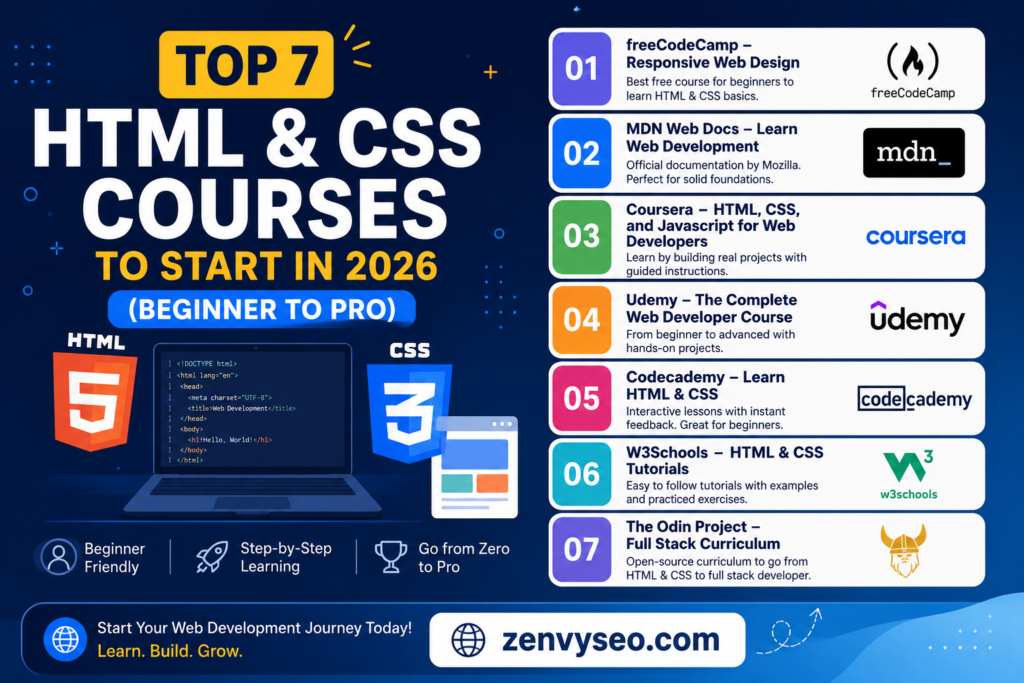
Whether you’re switching careers, building your first website, or leveling up your frontend skills, choosing the right course can make or break your learning journey. With dozens of options out there, it’s easy to get lost.
At ZenvySEO, we’ve done the legwork for you — analyzing the best platforms, reviewing course content, and comparing what each program actually delivers in 2026.
In this guide, you’ll find the top 7 HTML and CSS courses that are worth your time and money this year, with honest breakdowns of what you’ll learn, who they’re for, and how they stack up.
Why Learning HTML & CSS Still Matters in 2026
HTML and CSS are not going anywhere. According to the Stack Overflow Developer Survey 2025, HTML/CSS remains one of the most widely used technologies among developers worldwide. Every website you visit, every landing page you scroll through — it all starts with these two languages.
Mastering HTML gives you control over web structure. CSS gives you the power to style, animate, and make that structure responsive across every screen size. Together, they’re the foundation for everything from a personal portfolio to a fully functional e-commerce site.
If you’re aiming for a role as a front-end developer, web designer, or UI/UX specialist, these skills are non-negotiable.
What to Look for in a Good HTML & CSS Course
Before diving into the list, here’s a quick checklist of what separates a great course from a mediocre one:
- Modern CSS coverage — Flexbox, CSS Grid, container queries, and custom properties
- Hands-on projects — Real websites, not just isolated exercises
- Responsive design — Mobile-first thinking built into the curriculum
- Clear instruction — A teacher who explains the why, not just the how
- Community and support — Forums, Discord groups, or Q&A access
Top 7 HTML & CSS Courses to Start in 2026
1. HTML, CSS, and JavaScript for Web Developers — Coursera (Johns Hopkins University)
Platform: Coursera | Level: Beginner | Duration: ~40 hours | Certificate: Yes
If you want university-backed credibility with zero prior experience, this is the course to start with. Taught by Yaakov Chaikin, an Adjunct Professor of Graduate Computer Science at Johns Hopkins University, this Coursera course is one of the most well-structured introductions to web development available.
The course walks you through HTML5 fundamentals — semantic tags, valid document structure, and element nesting rules — before moving into CSS styling and basic JavaScript. What makes it stand out is the balance between theory and applied assignments. You’re not just watching; you’re building.
What you’ll learn:
- HTML5 document structure and semantic elements
- CSS selectors, the box model, and layout techniques
- JavaScript fundamentals and DOM interaction
- Bootstrap for responsive design
- AJAX for dynamic web content
Best for: Total beginners who want a structured, university-quality foundation with a shareable certificate.
Rating: ⭐ 4.7/5 (90,000+ learners)
2. Build Real-World Websites with HTML & CSS — Udemy
Platform: Udemy | Level: Beginner to Intermediate | Duration: 37+ hours | Certificate: Yes
This Udemy course is all about doing, not just watching. Instead of theory-heavy lectures, it places you in front of real projects from the very first lesson.
You’ll build actual websites — not toy examples — which is exactly the kind of portfolio material employers and clients look for.
The course covers modern HTML5 and CSS3 techniques, with a strong focus on responsive layouts and practical web design thinking. If you learn best by building things with your own hands, this course speaks your language.
What you’ll learn:
- HTML5 structure and best practices
- CSS Flexbox and Grid for modern layouts
- Responsive design with media queries
- Web design fundamentals (typography, color, spacing)
- Real-world multi-page website projects
Best for: Beginners who want to go from zero to a functional portfolio website as fast as possible.
Rating: ⭐ 4.8/5 (200,000+ students enrolled)
3. The Complete Web Developer: Zero to Mastery — Udemy / ZTM Academy
Platform: Udemy / zerotomastery.io | Level: Beginner to Advanced | Duration: 26+ hours | Certificate: Yes
If you’re serious about becoming a professional developer — not just a hobbyist — Andrei Neagoie’s Zero to Mastery course is one of the most comprehensive options available.
Andrei is a former senior software developer from Silicon Valley and Toronto, and his teaching approach reflects real-world experience rather than textbook theory.
This course doesn’t just cover HTML and CSS. It uses them as a launchpad into the full web development stack — JavaScript, React, Node.js, and databases. Graduates from this program have landed roles at companies like Google, Apple, IBM, and Amazon.
What you’ll learn:
- HTML and CSS from scratch with solid fundamentals
- JavaScript and modern ES6+ syntax
- Responsive and mobile-first design
- React.js for building interactive UIs
- Node.js and backend basics
- SQL and database fundamentals
Best for: Committed learners who want one course to take them from beginner to job-ready developer.
Rating: ⭐ 4.7/5 | Community: 10,000+ active members in Discord
4. Web Design for Everybody: Basics of Web Development & Coding — Coursera (University of Michigan)
Platform: Coursera | Level: Beginner | Duration: 5 months (flexible) | Certificate: Yes (Specialization)
This is one of Coursera’s most popular web development specializations, developed by the University of Michigan. It’s designed with absolute beginners in mind — no coding experience required — and it walks learners through the building blocks of web design at a very accessible pace.
The specialization covers five courses, progressively building your skills from basic HTML to CSS3 layout techniques, JavaScript interactivity, and web accessibility. It’s particularly strong on inclusive design and ensuring websites work for all users, which is increasingly important in 2026.
What you’ll learn:
- HTML5 tags, forms, and document structure
- CSS3 styling, animations, and transitions
- Responsive design and Bootstrap
- JavaScript and DOM manipulation
- Web accessibility standards (WCAG)
Best for: Learners who prefer a slow, structured academic approach with strong accessibility coverage.
Rating: ⭐ 4.8/5 (150,000+ learners across the specialization)
5. Web Design for Beginners: Real World Coding in HTML & CSS — Udemy
Platform: Udemy | Level: Beginner | Duration: 11+ hours | Certificate: Yes
This course is built specifically for those who’ve always wanted to learn web design but never knew where to start. It skips unnecessary complexity and gets straight to what matters: writing clean, real-world HTML and CSS that actually works in a browser.
What makes this course particularly beginner-friendly is its step-by-step pacing. Every concept is demonstrated visually, and the exercises reinforce each lesson before moving forward. By the end, you’ll have hands-on experience styling real web pages from scratch.
What you’ll learn:
- HTML fundamentals — headings, paragraphs, links, images, lists, forms
- CSS styling — fonts, colors, backgrounds, borders, and spacing
- Basic responsive layouts
- Introduction to web design principles
Best for: Absolute beginners who want a short, focused course without information overload.
Rating: ⭐ 4.5/5 | Ideal first step before moving to more advanced courses
6. Programming Foundations with JavaScript, HTML & CSS — Coursera (Duke University)
Platform: Coursera | Level: Beginner | Duration: ~30 hours | Certificate: Yes
Developed by Duke University, this Coursera course approaches web development from a programming foundations angle. It’s not just about writing HTML and CSS — it teaches you how to think like a developer, which is something most beginner courses skip entirely.
You’ll learn to problem-solve with code, understand computational thinking, and gradually build interactive web projects using HTML, CSS, and JavaScript. It’s a solid pick for anyone who wants to eventually transition into software engineering, not just front-end design.
What you’ll learn:
- Computational thinking and programming logic
- HTML and CSS for web page creation
- JavaScript for interactivity and programming fundamentals
- Building interactive web applications
- Data and algorithm basics
Best for: Beginners who want to understand programming concepts deeply, not just copy-paste code.
Rating: ⭐ 4.6/5 | Part of Duke’s broader software development curriculum
7. HTML & CSS for Beginners — LinkedIn Learning (formerly Lynda)
Platform: LinkedIn Learning | Level: Beginner | Duration: 5–8 hours | Certificate: Yes
LinkedIn Learning (formerly Lynda.com) offers a clean, professional HTML and CSS course that’s especially valuable for one reason: the certificate goes straight to your LinkedIn profile. In a world where professional visibility matters, that’s a real advantage.
The course is concise, well-produced, and covers all the essentials. It won’t take you to advanced levels, but it’s a strong starting point — especially for professionals adding web skills to their existing resume rather than making a full career switch.
What you’ll learn:
- HTML document structure and common tags
- CSS styling and the cascade
- Fonts, colors, and layout basics
- Introductory responsive design
- How browsers interpret HTML and CSS
Best for: Professionals who want to add verifiable web skills to their LinkedIn profile quickly.
Rating: ⭐ 4.5/5 | Included in LinkedIn Premium subscription
Quick Comparison Table
| Course | Platform | Level | Duration | Certificate | Best For |
| HTML, CSS & JS for Web Developers | Coursera (JHU) | Beginner | ~40 hrs | Yes | University-backed beginners |
| Build Real-World Websites | Udemy | Beginner–Inter. | 37+ hrs | Yes | Project-based learners |
| Zero to Mastery Web Developer | Udemy/ZTM | Beginner–Adv. | 26+ hrs | Yes | Career switchers |
| Web Design for Everybody | Coursera (UMich) | Beginner | 5 months | Yes | Accessibility-focused learners |
| Web Design for Beginners | Udemy | Beginner | 11+ hrs | Yes | First-time learners |
| Programming Foundations | Coursera (Duke) | Beginner | ~30 hrs | Yes | Logic-first thinkers |
| HTML & CSS for Beginners | LinkedIn Learning | Beginner | 5–8 hrs | Yes | Professionals on LinkedIn |
Which Course Should You Pick?
Here’s a simple way to decide:
- Completely new to coding? → Start with Web Design for Beginners on Udemy or Web Design for Everybody on Coursera.
- Want a university certificate? → Go with Johns Hopkins or University of Michigan on Coursera.
- Serious about becoming a developer? → Zero to Mastery is the most complete path.
- Pressed for time or a professional? → LinkedIn Learning gets you a polished certificate fast.
- Love learning by building? → The Udemy real-world websites course is hard to beat.
Conclusion
In 2026, there has never been a better time to learn HTML and CSS. The courses listed above come from trusted instructors, respected universities, and industry-leading platforms — each serving a different type of learner.
Whether you’re starting from absolute zero or filling gaps in your existing knowledge, there’s a course on this list built for you.
At ZenvySEO, we believe the best course is the one you actually finish. Pick one, commit to it, and start building. The web development community is waiting for you.
Frequently Asked Questions (FAQs)
How long does it take to learn HTML and CSS?
With consistent daily practice, most beginners can learn the fundamentals of HTML and CSS in 4 to 8 weeks. Becoming comfortable with responsive design and modern CSS layout takes a few months.
Do I need to know coding before starting these courses?
No. All seven courses listed above are beginner-friendly and require zero prior coding experience to get started.
Is HTML and CSS enough to get a job?
HTML and CSS alone are rarely enough for employment. Most roles also require JavaScript at a minimum, and often a framework like React. Think of HTML/CSS as the essential foundation, not the full house.
Are Coursera and Udemy certificates worth it?
Coursera certificates from top universities (Johns Hopkins, University of Michigan, Duke) carry significant weight. Udemy certificates are less formal but still show completed coursework. LinkedIn Learning certificates are particularly valuable for professional visibility.
Can I learn HTML and CSS for free?
Yes. Platforms like freeCodeCamp, The Odin Project, and MDN Web Docs offer world-class free HTML and CSS curricula. However, paid courses add structure, projects, and accountability that free resources often lack.